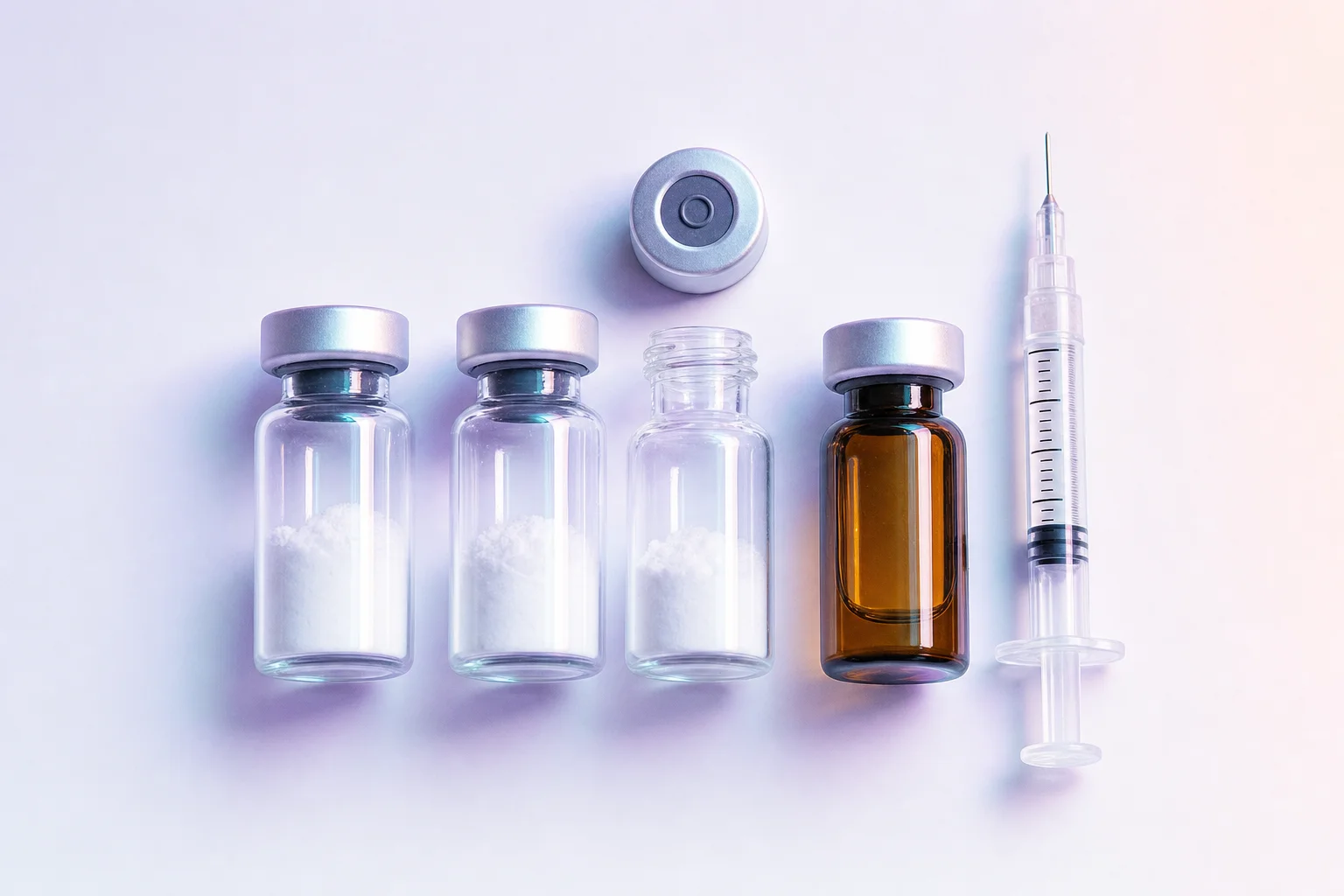
The rules are simple once you know them, but they catch a lot of people off guard. The most common mistake is treating a reconstituted vial the same as a dry one. They behave very differently, and storage decisions that are fine for a lyophilized (freeze-dried) vial can degrade a reconstituted one quickly.
Storing lyophilized (dry) peptides
Most research peptides arrive as a lyophilized powder, which is a freeze-dried cake or powder sealed in a vial. In this form they're relatively stable, but they still need some care.
For short-term storage (up to a few months): A standard refrigerator at 2–8°C works well. Keep vials in a dark place, since light can degrade some peptides, especially GHK-Cu and other light-sensitive peptides. Many researchers store dry vials in the original box and put the whole thing in the fridge.
For long-term storage (several months or more): Freeze them. A standard freezer at -20°C is adequate for most peptides. An ultra-low freezer at -80°C provides maximum shelf life, though that's not realistic for most people. In a standard freezer, most lyophilized peptides remain stable for 12 to 24 months.
A few practical notes:
- Keep vials sealed until you're ready to use them
- Minimize temperature swings; don't leave vials on the counter while you prepare your workspace
- Avoid humid environments; moisture degrades peptides even in powder form
- If ordering in bulk, freeze the vials you won't use right away
Freeze or refrigerate? A quick guide
| Situation | Best option |
|---|---|
| Using within 4–8 weeks | Refrigerator (2–8°C) |
| Using within a few months | Freezer (-20°C) |
| Long-term storage (6+ months) | Freezer (-20°C), ideally -80°C |
| Already reconstituted | Refrigerator only (see below) |
A common mistake is leaving dry vials at room temperature "just for now" and then forgetting about them for days or weeks. Degradation is slow at room temperature for lyophilized peptides, but it does happen. When in doubt, put it in the fridge.
After reconstitution: the clock starts now
Once you add liquid to your peptide vial, the rules change. Reconstituted peptides are significantly less stable than dry peptides. Two things matter most: what liquid you use, and how you store the vial afterward.
Refrigerate immediately after reconstituting. Store at 2–8°C. Do not freeze a reconstituted peptide. Ice crystals that form during freezing can physically damage the peptide structure and degrade your sample. Freeze the dry vial; refrigerate after you mix.
How long do reconstituted peptides last?
The answer is that it depends on the peptide and the liquid used. That said, here are the general windows the research community works with.
Reconstituted with bacteriostatic water (BACwater): 2 to 4 weeks refrigerated, sometimes up to 30 days. BACwater contains 0.9% benzyl alcohol, which acts as a preservative and meaningfully extends shelf life. This is the standard choice when you'll be using a vial across multiple sessions.
Reconstituted with sterile water: 24 to 72 hours. Sterile water has no preservative, so bacterial contamination risk increases over time. Some researchers use sterile water only when they plan to use the entire vial in one or two sessions.
As a rule of thumb: if you won't finish a vial within a week, reconstitute with BACwater, not sterile water.
Peptides vary in how stable they are once mixed. Weight-management research peptides like semaglutide and tirzepatide (sometimes called GLP-1 peptides) are generally stable for about 28 days refrigerated with BACwater. Growth hormone peptides like CJC-1295 and Ipamorelin are similar. BPC-157 is often cited as stable for 2 to 4 weeks with BACwater. When in doubt, check the stability notes for the specific peptide you're working with.
Reconstituted peptide storage: the rules
- Refrigerate, don't freeze. Ice crystals damage peptide structure.
- Use BACwater for anything you won't finish quickly. The preservative matters.
- Avoid light exposure. Amber or foil-wrapped vials help; or keep vials toward the back of the fridge, away from the door light.
- Minimize repeated punctures. Every time you pierce the stopper there's a small contamination risk; work cleanly.
- Label your vials. Write the date of reconstitution directly on the vial. You will forget otherwise.
- Discard if cloudy or discolored. A solution that turns cloudy has likely been contaminated or degraded. Don't use it.
What about freeze-thaw cycles?
Each time you freeze and thaw a peptide, you put mechanical stress on the molecule. Ice crystals form and break, and some percentage of peptide degrades with each cycle. The guidance is to avoid repeated freeze-thaw cycles.
For dry peptides: one freeze-thaw to move from long-term storage to reconstitution is fine.
For reconstituted peptides: don't freeze them at all. Refrigerate and use within the recommended window.
If you have a large dry vial and know you'll only use part of it at a time, some researchers divide the dry powder into smaller individual vials (a process called aliquoting) before reconstituting, so each portion gets mixed fresh when needed.
Quick reference
| Peptide state | Storage temp | Shelf life |
|---|---|---|
| Lyophilized, short-term | 2–8°C (fridge) | Up to 2 months |
| Lyophilized, long-term | -20°C (freezer) | 12–24 months |
| Reconstituted + BACwater | 2–8°C (fridge) | 2–4 weeks |
| Reconstituted + sterile water | 2–8°C (fridge) | 24–72 hours |
| Reconstituted, frozen | Not recommended | N/A |
A note on shipping
Most peptide suppliers ship lyophilized peptides without cold packs, and this is generally fine for transit (a few days to a week). The lyophilized form handles short periods at room temperature without significant degradation. If you're ordering in summer or shipping to a warm climate, it's worth asking your supplier about cold chain options. Once the vials arrive, get them into the fridge or freezer promptly.
Where to go from here
If you're reconstituting for the first time and want to understand how much liquid to add, the guide on reconstituting peptides with BACwater walks through the math in plain language.
When you're ready to compare prices across suppliers on specific peptides, the Peptide Price Lab pricing tool has live vendor data so you can find the best price per mg.