What it is
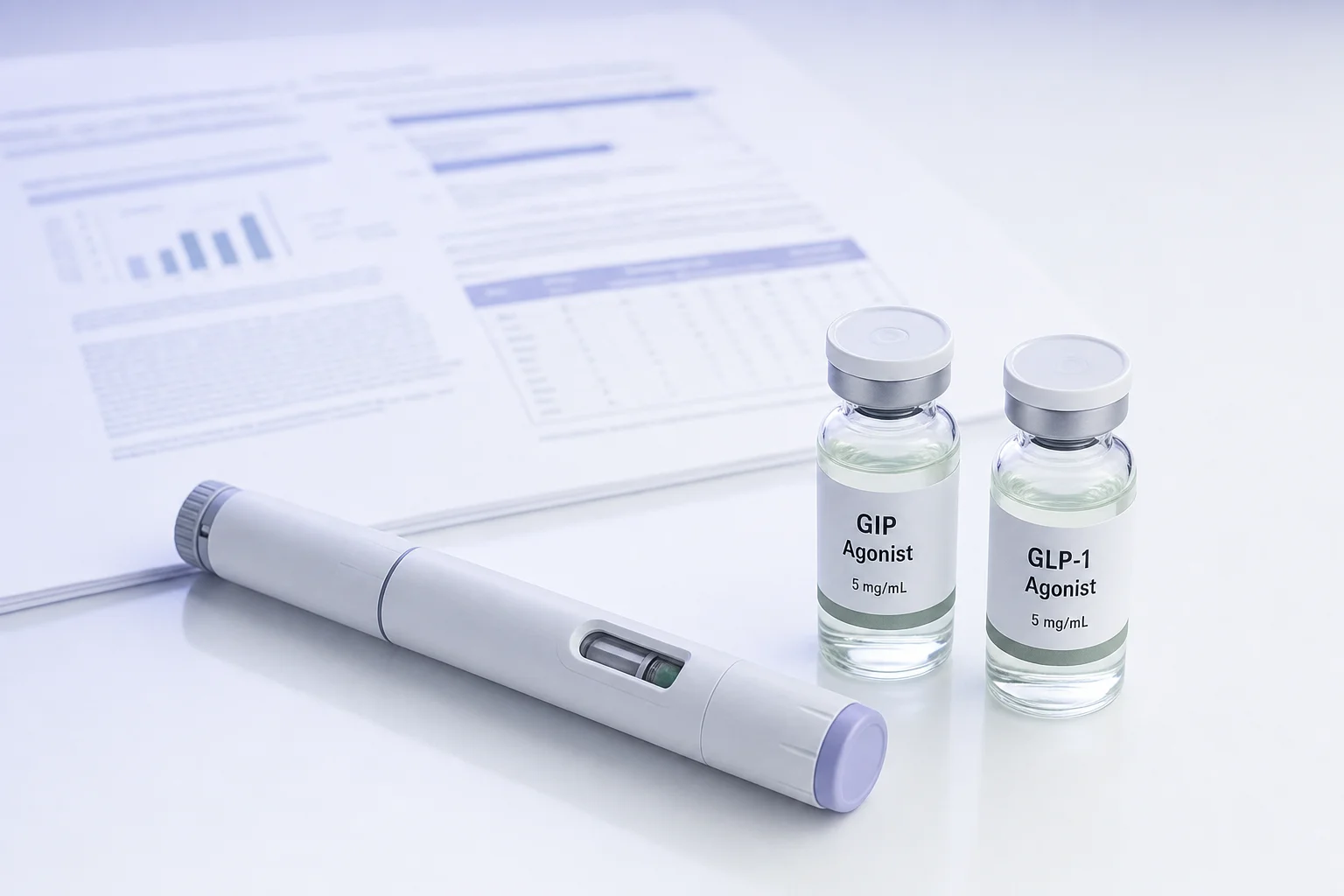
Tirzepatide is a synthetic 39 amino acid acylated peptide that activates both the GIP (glucose-dependent insulinotropic polypeptide) and GLP-1 (glucagon-like peptide-1) receptors. It was developed by Eli Lilly and is sold under the brand names Mounjaro (for type 2 diabetes) and Zepbound (for weight management). Researchers also refer to it by its development code LY3298176.
The dual mechanism distinguishes tirzepatide from GLP-1-only agonists like semaglutide. GIP is a separate incretin hormone that also stimulates insulin secretion and plays a role in fat metabolism and energy balance. By co-activating both incretin receptors, tirzepatide appears to produce larger effects on body weight and glycemic control than either receptor alone can account for, though the precise contributions of each pathway remain an active area of study.[3]
What researchers study it for
- Weight management in obesity The SURMOUNT-1 trial, published in the New England Journal of Medicine in 2022, found that tirzepatide at 15 mg weekly produced a mean body weight reduction of approximately 22.5% over 72 weeks in adults with obesity or overweight, compared to 2.4% in the placebo group.[1] This is among the largest weight reductions observed in a pharmacological trial to date.
- Glycemic control in type 2 diabetes The SURPASS program established tirzepatide's efficacy in type 2 diabetes across multiple trial arms, including comparisons against insulin. The SURPASS-5 trial found that tirzepatide added to titrated insulin glargine significantly reduced HbA1c and body weight compared to placebo in people with type 2 diabetes.[2]
- Weight maintenance with sustained treatment The SURMOUNT-4 trial examined what happens when treatment stops after initial weight loss. Participants who continued tirzepatide maintained their weight reduction, while those switched to placebo regained a mean of approximately 14% of body weight over the following 52 weeks, indicating that ongoing treatment appears necessary to sustain the effect.[4]
- Heart failure with preserved ejection fraction, the type most common in women The SUMMIT trial (NEJM, 2025) found that tirzepatide reduced the risk of cardiovascular death or worsening heart failure, and improved health status, in people with HFpEF and obesity.[5] HFpEF is the form of heart failure where the muscle contracts normally but the ventricles are stiff; it disproportionately affects women, particularly after menopause.
- Diabetes prevention in people with prediabetes and obesity A three-year extension of the SURMOUNT-1 trial, published in NEJM in 2025, found that tirzepatide produced sustained weight reduction and a markedly lower risk of progression from prediabetes to type 2 diabetes compared to placebo in adults with obesity.[6]
- Dual incretin receptor pharmacology Researchers studying the relative contributions of GIP and GLP-1 receptor activation continue to investigate why the combination produces outcomes that appear to exceed either receptor pathway alone; current evidence suggests complementary mechanisms involving appetite signaling, adipose tissue, and insulin secretion.[3]
Research context
Tirzepatide has one of the most extensive and rapidly growing clinical trial records in the research peptide market. The SURPASS program (seven major phase 3 trials) established efficacy and safety in type 2 diabetes across diverse comparator arms, including head-to-head comparisons against insulin glargine and semaglutide.[2] The SURMOUNT program expanded the evidence base to obesity, weight maintenance, obesity with type 2 diabetes (SURMOUNT-2), a Chinese population cohort (SURMOUNT-CN), and a three-year diabetes prevention endpoint.[1][4][6]
No completed randomized head-to-head trial has directly compared tirzepatide against semaglutide for weight outcomes in an identical population, but observational and network meta-analysis data consistently suggest larger weight reductions with tirzepatide at equivalent treatment durations. The SURPASS-CVOT trial (design published 2024) is the ongoing dedicated cardiovascular outcomes trial comparing tirzepatide against dulaglutide in people with type 2 diabetes and established cardiovascular disease; full results are anticipated in the coming years. The SUMMIT trial, published in early 2025, already established a cardiovascular signal in the HFpEF population.[5] If you are weighing it against the newer triple-receptor compound, retatrutide vs tirzepatide lays the two side by side.
The safety profile of pharmaceutical tirzepatide is well-characterized from trial data. The most common adverse effects are gastrointestinal (nausea, diarrhea, vomiting, constipation), most prominent during dose escalation and typically diminishing over time.[3] The same class-level concerns that apply to GLP-1 agonists (including pancreatitis and thyroid C-cell findings from rodent models) are present in the prescribing information. Research peptide tirzepatide sold by vendors is not manufactured to pharmaceutical standards; purity, concentration accuracy, and sterility can vary meaningfully between sources.
Typical research parameters
| Parameter | Typical range |
|---|---|
| Common vial sizes | 2 mg, 5 mg, 10 mg (research peptide); pharmaceutical autoinjector pens available in 2.5, 5, 7.5, 10, 12.5, and 15 mg |
| Supplied as | Lyophilized powder (research peptide); single-dose autoinjector pens (pharmaceutical versions Mounjaro and Zepbound) |
| Storage | Refrigerated; protect from light. Lyophilized peptide stable when refrigerated; reconstituted solution should be refrigerated and used within 28 days |
| Stability | Lyophilized: stable refrigerated for extended periods; reconstituted: use within 28 days, avoid freeze-thaw cycles |
| Administration studied | Subcutaneous injection (weekly), which is the only route used in all published clinical trials |
| Half-life | Approximately 5 days, enabling once-weekly dosing in the clinical trial protocols |
| Purity to look for | ≥98% by HPLC; third-party certificate of analysis recommended for research use |
References
- [1] Jastreboff AM, Aronne LJ, Ahmad NN, et al.; SURMOUNT-1 Investigators. Tirzepatide Once Weekly for the Treatment of Obesity. The New England Journal of Medicine. 2022;387. PubMed ↗
- [2] Dahl D, Onishi Y, Norwood P, et al. Effect of Subcutaneous Tirzepatide vs Placebo Added to Titrated Insulin Glargine on Glycemic Control in Patients With Type 2 Diabetes: The SURPASS-5 Randomized Clinical Trial. JAMA. 2022;327. PubMed ↗
- [3] Nauck MA, D'Alessio DA. Tirzepatide, a dual GIP/GLP-1 receptor co-agonist for the treatment of type 2 diabetes with unmatched effectiveness regrading glycaemic control and body weight reduction. Cardiovascular Diabetology. 2022;21. PubMed ↗
- [4] Aronne LJ, Sattar N, Horn DB, et al.; SURMOUNT-4 Investigators. Continued Treatment With Tirzepatide for Maintenance of Weight Reduction in Adults With Obesity: The SURMOUNT-4 Randomized Clinical Trial. JAMA. 2024;331. PubMed ↗
- [5] Packer M, Zile MR, Kramer CM, et al.; SUMMIT Trial Investigators. Tirzepatide for Heart Failure with Preserved Ejection Fraction and Obesity. The New England Journal of Medicine. 2025;392. PubMed ↗
- [6] Jastreboff AM, le Roux CW, Stefanski A, et al.; SURMOUNT-1 Investigators. Tirzepatide for Obesity Treatment and Diabetes Prevention. The New England Journal of Medicine. 2025;392. PubMed ↗