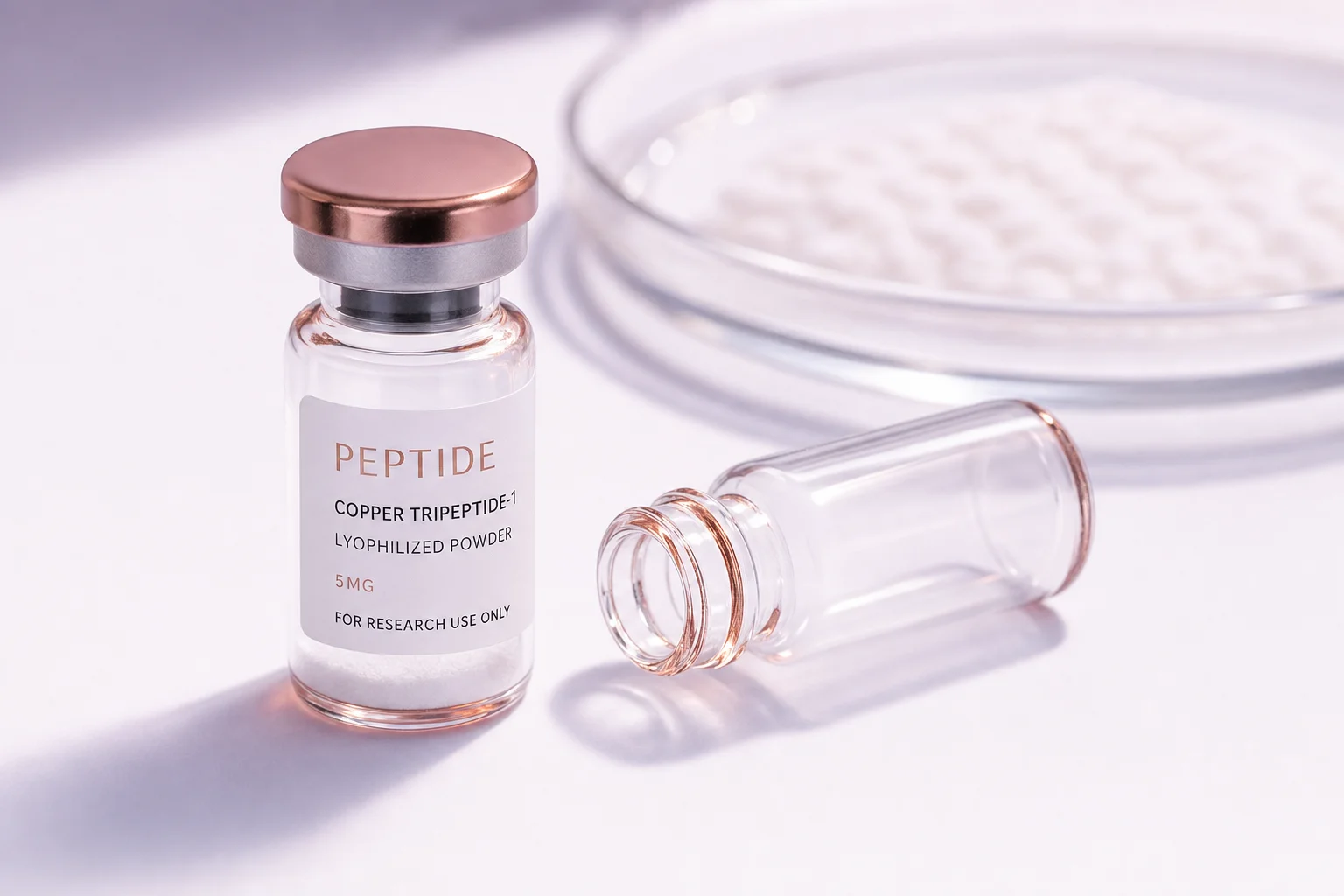
What it is
GHK-Cu is a naturally occurring copper peptide composed of three amino acids: glycine, L-histidine, and L-lysine. It forms a stable complex with copper(II) ions, and is found in human blood plasma, saliva, and urine. Serum concentrations decline significantly with age, from roughly 200 ng/ml at age 20 to approximately 80 ng/ml by age 60.[1]
In cosmetic ingredient lists, it appears as Copper Tripeptide-1 or Tripeptide-1. Research-grade GHK-Cu for laboratory use is typically produced via solid-phase peptide synthesis. It is one of the most-cited peptides in the skin aging and wound healing literature, with research interest spanning several decades.
What researchers study it for
- Skin collagen synthesis and remodeling In vitro studies have examined GHK-Cu's role in stimulating collagen production and fibroblast activation, with multiple laboratory studies suggesting effects on the pathways that regulate skin extracellular matrix turnover.[2]
- Anti-aging and gene expression Researchers have studied GHK-Cu's potential to influence gene expression patterns associated with aging, including genes involved in tissue repair, antioxidant defense, and inflammation regulation.[1]
- Wound healing and tissue remodeling GHK-Cu has been studied in the context of post-wound tissue remodeling, with in vitro and animal work examining its effects on fibroblast and keratinocyte behavior and on the transition from inflammatory to repair phases.[3]
- Anti-inflammatory and antioxidant activity Animal model studies have examined GHK-Cu's effects on inflammatory signaling and oxidative stress, with a 2024 study in silicosis mouse models finding reductions in lung inflammation and fibrosis markers via antioxidant pathways.[5]
- Joint and connective tissue repair Research in rat models has examined GHK-Cu's effects on ligament and tendon healing, with one study finding transient improvements in histological scores at early time points following ACL reconstruction.[4]
Research context
GHK-Cu has an unusually large body of published literature for a research peptide, but the evidence base is weighted heavily toward in vitro studies and laboratory models rather than controlled human trials.[2][3] The collagen synthesis and skin remodeling findings are well-replicated in cell culture, which is why GHK-Cu is widely used as a cosmetic ingredient; however, in vitro collagen results do not automatically translate to equivalent systemic or topical effects in humans. The most rigorous evidence for skin benefits comes from topical cosmetic studies, not from research-grade injectable protocols.
The age-related serum decline in GHK is a well-documented observation, and it forms the conceptual basis for much of the anti-aging research interest.[1] Animal studies on wound healing and inflammation are promising but remain preclinical. There are no published human randomized controlled trials on systemic GHK-Cu administration for any indication. Researchers working with this compound should note that the cosmetic evidence and the injectable research evidence are largely separate bodies of work, and conclusions from one context do not automatically apply to the other.
Typical research parameters
| Parameter | Typical range |
|---|---|
| Common vial sizes | 50 mg, 100 mg (bulk powder); 5 mg, 10 mg (smaller research vials from select vendors) |
| Supplied as | Lyophilized (freeze-dried) powder; some vendors supply as pre-made solution |
| Storage | Lyophilized: refrigerated at 2–8°C, protected from light; reconstituted solution: refrigerated, use within 4 weeks |
| Stability | Lyophilized powder: stable up to 24 months under proper storage; copper-peptide complexes are sensitive to pH and oxidation once in solution |
| Administration studied | Topical application (cosmetic and wound healing studies); subcutaneous injection (animal models); in vitro cell culture (majority of published research) |
| Purity standard | Research-grade vendors typically report greater than 98% purity by HPLC; cosmetic-grade purity standards differ and are not equivalent |
References
- [1] Dou Y, Lee A, Zhu L, Morton J, Ladiges W. The potential of GHK as an anti-aging peptide. Aging pathobiology and therapeutics. 2020;2. PubMed ↗
- [2] Pickart L, Vasquez-Soltero JM, Margolina A. GHK Peptide as a Natural Modulator of Multiple Cellular Pathways in Skin Regeneration. BioMed research international. 2015;2015. PubMed ↗
- [3] Pickart L. The human tri-peptide GHK and tissue remodeling. Journal of biomaterials science. Polymer edition. 2008;19. PubMed ↗
- [4] Fu SC, Cheuk YC, Chiu WY, Yung SH, Rolf CG, Chan KM. Tripeptide-copper complex GHK-Cu (II) transiently improved healing outcome in a rat model of ACL reconstruction. Journal of orthopaedic research. 2015;33. PubMed ↗
- [5] Bian Y, Deng M, Liu J, Li J, Zhang Q, Wang Z, Liao L, Miao J, Li R, Zhou X, Hou G. The glycyl-l-histidyl-l-lysine-Cu2+ tripeptide complex attenuates lung inflammation and fibrosis in silicosis by targeting peroxiredoxin 6. Redox biology. 2024;75. PubMed ↗