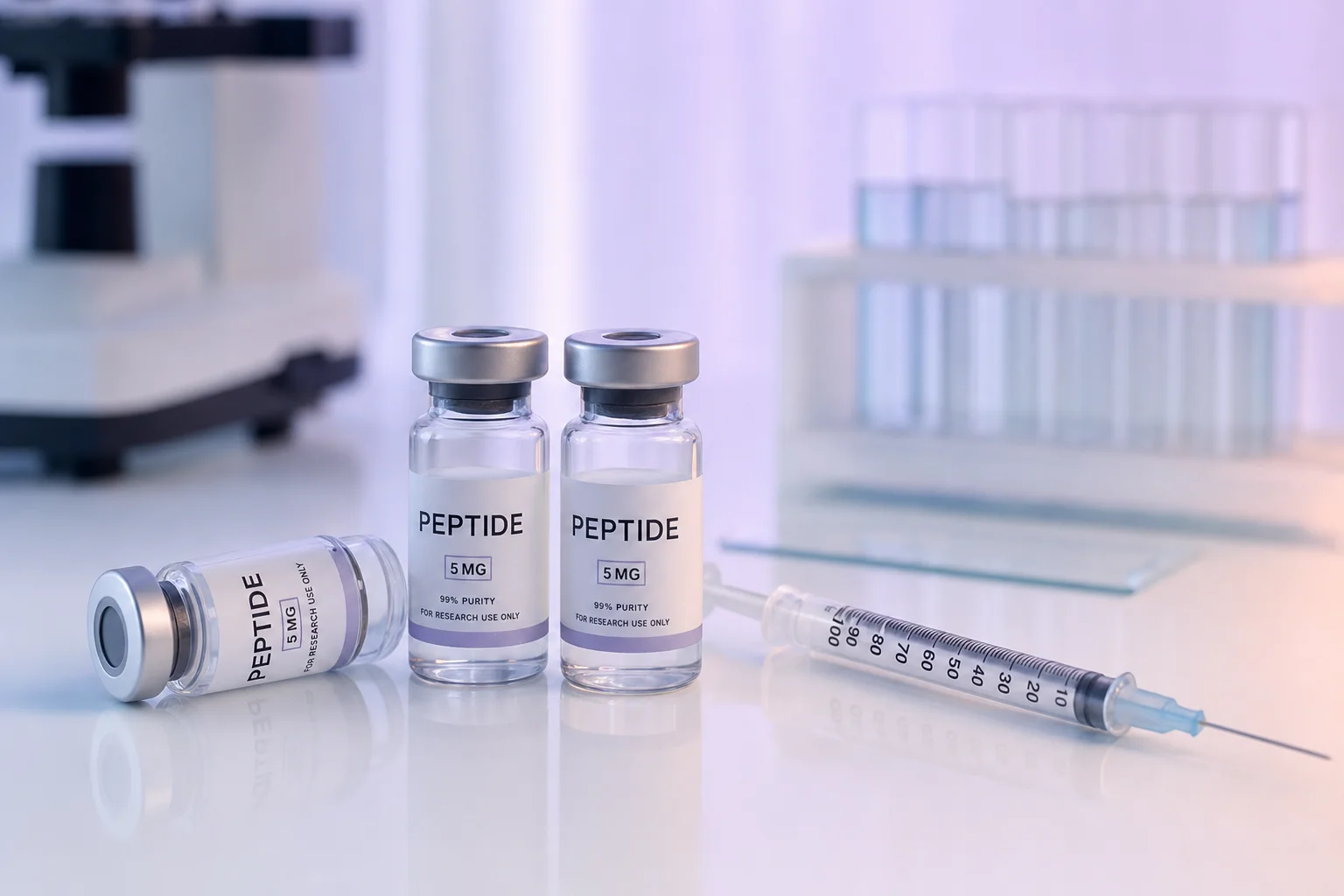
What it is
TB-500 is a synthetic peptide corresponding to residues 17 through 23 of thymosin beta-4 (abbreviated Tb4), a naturally occurring protein involved in actin regulation and cellular repair. The commercial product is the acetylated heptapeptide Ac-LKKTETQ, synthesized via solid-phase peptide synthesis rather than isolated from biological sources.[1]
Thymosin beta-4 itself is a 43-amino-acid protein found in nearly all human cells; TB-500 is designed to replicate the actin-binding activity attributed to this short sequence. It is sometimes referred to interchangeably with thymosin beta-4 in research literature, though the two are structurally distinct. TB-500 is frequently studied alongside BPC-157 in tissue repair research.
What researchers study it for
- Tissue repair and wound healing Researchers have studied TB-500's ability to promote cell migration and tissue regeneration through its interaction with actin, a structural protein central to cell motility and repair processes.[5]
- Cardiac regeneration Animal model studies have examined TB-500 (and its parent molecule thymosin beta-4) for potential roles in cardiac repair after ischemic injury, including effects on cardiomyocyte survival and angiogenesis.[4]
- Ocular surface repair Thymosin beta-4 has been studied in human clinical trials for dry eye and neurotrophic keratopathy (corneal nerve damage); this is the most clinically advanced application of the compound class, with Phase 3 trial data available.[3]
- Anti-inflammatory activity Studies have examined TB-500's role in modulating inflammatory signaling, with research suggesting it may influence the actin cytoskeleton in ways that affect immune cell recruitment and local inflammation.[5]
- Longevity and cellular aging research Review literature has examined thymosin beta-4 fragment activity in the context of cellular senescence, tissue homeostasis, and age-related repair capacity, placing TB-500 within broader longevity research programs.[2]
Research context
The evidence base for TB-500 is predominantly preclinical. The majority of published work involves animal models (rodent and equine) and in vitro cell studies rather than controlled human trials.[1][4] The parent molecule, thymosin beta-4, has a considerably larger body of research behind it, and TB-500's effects in published studies are often attributed to the shared actin-binding sequence. It is worth noting that animal studies and in vitro findings do not reliably predict human outcomes, and extrapolation from thymosin beta-4 data to TB-500 specifically requires caution.
The one area with meaningful human clinical data is ocular surface treatment. Thymosin beta-4 eye drops have completed Phase 3 trials for neurotrophic keratopathy, representing the furthest-advanced clinical application of this peptide class.[3] Cardiac and systemic tissue repair applications remain in preclinical stages, with no published human randomized controlled trials specific to TB-500.[2] Researchers studying TB-500 should weigh the strength of evidence accordingly: ocular research is most mature; cardiac and wound-healing applications are promising but not yet human-validated.
Typical research parameters
| Parameter | Typical range |
|---|---|
| Common vial sizes | 5 mg, 10 mg |
| Supplied as | Lyophilized (freeze-dried) powder; reconstituted with bacteriostatic water or sterile saline before use |
| Storage | Lyophilized: room temperature or refrigerated; reconstituted: refrigerated at 2–8°C |
| Stability | Lyophilized powder: 24 months or longer; reconstituted solution: approximately 4 weeks refrigerated |
| Administration studied | Subcutaneous injection (systemic animal studies); topical ophthalmic solution (ocular clinical trials); intraperitoneal injection (rodent models) |
| Purity standard | Reputable vendors typically report greater than 98% purity by HPLC with mass spectrometry confirmation |
References
- [1] Esposito S, Deventer K, Geldof L, Van Eenoo P. In vitro metabolic studies of thymosin beta-4 and its N-terminal tetrapeptide acetyl-N-Ser-Asp-Lys-Pro (AcSDKP). Drug Testing and Analysis. 2012;4(11):928–934. PubMed ↗
- [2] Bock-Marquette I, Ruvinov E, Shvets O, Pintzas A, Tsipis A. Thymosin beta-4 and regeneration: recent advances and future directions. International Immunopharmacology. 2023;116:109741. PubMed ↗
- [3] Sosne G. Thymosin beta4: a potential novel therapy for neurotrophic keratopathy, dry eye, and ocular surface disease. Expert Opinion on Biological Therapy. 2018;18(sup1):83–90. PubMed ↗
- [4] Maar K, Hetenyi R, Maar S, Faskerti G, Lipp I, Bock-Marquette I. Thymosin beta-4 in cardiac repair and regeneration: a 20-year perspective. International Journal of Molecular Sciences. 2025;26(9):4131. PubMed ↗
- [5] Belsky JB, Siberski CR, Reid AB, Berkheimer MS, Czura CJ. Thymosin beta 4 and the anti-inflammatory pathway. Expert Opinion on Biological Therapy. 2018;18(sup1):131–137. PubMed ↗