Just need the numbers? Jump to the reconstitution calculator ↓
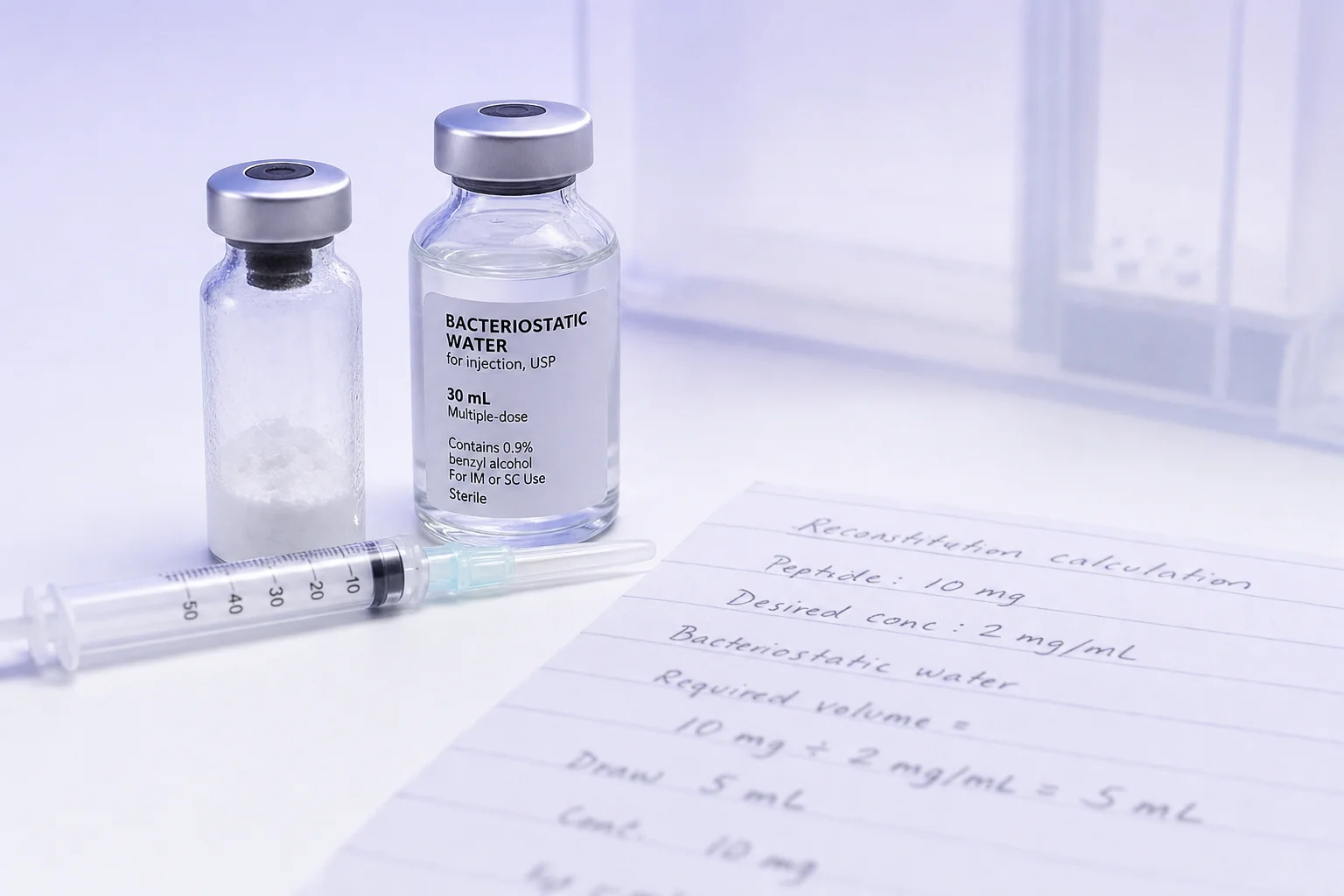
Peptides arrive as a dry powder in a sealed vial. Before they can be injected, they need to be dissolved in liquid. That liquid is almost always bacteriostatic water (commonly called bac water), which is sterile water with a small amount of benzyl alcohol added to prevent bacterial growth and extend the shelf life of the reconstituted solution.
Once reconstituted, the vial holds a known concentration of peptide. The question then becomes: how many units do you pull into a syringe to get a specific dose? That's a math problem, and it has a clean answer.
Want this already worked out for a specific vial? Our reconstitution and dosing protocols walk through common vials step by step, with the numbers filled in.
What you need to know before you calculate
Three numbers:
- Vial size: how many milligrams (mg) of peptide are in the vial (e.g., 5 mg, 10 mg)
- Bac water volume added: how many milliliters (mL) of bac water you add to reconstitute (e.g., 1 mL, 2 mL)
- Desired dose: how many mcg or mg you intend to draw (this comes from your own research or a provider)
How much bac water should you add?
There's no single right answer. The amount of bac water you add determines the concentration of your solution. A smaller volume means a more concentrated solution; a larger volume means a more dilute one.
The most common reason to choose one over the other is the syringe you're using and the dose you're drawing. If your dose is very small (say, 100 mcg), you want enough volume in the solution that you can measure it accurately on a syringe. If you use too little bac water, 100 mcg might only be 2 or 3 units on a syringe, which is hard to measure precisely. More bac water spreads the peptide out, so your dose takes up more space on the syringe and is easier to draw accurately.
Most people working with peptides in the 100 mcg to 500 mcg range find that 1 mL or 2 mL of bac water per vial gives a workable concentration. For milligram-range doses, you may be fine with 1 mL. These are practical considerations, not chemistry requirements: the math below works regardless of how much bac water you choose.
The concentration formula
Once you've added your bac water, your concentration is simply:
Concentration = vial size (in mcg) divided by bac water volume (in mL)
For example: a 5 mg vial reconstituted with 2 mL of bac water.
- 5 mg = 5,000 mcg
- 5,000 mcg divided by 2 mL = 2,500 mcg per mL
Your solution now contains 2,500 mcg per every 1 mL.
Translating mL to syringe units
Most insulin syringes used for peptide injections are marked in units, not milliliters. A standard 100-unit insulin syringe holds 1 mL total. So 100 units = 1 mL, which means:
- 10 units = 0.1 mL
- 20 units = 0.2 mL
- 50 units = 0.5 mL
- 100 units = 1 mL
Putting it together: a worked example
Let's say you have a 10 mg vial, you add 2 mL of bac water, and you want to draw a 500 mcg dose.
Step 1: Find your concentration.
10 mg = 10,000 mcg. Divided by 2 mL = 5,000 mcg per mL.
Step 2: Find what fraction of a mL equals your dose.
500 mcg divided by 5,000 mcg/mL = 0.1 mL.
Step 3: Convert to syringe units.
0.1 mL = 10 units on a 100-unit syringe.
So you'd draw to the 10-unit mark. That's your 500 mcg dose.
A second example with a smaller dose
Same 10 mg vial, same 2 mL bac water (5,000 mcg/mL), but now you want 250 mcg.
- 250 mcg divided by 5,000 mcg/mL = 0.05 mL
- 0.05 mL = 5 units on a 100-unit syringe
Five units is a small but readable mark on a syringe. If you found that too difficult to measure accurately, you could add more bac water (say, 4 mL instead of 2 mL) to spread the concentration out and make the same dose occupy 10 units instead of 5.
The formula, restated simply
Once you know your concentration in mcg/mL, every calculation follows the same pattern:
Units to draw = (dose in mcg divided by concentration in mcg/mL) multiplied by 100
That final multiplication by 100 converts mL to units on a 100-unit syringe.
Try it: Reconstitution Calculator
Enter your vial, bac water amount, target dose, and syringe — and we'll tell you exactly where to draw to.
How much to buy: matching a vial to your shelf life
There's a math problem hiding behind the reconstitution math, and it's the one that actually costs people money: once bacteriostatic water goes into a vial, the whole vial is on the clock, not just the portion you plan to use. A bigger vial is usually a better price per milligram, but only if the shelf life of the reconstituted solution can keep up with how much you'll actually draw from it before it has to be discarded.
The number to plan around is 28 days refrigerated. That's the figure used consistently across compounding pharmacies (it comes from USP compounding standards for a bacteriostatic-water solution) and across most research-peptide vendors, some of whom describe a window as short as 21 days or as long as roughly 6 weeks, so 28 days is the reasonable, conservative planning number rather than the outer edge of what anyone claims. It is not the same figure as the 56-day in-use window printed on an approved pharmaceutical pen like Ozempic, and that longer number shouldn't be borrowed as a reason to stretch a research vial further. The pen is a sealed, single-access device with its own tested formulation; a vial that gets punctured with a needle multiple times a week is a different situation, and the shorter, more conservative figure is the one to plan a purchase around.
A little arithmetic before you buy: multiply the amount in a single dose by roughly 4 (the number of weekly doses in a 28-day window), or by however many doses you'll actually draw in that window if you're dosing more or less often than weekly. If a vial holds meaningfully more than that once reconstituted, either it should be split so only part of it gets water added now, or a smaller vial is the better buy even at a slightly worse price per milligram, since a discarded remainder is not actually cheaper. The unreconstituted, lyophilized (dry) powder in an unopened vial keeps for many months under proper refrigeration, so buying in bulk is still fine, the timing of when you add water is the part to plan around, not the size of the order.
Two situations worth naming specifically. If a dosing schedule is escalating over several weeks, an early, low amount can leave most of a vial unused if it's reconstituted all at once at the start, since only a small fraction of it gets drawn before the 28-day window closes; reconstituting a smaller vial first and stepping up to a larger one as the amount increases avoids that waste. And if a compound is used occasionally rather than on a fixed schedule (an as-needed rather than a weekly one), a large reconstituted vial is especially likely to outlive its own shelf life before it's used up, so reconstituting a smaller volume, closer to what a realistic month of occasional use requires, is usually the better call. A few compounds also have a meaningfully shorter reconstituted window than 28 days once mixed; check the specific compound's own guide for that figure before assuming the general 28-day number applies.
Where to go from here
If you're still working out what dose range to be looking for in the first place, How Peptide Dosing Is Communicated in Research explains the vocabulary: mcg/kg, protocol descriptions, and why dosing varies between compounds.
For context on specific peptides, the research notes pages on this site document the dose ranges used in published studies. BPC-157, TB-500, and MOTS-c all include protocol information from the literature, which is useful context when you're trying to understand what researchers have actually tested.