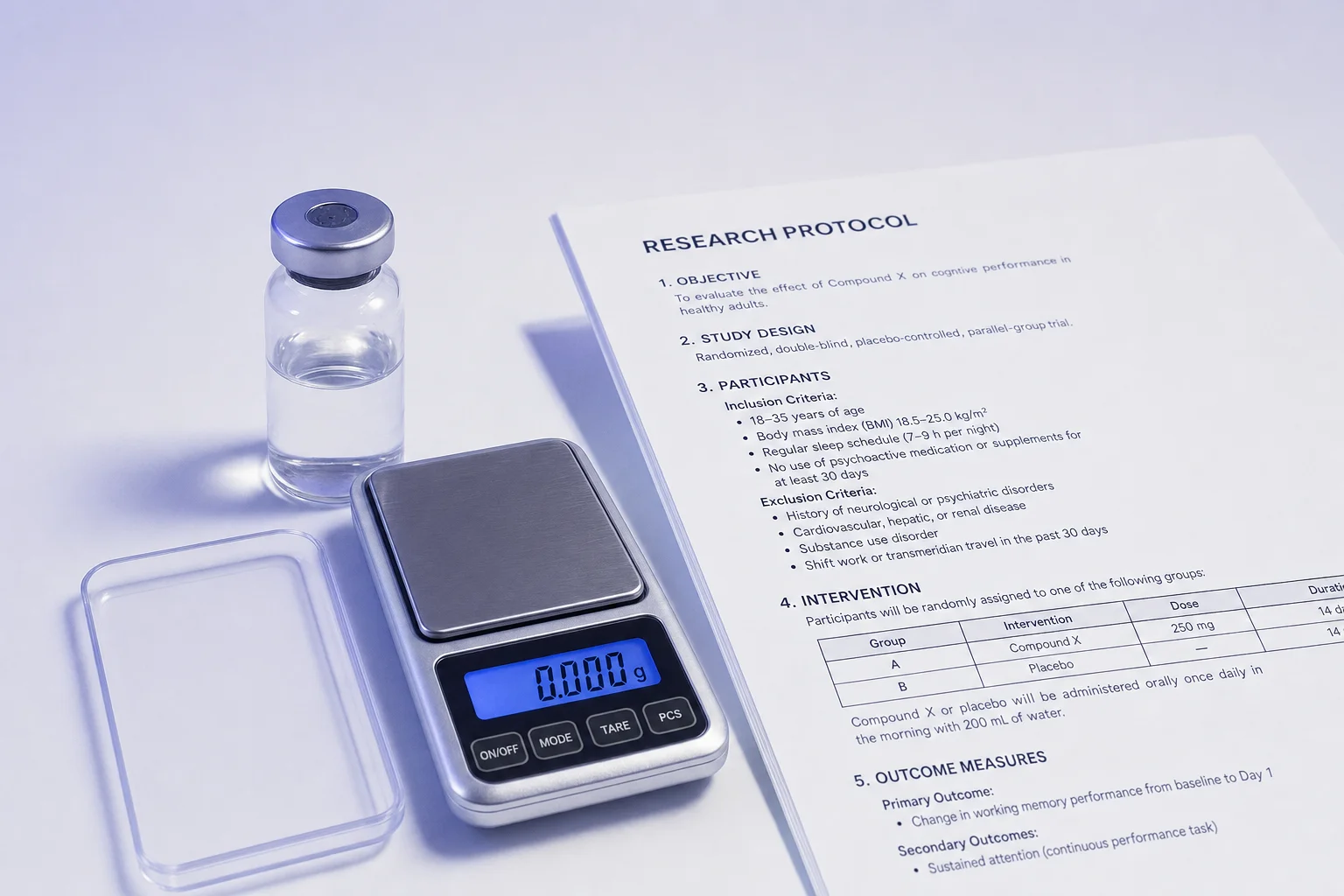
One of the first things people notice when they start reading peptide research is that the papers don't give instructions. They describe what happened in a controlled study: what compound was used, what amount was administered, and what the researchers measured. That's useful information, but it takes a little translation to understand.
The basic unit: micrograms
Most peptide doses in research are measured in micrograms (mcg) or milligrams (mg). A milligram is one thousandth of a gram. A microgram is one thousandth of a milligram. So:
- 1 mg = 1,000 mcg
- 0.5 mg = 500 mcg
- 0.1 mg = 100 mcg
Smaller peptides (like Ipamorelin or Selank) are often dosed in micrograms. Larger or longer-acting peptides (like BPC-157 or TB-500) are often dosed in milligrams. The difference matters when you're reading a paper and trying to understand what "200 mcg" or "5 mg" actually represents relative to a vial you're looking at.
What "per kilogram" means
You'll often see doses written as mcg/kg or mg/kg, which means micrograms (or milligrams) per kilogram of body weight. This is how researchers standardize across subjects of different sizes.
For example, if a rodent study used 200 mcg/kg, that means a 0.3 kg rat received about 60 mcg total. Translating that directly to a human body weight isn't straightforward, and researchers who study human applications often develop their own protocols that don't scale linearly from animal data. This is one of the reasons dosing in the peptide space is so variable: the human research base is thin for most compounds, and what exists rarely comes with a clean "here's the right dose" conclusion.
How study protocols are described
When a paper does report a human protocol (or a well-characterized animal protocol that researchers reference), it usually looks something like this:
- Amount per dose: How much was given each time (e.g., 100 mcg, 1 mg, 5 mg)
- Frequency: How often it was administered (e.g., once daily, twice daily, every other day)
- Duration: How long the study ran (e.g., 4 weeks, 12 weeks)
- Route: How it was delivered (subcutaneous injection, intranasal, oral, etc.)
A typical protocol description might read: "Subjects received 100 mcg subcutaneously twice daily for 8 weeks." That tells you everything the researchers actually controlled for. It doesn't tell you whether a different amount would produce a different result, or whether the same protocol would apply to a different population.
Why dosing varies so much between peptides
Peptides work through different mechanisms and at very different concentrations. A growth hormone secretagogue (a compound that stimulates the body to release growth hormone) like Ipamorelin is active at microgram quantities. A tissue-repair peptide like BPC-157 is typically studied in milligram quantities. A longer-acting compound like MOTS-c has its own published dose ranges from the small number of human studies that exist.
There's no universal rule like "one peptide = one dose." Each compound has its own pharmacology, and the research literature for each one is at a different stage of development. Some have solid human trial data. Many are still primarily studied in animal models.
What this means in practice
When you're reading a peptide research notes page or a study, you'll see protocol descriptions rather than prescriptions. The most useful thing you can do is note: what amount was used, how often, and in what population. That context helps you evaluate whether a particular piece of research is relevant to whatever question you're investigating.
It does not, on its own, tell you what to do. That step involves a conversation with a healthcare provider who is familiar with this area of research.
Where to go from here
Once you understand how doses are expressed, the next practical question is usually about reconstitution: if you're looking at a peptide vial, how does the amount in the vial relate to what you'd actually draw into a syringe? That's covered in Bac Water and Syringe Math: How to Calculate Your Draw.
If you want to see how dosing is described for a specific compound, the research notes pages on this site include protocol information pulled directly from published studies. BPC-157, TB-500, and MOTS-c are good starting points if you're new to reading those pages.