What it is
Ipamorelin is a synthetic pentapeptide (five amino acids) that acts as a selective agonist of the ghrelin receptor, also called GHSR-1a (growth hormone secretagogue receptor type 1a). It was developed as a growth hormone releasing peptide and is one of the more selective compounds in its class, described in early research as the first GH secretagogue to stimulate GH release without measurably elevating cortisol or ACTH at effective doses.[1]
Unlike some earlier GH secretagogues in the GHRP family, ipamorelin is not known to significantly stimulate appetite-related pathways at typical research concentrations, which makes it a frequently studied comparator in GH secretagogue research. It is often studied alongside CJC-1295 (a GHRH analog), though it is also researched as a standalone compound.
What researchers study it for
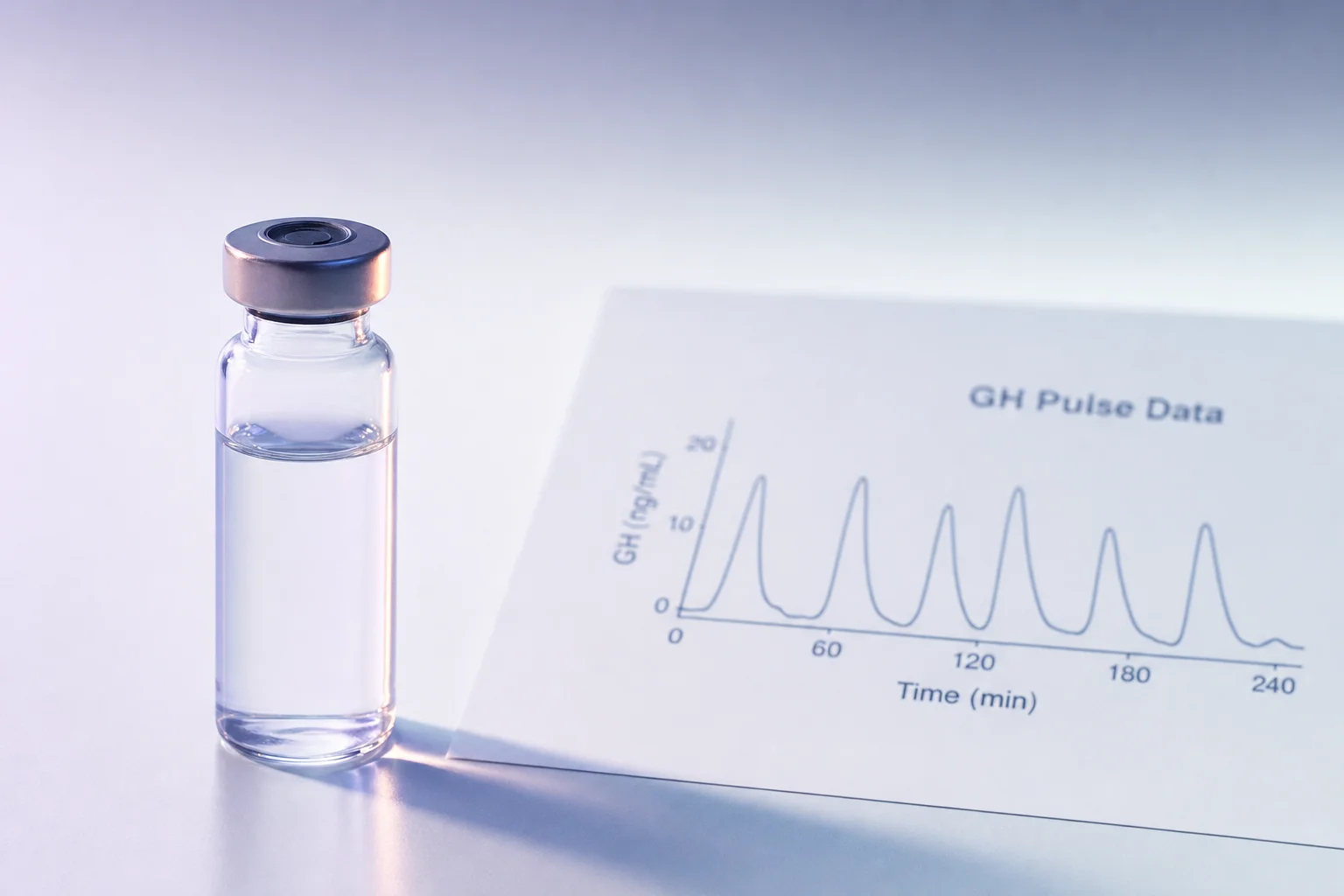
- Growth hormone pulse stimulation Research has examined ipamorelin's ability to stimulate pulsatile GH release from the pituitary with a degree of selectivity not seen in earlier GHRPs, including lower effects on cortisol and prolactin at GH-effective concentrations.[1]
- Gut motility and postoperative ileus Ipamorelin has been studied in rodent models of postoperative ileus, with researchers examining whether ghrelin receptor agonism accelerates the return of normal gut motility after bowel surgery.[2] A human proof-of-concept RCT (n=33) in bowel resection patients found shorter time to first bowel movement and bowel function index improvement in the ipamorelin group compared to placebo.[3]
- Bone and muscle preservation under glucocorticoid stress Animal studies have investigated whether ipamorelin can counteract the catabolic effects of glucocorticoid treatment on bone formation and skeletal muscle, with one rat study showing increased periosteal bone formation rate when ipamorelin was co-administered with methylprednisolone.[4]
- Body composition and metabolic health As a GH and IGF-1 stimulator, ipamorelin has been reviewed in the context of managing body composition changes associated with low GH states, including fat redistribution and lean mass changes.[5]
- Pituitary selectivity as a research model Ipamorelin is used in basic research as a model compound for studying selective GH secretagogue pharmacology, particularly for distinguishing pituitary GH-axis effects from broader neuroendocrine effects common to older GHRPs.
Research context
The evidence base for ipamorelin spans basic pharmacology, animal models, and a small number of human studies. The compound's most distinctive feature, its selectivity for GH release over cortisol and ACTH stimulation, was established in early characterization studies and is well-replicated in the preclinical literature.[1] This selectivity profile is one reason ipamorelin appears frequently in GH secretagogue research as a reference compound.
The gut motility research has progressed furthest toward human evidence. A randomized, placebo-controlled proof-of-concept trial in bowel resection patients reported statistically significant improvements in postoperative bowel function for the ipamorelin group.[3] The bone and body composition research is primarily preclinical; the animal data is promising, but human trials examining those endpoints are limited. A 2020 review of GH secretagogues summarized ipamorelin as a potent GH and IGF-1 stimulator with potential applications in body composition management, while noting that clinical evidence in humans remains sparse.[5]
Typical research parameters
| Parameter | Typical range |
|---|---|
| Common vial sizes | 2 mg, 5 mg |
| Supplied as | Lyophilized powder, reconstituted with bacteriostatic water before use |
| Storage | Refrigerated after reconstitution; lyophilized powder stable at room temperature |
| Stability | Lyophilized: 24+ months / Reconstituted: 4–6 weeks refrigerated |
| Administration studied | Subcutaneous injection in most animal and human research; intravenous in some pharmacology studies |
References
- [1] Raun K, Hansen BS, Johansen NL, et al. Ipamorelin, the first selective growth hormone secretagogue. European Journal of Endocrinology. 1998;139(5):552–561. PubMed ↗
- [2] Venkova K, Fraser G, Hoveyda HR, Greenwood-Van Meerveld B. Efficacy of ipamorelin, a novel ghrelin mimetic, in a rodent model of postoperative ileus. Journal of Pharmacology and Experimental Therapeutics. 2009;329(3):1110–1116. PubMed ↗
- [3] Beck DE, Sweeney WB, McCarter MD; Ipamorelin 201 Study Group. Prospective, randomized, controlled, proof-of-concept study of the Ghrelin mimetic ipamorelin for the management of postoperative ileus in bowel resection patients. International Journal of Colorectal Disease. 2014;29(12):1527–1534. PubMed ↗
- [4] Andersen NB, Malmlöf K, Johansen PB, Andreassen TT, Ørtoft G, Oxlund H. The growth hormone secretagogue ipamorelin counteracts glucocorticoid-induced decrease in bone formation of adult rats. Growth Hormone & IGF Research. 2001;11(5):266–272. PubMed ↗
- [5] Sinha DK, Balasubramanian A, Tatem AJ, et al. Beyond the androgen receptor: the role of growth hormone secretagogues in the modern management of body composition in hypogonadal males. Translational Andrology and Urology. 2020;9(Suppl 2):S149–S159. PubMed ↗