What it is
CJC-1295 No DAC is a 29-amino acid synthetic analog of growth hormone-releasing hormone (GHRH), engineered to activate the GHRH receptor in the anterior pituitary and stimulate GH secretion. The "No DAC" designation is important: it distinguishes this compound from CJC-1295 (with DAC), which carries a Drug Affinity Complex modification that enables albumin binding and extends plasma half-life to approximately 6-8 days. Without that modification, CJC-1295 No DAC is cleared much more rapidly, with a half-life of roughly 15-30 minutes. This shorter half-life makes it suitable for acute, pulsatile injection protocols rather than the sustained-elevation approach of the with-DAC formulation. CJC-1295 No DAC is also known as Modified GRF (1-29), or Mod GRF 1-29.
Ipamorelin is a synthetic pentapeptide classified as a growth hormone releasing peptide (GHRP). It acts as a selective agonist of the ghrelin receptor (GHS-R1a) in the pituitary, triggering GH release through a mechanism that is entirely separate from the GHRH pathway. Foundational research established ipamorelin as the first selective growth hormone secretagogue because it stimulated GH release in animal models without the concurrent ACTH and cortisol elevation seen with earlier GHRPs such as GHRP-6 at equivalent doses.[3] In human pharmacokinetic studies, ipamorelin produced a single, well-defined episodic GH pulse with a half-life of approximately two hours and a peak GH response at roughly 40 minutes post-injection.[4]
The rationale for combining the two compounds is mechanistic. CJC-1295 No DAC acts on GHRH receptors; ipamorelin acts on ghrelin receptors. Because these are independent receptor systems, activating both simultaneously is thought to produce a GH response that is additive rather than redundant. Research on the GHRH pathway has demonstrated that CJC-1295 formulations can produce 2- to 10-fold increases in mean GH levels with sustained IGF-I elevation in human subjects, while preserving the natural pulsatile pattern of GH secretion.[1][2] Ipamorelin adds a separate, acute pulse through ghrelin receptor activation. The paired protocol is among the most frequently discussed GH secretagogue combinations in the research and clinical literature.[5]
For information on CJC-1295 with DAC as a standalone compound, see the CJC-1295 research notes. For the CJC-1295 (with DAC) and Ipamorelin combination, see CJC-1295 (with DAC) + Ipamorelin research notes.
What researchers study it for
- Dual-pathway GH pulse amplification The core rationale for the combination is that CJC-1295 No DAC and ipamorelin act through independent receptor systems: GHRH receptors and ghrelin receptors, respectively. Activating both pathways simultaneously is studied for additive GH release beyond what either compound achieves alone.[3][1]
- GH and IGF-1 elevation with preserved pulse architecture Studies on GHRH analogs in the CJC-1295 family have documented significant GH and IGF-1 increases in human subjects while maintaining the natural frequency and amplitude of GH pulses. In one clinical trial, CJC-1295 (the DAC formulation) produced mean GH increases of 2- to 10-fold and IGF-I increases of 1.5- to 3-fold, with pulsatile secretion preserved throughout the period of stimulation.[1][2]
- Cortisol-neutral GH stimulation Ipamorelin's selectivity profile is central to its appeal in combination protocols. Unlike GHRP-6, which raises ACTH and cortisol as secondary effects, ipamorelin did not elevate ACTH or cortisol even at doses 200 times the GH-stimulating ED50 in preclinical models.[3] This selectivity makes ipamorelin the preferred GHRP partner in protocols where GH stimulation without cortisol disruption is a research priority.
- Sleep architecture and nocturnal GH release GH secretion is closely coupled to slow-wave sleep: the largest GH pulse of the day typically occurs within the first 90 minutes of sleep onset, during deep sleep stages. Research interest in GH secretagogues for sleep-related outcomes focuses on whether restoring more youthful GH pulse patterns (which decline with age) may support improvements in sleep architecture. Animal studies have explored whether GH secretagogues influence deep sleep duration, though controlled human data on this specific outcome remains limited.[6]
- Body composition and lean mass preservation GH and its downstream mediator IGF-1 play well-established roles in promoting lipolysis (fat breakdown) and lean tissue preservation. Reviews of GH secretagogues including ipamorelin have noted their potential relevance to body composition outcomes and hormonal decline symptoms in aging populations, while acknowledging that a limited clinical evidence base constrains current understanding.[6]
- Muscle recovery and orthopedic research context A 2026 review in the American Journal of Sports Medicine evaluated the CJC-1295 and ipamorelin combination specifically and found that it showed improved maximum tetanic tension in glucocorticoid-induced muscle loss animal models, placing it among the peptide combinations of active interest in orthopaedic and sports medicine research.[5] The review noted that significant human clinical data is still lacking.
Research context
Understanding the evidence base for this combination requires distinguishing between what is known about each compound individually and what has been studied for the combination directly. The clearest human data for the GHRH axis component comes from CJC-1295 with DAC, not the No DAC formulation. Teichman et al. (2006) conducted the most cited Phase 2 clinical trial of CJC-1295, and Ionescu and Frohman (2006) followed with data confirming pulsatility preservation, but both studies used the albumin-binding DAC formulation.[1][2] The No DAC version shares the same receptor target and amino acid sequence, but its rapid clearance means it functions as a pulse initiator rather than a sustained stimulant. Direct human RCT data specifically for CJC-1295 No DAC is not yet available.
For ipamorelin, the founding characterization comes from preclinical rodent work, with human pharmacokinetic and pharmacodynamic data documented in a 1999 clinical study by Gobburu et al.[4] The compound's selectivity (GH release without cortisol elevation) was a significant finding that distinguished it from earlier GHRPs.[3] Human clinical data on ipamorelin across downstream outcomes (sleep, body composition, tissue repair) remains sparse.
For the combination itself, no dedicated human RCT exists as of mid-2026. The most current peer-reviewed evaluation appears in a 2026 American Journal of Sports Medicine review, which characterized the CJC-1295 and ipamorelin combination as showing relevant animal model results but called for significant additional human research before clinical conclusions can be drawn.[5] A 2020 review in Translational Andrology and Urology similarly described GH secretagogues including ipamorelin as showing clinical promise for body composition and hormonal aging, while noting that a paucity of rigorous clinical data limits the evidence base.[6]
Neither CJC-1295 No DAC nor Ipamorelin is FDA-approved for any indication. Both are research compounds.
Typical research parameters
| Parameter | CJC-1295 No DAC | Ipamorelin |
|---|---|---|
| Also known as | Modified GRF (1-29), Mod GRF 1-29 | NNC 26-0161 |
| Receptor target | GHRH receptor (GHRHr) in anterior pituitary | Ghrelin receptor (GHS-R1a) in anterior pituitary |
| Plasma half-life | Approximately 15-30 minutes (no albumin binding) | Approximately 2 hours |
| Common vial sizes | 2 mg, 5 mg | 2 mg, 5 mg, 10 mg |
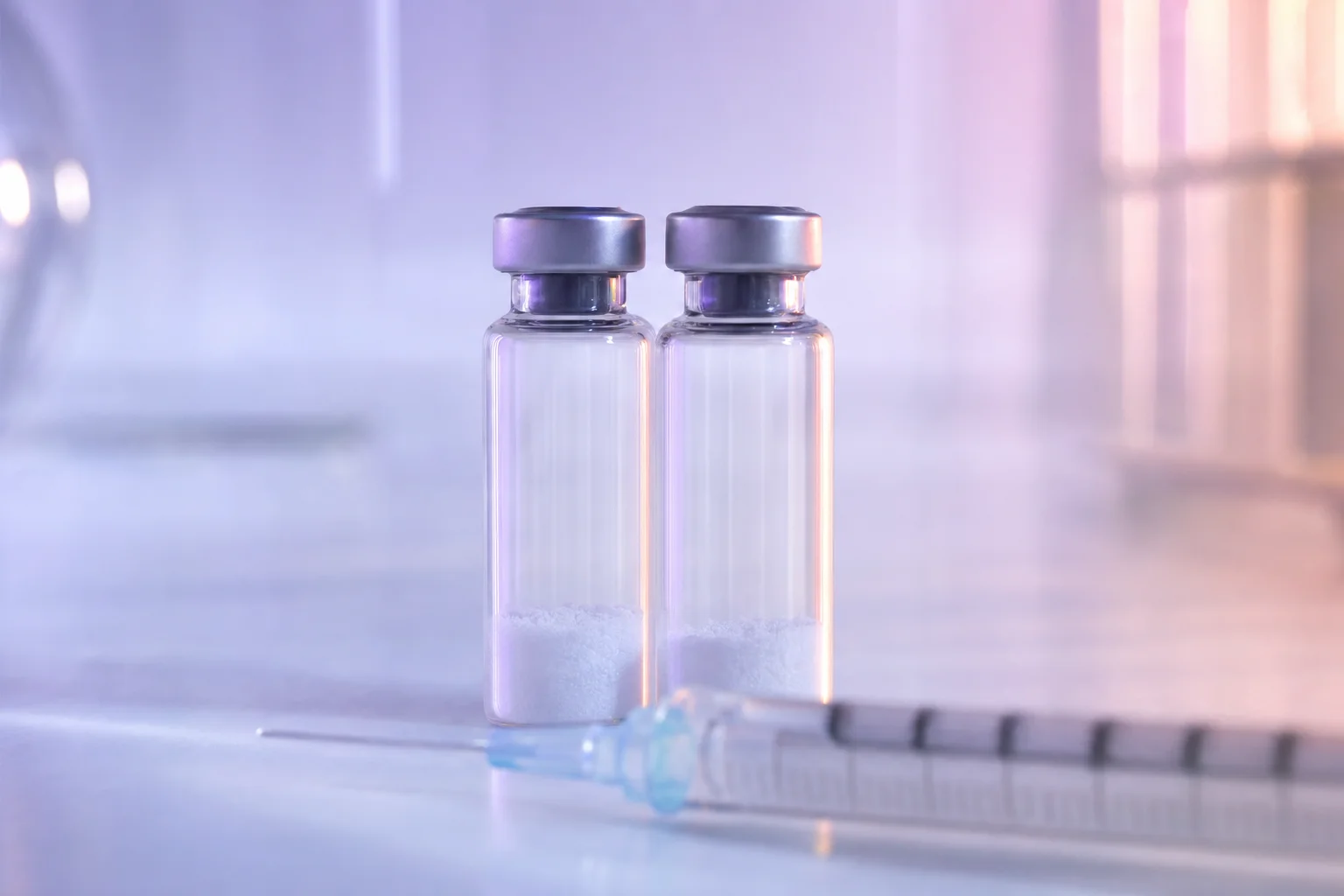
| Supplied as | Lyophilized powder; reconstituted with bacteriostatic water | Lyophilized powder; reconstituted with bacteriostatic water |
| Storage | Refrigerate after reconstitution; lyophilized powder stable at room temperature short term | Refrigerate after reconstitution; lyophilized powder stable at room temperature short term |
| Stability | Lyophilized: 24+ months; reconstituted: approximately 4-6 weeks refrigerated | Lyophilized: 24+ months; reconstituted: approximately 4-6 weeks refrigerated |
| Administration studied | Subcutaneous injection; co-injected with ipamorelin in combination protocols | Subcutaneous injection; human PK/PD data available[4] |
References
- [1] Teichman SL et al. Prolonged stimulation of growth hormone (GH) and insulin-like growth factor I secretion by CJC-1295, a long-acting analog of GH-releasing hormone, in healthy adults. J Clin Endocrinol Metab. 2006;91(3):799-805. PubMed ↗ (Phase 2 RCT using CJC-1295 with DAC formulation; establishes GHRH analog GH/IGF-1 amplification in humans)
- [2] Ionescu M, Frohman LA. Pulsatile secretion of growth hormone (GH) persists during continuous stimulation by CJC-1295, a long-acting GH-releasing hormone analog. J Clin Endocrinol Metab. 2006;91(12):4792-7. PubMed ↗ (CJC-1295 with DAC formulation; confirms pulsatile GH secretion is preserved during GHRH analog stimulation)
- [3] Raun K et al. Ipamorelin, the first selective growth hormone secretagogue. Eur J Endocrinol. 1998;139(5):552-61. PubMed ↗
- [4] Gobburu JV et al. Pharmacokinetic-pharmacodynamic modeling of ipamorelin, a growth hormone releasing peptide, in human volunteers. Pharm Res. 1999;16(9):1412-6. PubMed ↗
- [5] Mayfield CK et al. Injectable Peptide Therapy: A Primer for Orthopaedic and Sports Medicine Physicians. Am J Sports Med. 2026;54(1):223-229. PubMed ↗
- [6] Sinha DK et al. Beyond the androgen receptor: the role of growth hormone secretagogues in the modern management of body composition in hypogonadal males. Transl Androl Urol. 2020;9(Suppl 2):S149-S159. PubMed ↗