What it is
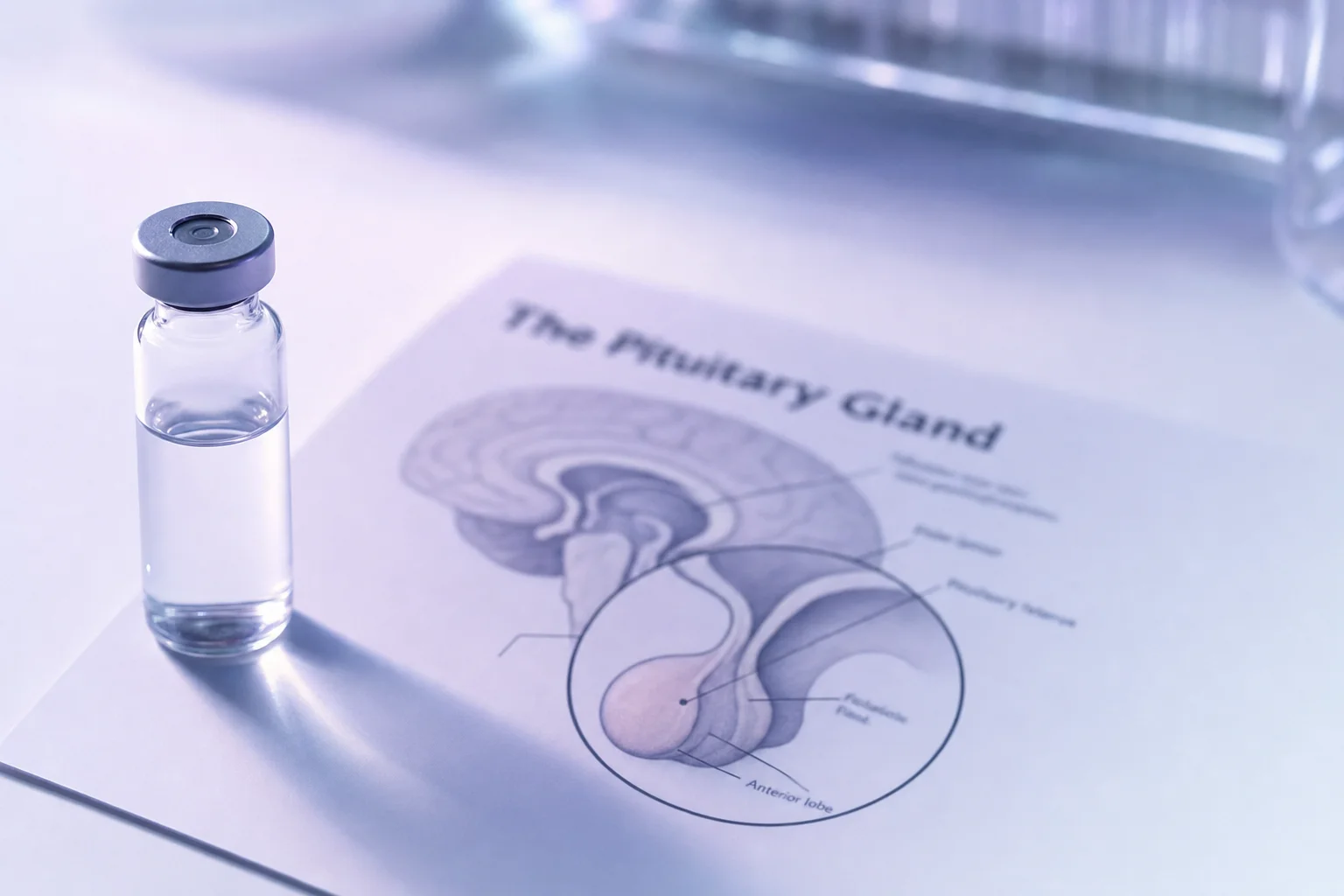
Sermorelin (also designated GRF 1-29 or sermorelin acetate) is a synthetic 29-amino-acid peptide corresponding to the N-terminal fragment of endogenous growth hormone-releasing hormone (GHRH). This fragment retains the full receptor-binding activity of native GHRH, which contains 44 residues; early characterization established it as the shortest GHRH analog with complete biological activity.[5]
Sermorelin received FDA approval in 1997 under the brand name Geref for the diagnosis and treatment of growth hormone deficiency in children. The branded product was voluntarily withdrawn from the US market in 2008, and no FDA-approved commercial form currently exists. Compounded sermorelin remains available through licensed compounding pharmacies and continues to appear in clinical and research contexts.
What researchers study it for
- GH secretion stimulation Foundational research established that the N-terminal 29 amino acids of GHRH are sufficient to bind pituitary GHRH receptors and trigger GH release; both intravenous and subcutaneous administration have produced significant GH pulses in human subjects in pharmacokinetic studies.[5]
- Growth hormone deficiency diagnosis Prakash and Goa reviewed IV sermorelin as a provocative test for GH deficiency, noting it produced fewer false-positive responses than several alternative stimulation tests and was well-tolerated as a single-dose diagnostic tool in children.[2]
- Height velocity in GH-deficient children Subcutaneous sermorelin in pediatric GH deficiency produced meaningful increases in height velocity in studies lasting up to 36 months, with researchers observing catch-up growth in the majority of treated children; responses were generally smaller than those seen with exogenous somatropin at equivalent intervals.[2]
- Adult-onset GH insufficiency Walker reviewed sermorelin as a potential alternative to synthetic GH replacement in adults with age-related GH decline, noting that stimulating endogenous pulsatile GH release via GHRH receptors preserves hypothalamic-pituitary feedback mechanisms that exogenous GH administration bypasses.[1]
- IGF-1 elevation in GH secretagogue research In a retrospective study of hypogonadal individuals receiving GH secretagogue therapy (sermorelin combined with GHRP-2 and GHRP-6), mean IGF-1 levels increased significantly from baseline, with researchers proposing IGF-1 as a practical surrogate marker for GH axis responsiveness.[3]
- Body composition in GH-insufficient states Sinha et al. reviewed sermorelin alongside other GH secretagogues as potential tools for addressing fat accumulation and lean mass loss associated with GH insufficiency, noting that the evidence base for GHS in these contexts remains largely observational and that controlled trials are needed.[4]
Research context
Sermorelin has one of the deeper evidence trails of any research peptide in the GHRH analog class, partly because it has a history as a regulated pharmaceutical. Clinical studies from the 1980s through the early 2000s established its safety profile and diagnostic utility, and it was the subject of multiple pediatric trials examining height velocity outcomes.[2] The evidence base for its diagnostic use is well-characterized. The therapeutic evidence for growth promotion is more mixed: most pediatric trials showed smaller effects than exogenous somatropin, though some researchers have argued that preserving the physiological GH pulse pattern is a meaningful consideration when the two approaches are compared.[1]
Contemporary research interest in sermorelin has shifted toward adult populations: people with age-related GH decline, metabolic changes associated with GH insufficiency, and body composition in hypogonadal settings.[4] Sermorelin appears in this literature alongside GHRP-2 and GHRP-6 as part of multi-compound GH secretagogue protocols, and retrospective data suggests meaningful IGF-1 changes in treated individuals.[3] Controlled trials isolating sermorelin's effects in adult populations remain limited; most current evidence in these contexts comes from retrospective reviews and case series rather than randomized trials.
Typical research parameters
| Parameter | Detail |
|---|---|
| Common vial sizes | 2 mg, 5 mg (some vendors offer 10 mg research vials) |
| Supplied as | Lyophilized powder; reconstituted with bacteriostatic water before use |
| Storage | Lyophilized powder: stable at room temperature short-term, refrigerate for longer storage; reconstituted solution: refrigerate, do not freeze |
| Stability | Lyophilized: 24+ months under appropriate conditions; reconstituted: approximately 28 days refrigerated |
| Administration studied | Subcutaneous injection (primary research and clinical use); intravenous (diagnostic protocols); intranasal administration was explored in early pharmacokinetic work but bioavailability was low (~3–5%) |
References
- [1] Walker RF. Sermorelin: a better approach to management of adult-onset growth hormone insufficiency? Clin Interv Aging. 2006;1(4):307-8. PubMed ↗
- [2] Prakash A, Goa KL. Sermorelin: a review of its use in the diagnosis and treatment of children with idiopathic growth hormone deficiency. BioDrugs. 1999;12(2):139-57. PubMed ↗
- [3] Sigalos JT, Pastuszak AW, et al. Growth Hormone Secretagogue Treatment in Hypogonadal Men Raises Serum Insulin-Like Growth Factor-1 Levels. Am J Mens Health. 2017;11(6):1752-1757. PubMed ↗
- [4] Sinha DK, Balasubramanian A, et al. Beyond the androgen receptor: the role of growth hormone secretagogues in the modern management of body composition in hypogonadal males. Transl Androl Urol. 2020;9(Suppl 2):S149-S159. PubMed ↗
- [5] Grossman A, Savage MO, Besser GM. Growth hormone releasing hormone. Clin Endocrinol Metab. 1986;15(3):607-27. PubMed ↗