What it is
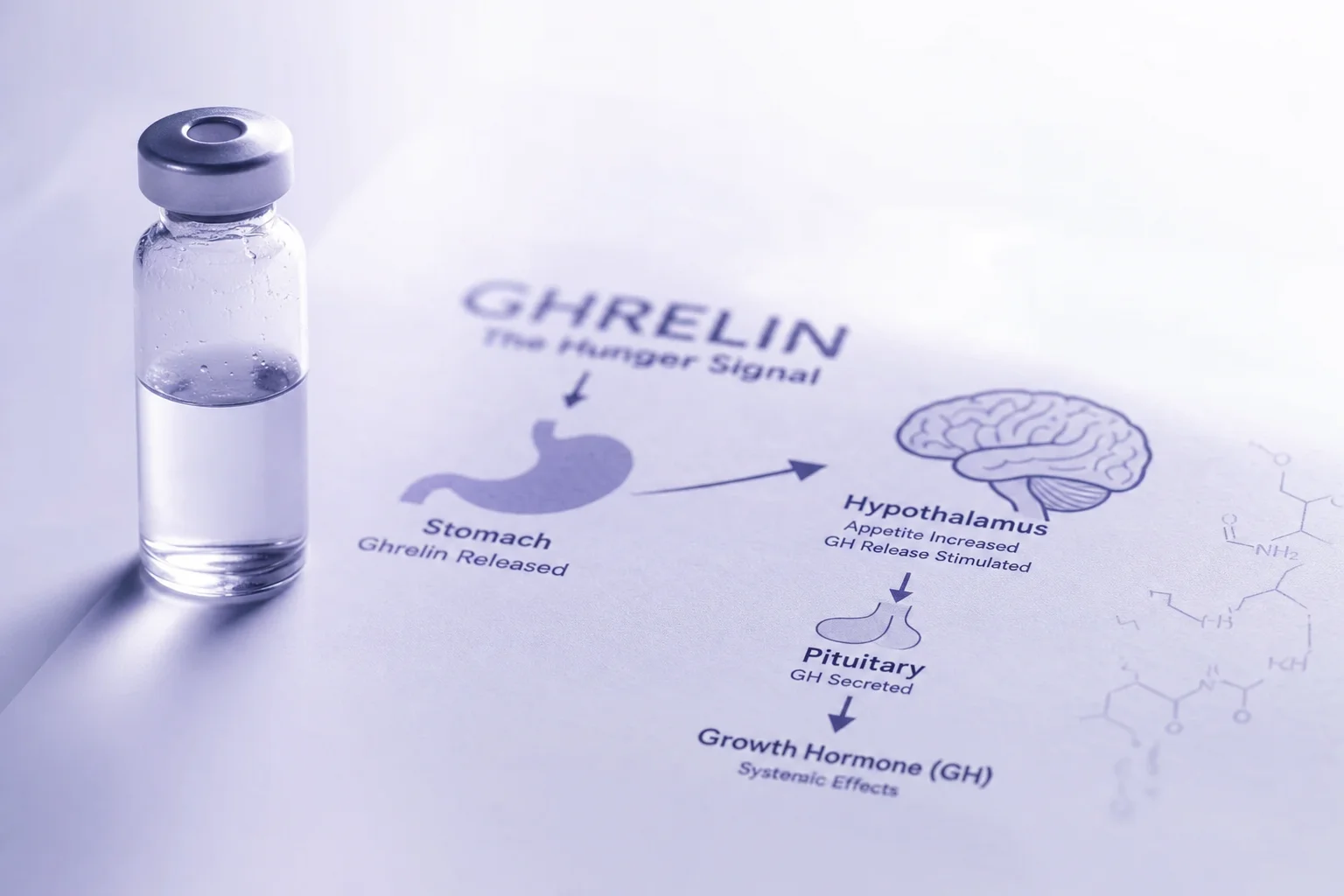
GHRP-6 (growth hormone releasing hexapeptide-6) is a synthetic six-amino-acid peptide with the sequence His-DTrp-Ala-Trp-DPhe-Lys-NH2. It was first described by Cyril Bowers and colleagues in 1984 and represents the founding compound of the GHRP family. GHRP-6 acts as an agonist at the growth hormone secretagogue receptor type 1a (GHSR-1a), the same receptor activated by the endogenous peptide ghrelin.
As the reference GHRP, GHRP-6 is widely used in comparative research to benchmark the selectivity and side-effect profiles of newer compounds such as ipamorelin and GHRP-2. Unlike ipamorelin, GHRP-6 stimulates not only GH secretion but also ACTH and cortisol release, which has made selectivity a focus of subsequent GHRP development.[3]
What researchers study it for
- Growth hormone secretion via ghrelin receptor agonism GHRP-6 was characterized as a potent GH secretagogue that operates through a receptor distinct from the GHRH receptor; subsequent work confirmed this receptor as GHSR-1a, the same target activated by the endogenous hormone ghrelin, establishing GHRP-6 as a ghrelin mimetic before ghrelin itself was identified.[1]
- Appetite stimulation and food intake Ghrelin receptor agonism in the hypothalamus activates orexigenic signaling; researchers have studied GHRP-6 as a tool for probing the appetite-regulating functions of the ghrelin axis, with central administration in rodent models producing significant increases in food intake and meal size.[2]
- Cortisol and ACTH stimulation (selectivity research) GHRP-6 activates the hypothalamic-pituitary-adrenal (HPA) axis in addition to stimulating GH release; studies comparing GHRP-6 with ghrelin and GHRH have measured ACTH and cortisol responses in both healthy individuals and patients with pituitary or adrenal conditions, making GHRP-6 a useful probe in neuroendocrine diagnostic research.[3]
- GHRH plus GHRP-6 as a GH secretion diagnostic The combined GHRH + GHRP-6 stimulation test is studied as an assessment tool for pituitary GH reserve; researchers have evaluated its utility in children and adults with suspected GH deficiency or neurosecretory dysfunction, where it produces a more robust GH response than either agent alone.[4]
- Cardioprotective properties A growing body of preclinical research, primarily from Cuban research groups, has examined GHRP-6's potential to protect cardiac tissue; studies have investigated its effects on myocardial infarct models, doxorubicin-induced cardiotoxicity, and post-infarct ventricular remodeling, finding reduced apoptosis and improved systolic function in animal models.[5]
- GH axis reference compound Because GHRP-6 was the first characterized GHRP, it serves as the comparison baseline in most studies evaluating newer secretagogues; researchers studying ipamorelin, GHRP-2, and hexarelin routinely include GHRP-6 as a reference to quantify improvements in GH selectivity and reduction in cortisol co-stimulation.[6]
Research context
GHRP-6 has one of the longest research histories of any synthetic peptide in this class, with studies spanning more than four decades. The early characterization work established it as a potent GH secretagogue and led directly to the development of the ghrelin system; ghrelin itself was only identified in 1999, years after GHRP-6 research began.[1] This makes GHRP-6 somewhat unusual: it helped define a receptor before the receptor's endogenous ligand was known.
The main limitation of GHRP-6 compared to later GHRPs is its non-selective activation of the HPA axis, which produces measurable cortisol and ACTH increases alongside GH release.[3] This property makes it useful as a neuroendocrine diagnostic tool and as a research comparator, but it has also driven the development of more selective compounds. The cardioprotective research represents an independent research trajectory; most of this work is from animal models and has not yet been replicated in human clinical trials. Human studies of GHRP-6 exist primarily in the context of GH axis diagnostics, not the other research areas outlined above.
Typical research parameters
| Parameter | Typical range |
|---|---|
| Common vial sizes | 2 mg, 5 mg; some vendors offer 10 mg |
| Supplied as | Lyophilized powder; reconstituted with bacteriostatic water prior to use |
| Storage | Lyophilized powder: stable at room temperature short term, refrigeration preferred; reconstituted: refrigerate and use within 4–6 weeks |
| Stability | Lyophilized: 24+ months refrigerated; reconstituted: approximately 4–6 weeks |
| Administration studied | Subcutaneous injection (most human and animal studies); intravenous (diagnostic protocols); intranasal (preclinical exploratory work) |
References
- [1] Muccioli G et al. Do growth hormone-releasing peptides act as ghrelin secretagogues? J Endocrinol Invest. 2001;24(9):774-9. PubMed ↗
- [2] Seoane LM et al. Acute central ghrelin and GH secretagogues induce feeding and activate brain appetite centers. Eur J Endocrinol. 2003;149(2):159-63. PubMed ↗
- [3] Broglio F et al. Ghrelin and GHRP-6-induced ACTH and cortisol release in patients with Cushing's disease. Pituitary. 2009;12(3):236-43. PubMed ↗
- [4] Lal S et al. Combined growth hormone-releasing hormone and growth hormone-releasing peptide-6 test for the evaluation of growth hormone secretion in children with growth hormone deficiency and growth hormone neurosecretory dysfunction. Horm Res. 2008;70(5):265-72. PubMed ↗
- [5] Rodriguez-Viera F et al. Growth hormone releasing peptide-6 (GHRP-6) prevents doxorubicin-induced myocardial and extra-myocardial damages by activating prosurvival mechanisms. Peptides. 2024;179:171281. PubMed ↗
- [6] Arvat E et al. Effects of GHRP-2 and hexarelin, two synthetic GH-releasing peptides, on GH, prolactin, ACTH and cortisol levels in man. Comparison with the effects of GHRH, TRH and hCRH. Peptides. 1997;18(6):885-91. PubMed ↗