What it is
Ipamorelin is a synthetic pentapeptide (five amino acids) classified as a growth hormone releasing peptide (GHRP). It acts as a selective agonist of the ghrelin receptor in the pituitary gland, prompting GH release without the significant cortisol or ACTH stimulation observed with earlier GHRPs such as GHRP-6.[1]
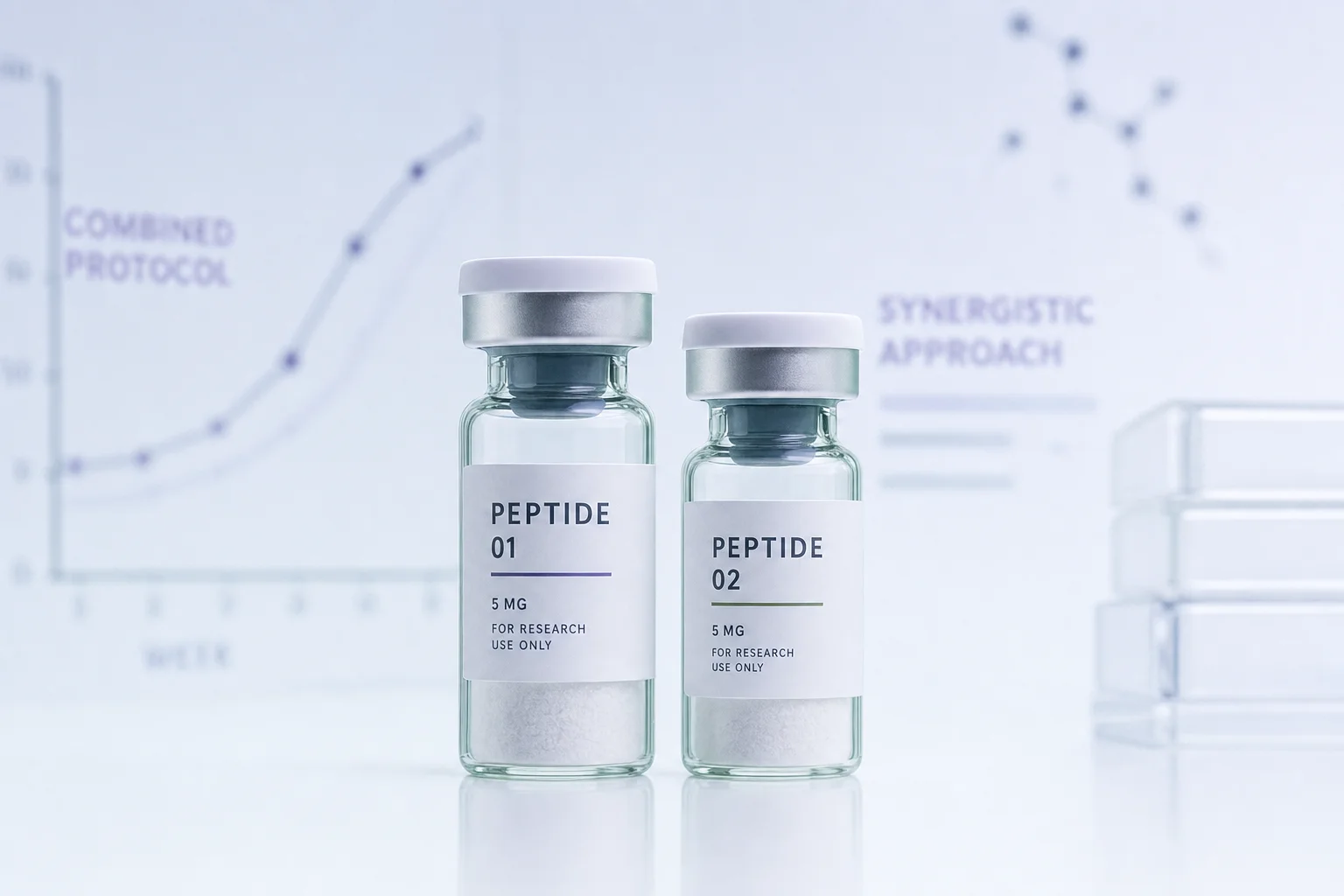
CJC-1295 is a synthetic analog of growth hormone-releasing hormone (GHRH), modified with a Drug Affinity Complex (DAC) that allows it to covalently bind albumin in plasma after injection. This albumin binding protects CJC-1295 from rapid enzymatic degradation, extending its plasma half-life from minutes (for native GHRH) to approximately 6–8 days.[4] Researchers studying GH axis stimulation often examine the two compounds together, as ipamorelin targets ghrelin receptors (GHSR-1a) while CJC-1295 targets GHRH receptors (GHRHr), stimulating GH release through distinct mechanisms.
What researchers study it for
- Selective GH secretion without cortisol elevation Ipamorelin was characterized in early research as the first selective growth hormone secretagogue because it stimulated GH release in animal models without the concurrent ACTH and cortisol increases seen with GHRP-6 and GHRP-2 at equivalent doses.[1]
- Extended GH pulse duration via albumin binding CJC-1295's DAC modification enables it to attach to circulating albumin, resulting in sustained, pulsatile GH secretion over multiple days rather than the brief pulse produced by unmodified GHRH; this mechanism was identified in preclinical work establishing CJC-1295 as a long-lasting GHRH analog.[4]
- GH and IGF-I elevation in human subjects In a Phase 2 clinical trial by Teichman et al., a single subcutaneous injection of CJC-1295 produced mean GH increases of 2–10 fold and IGF-I increases of 1.5–3 fold in healthy adult participants, with effects persisting for up to 6 days after administration.[5]
- Bone formation and glucocorticoid-induced catabolism In rodent models, ipamorelin has been studied for its ability to counteract the bone-loss effects of glucocorticoid treatment; one study found a fourfold increase in periosteal bone formation rate in glucocorticoid-treated rats receiving ipamorelin compared to controls.[2]
- GI motility and postoperative ileus Researchers have examined ipamorelin's ghrelin-mimetic activity in the gastrointestinal tract; in a rodent model of postoperative ileus, ipamorelin accelerated GI transit and reduced markers of ileus compared to placebo, suggesting a possible role for ghrelin receptor agonism in GI recovery research.[3]
- Serum protein and metabolic marker changes A follow-up study in normal adult subjects found that CJC-1295 administration produced measurable shifts in serum protein profiles consistent with activation of the GH/IGF-1 axis, identifying potential biomarkers for monitoring GH axis responsiveness in research settings.[6]
Research context
Ipamorelin's foundational characterization comes from a relatively small set of preclinical studies, most conducted in rodent models. The compound's selectivity profile (GH release without cortisol elevation) was a key finding that distinguished it from earlier GHRPs.[1] Downstream research on ipamorelin covers bone metabolism, GI motility, and catabolism. Human clinical data on ipamorelin specifically is limited; most of the post-characterization evidence base is from animal studies.
CJC-1295's human evidence is anchored by the Teichman et al. 2006 Phase 2 trial, which remains one of the few controlled studies of a GHRH analog in human subjects.[5] Development of CJC-1295 as a pharmaceutical compound was discontinued after a trial participant died during a subsequent study; investigators determined the death was unrelated to the study drug, but commercial development did not continue. The combination of ipamorelin and CJC-1295 as a research protocol is frequently discussed in the literature, but controlled human trials examining the pair together are not yet available. Researchers working with this combination are operating largely from extrapolated preclinical and mechanistic data.[4]
Typical research parameters
| Parameter | Ipamorelin | CJC-1295 |
|---|---|---|
| Common vial sizes | 2 mg, 5 mg | 2 mg, 5 mg |
| Supplied as | Lyophilized powder; reconstituted with bacteriostatic water | Lyophilized powder (with DAC or without DAC formulations available); reconstituted with bacteriostatic water |
| Storage | Refrigerate after reconstitution; lyophilized powder stable at room temperature short term | Refrigerate after reconstitution; lyophilized powder stable at room temperature short term |
| Stability | Lyophilized: 24+ months; reconstituted: approximately 4–6 weeks refrigerated | Lyophilized: 24+ months; reconstituted: approximately 4–6 weeks refrigerated |
| Administration studied | Subcutaneous injection (rodent studies and in vitro); oral bioavailability under preclinical investigation | Subcutaneous injection (human Phase 2 trial and preclinical work) |
References
- [1] Raun K et al. Ipamorelin, the first selective growth hormone secretagogue. Eur J Endocrinol. 1998;139(5):552-61. PubMed ↗
- [2] Andersen NB et al. The growth hormone secretagogue ipamorelin counteracts glucocorticoid-induced decrease in bone formation of adult rats. Growth Horm IGF Res. 2001;11(5):266-72. PubMed ↗
- [3] Greenwood-Van Meerveld B et al. Efficacy of ipamorelin, a novel ghrelin mimetic, in a rodent model of postoperative ileus. J Pharmacol Exp Ther. 2009;329(3):1117-25. PubMed ↗
- [4] Sam JM et al. Human growth hormone-releasing factor (hGRF)1-29-albumin bioconjugates activate the GRF receptor on the anterior pituitary in rats: identification of CJC-1295 as a long-lasting GRF analog. Endocrinology. 2005;146(7):3024-33. PubMed ↗
- [5] Teichman SL et al. Prolonged stimulation of growth hormone (GH) and insulin-like growth factor I secretion by CJC-1295, a long-acting analog of GH-releasing hormone, in healthy adults. J Clin Endocrinol Metab. 2006;91(3):799-805. PubMed ↗
- [6] Khatib N et al. Activation of the GH/IGF-1 axis by CJC-1295, a long-acting GHRH analog, results in serum protein profile changes in normal adult subjects. Growth Horm IGF Res. 2009;19(4):399-409. PubMed ↗