GHK-Cu vs AHK-Cu
Two copper peptides one amino acid apart, one with the hair marketing and one with the bigger research file, and plenty of scalp serums carrying both.
GHK-Cu or AHK-Cu?
Choose GHK-Cu if
Your skin is on the list as well as your hair, firmness and fine lines included, and you'd rather start with the copper peptide that has more research behind it.
Choose AHK-Cu if
Hair is the whole point, a wider part or a thinner ponytail, and you're comfortable that the case for it is one promising lab result rather than a trial.
Or both. The common way is a hair serum that already contains both, which is how a lot of scalp products are sold. That comes from how products are formulated and what people describe, not from a study of the pair.
GHK-Cu and AHK-Cu, side by side
The GHK-Cu injected amount comes from our GHK-Cu dosage page, which draws on vendor pages and research forums. No study, label or dosage page sets an amount for AHK-Cu, so we don't give one.
The difference, in plain words
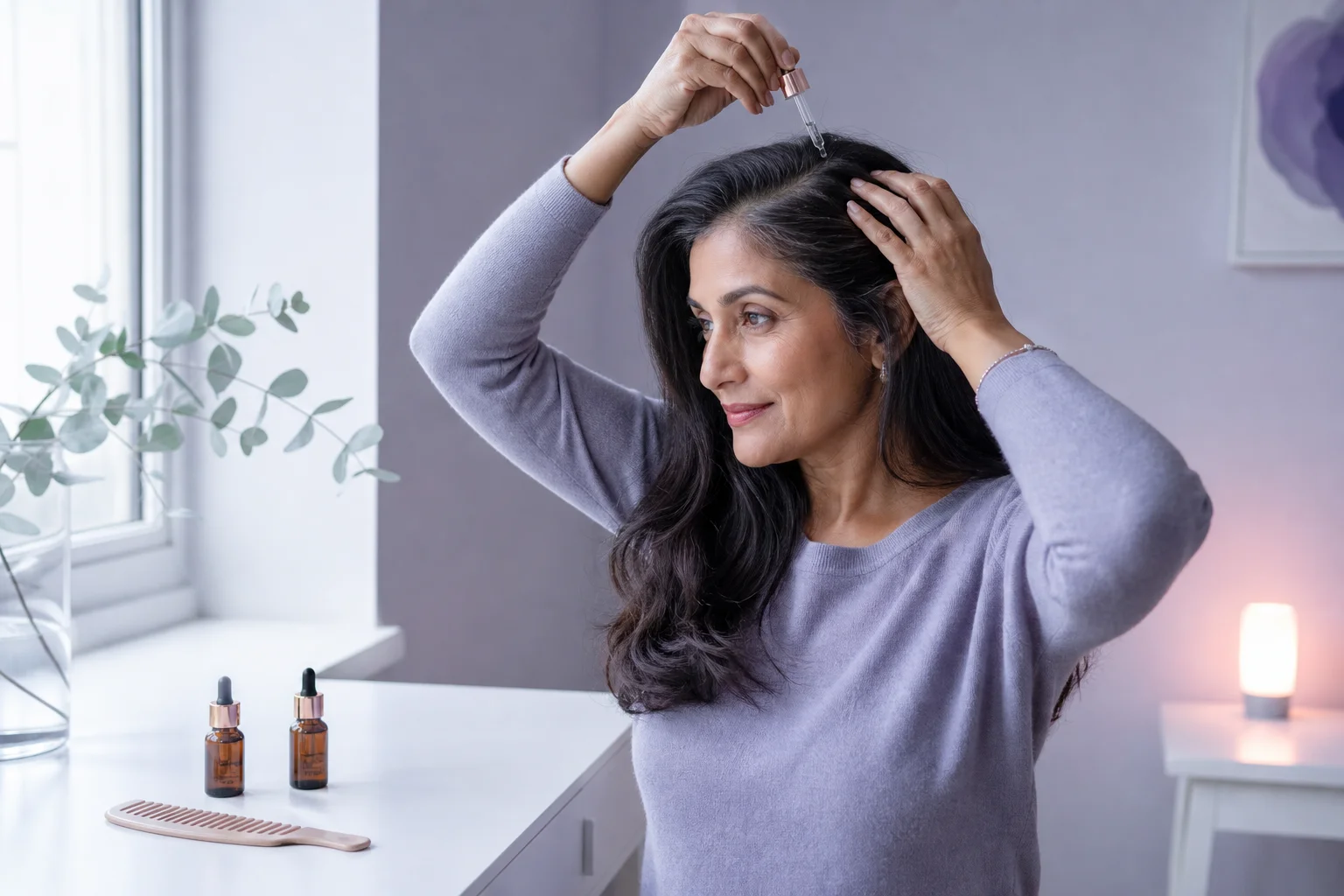
A wider part, a thinner ponytail or more hair in the brush than there used to be is what sends most women to these two names, often in perimenopause or past it. Both are copper peptides, both turn up in scalp serums, and the useful question is less which one wins and more which research belongs to which.
AHK-Cu is the one people buy mostly for thinning hair. It's a small lab-made peptide, three amino acids, the building blocks of protein, holding a single copper atom, listed on labels as copper tripeptide-3. Its hair case is a single lab study on hair follicles in a dish: researchers in Seoul grew human follicles in the lab, and the ones given AHK-Cu grew longer than untreated ones. The cells at the base of the follicle that tell it when to grow also multiplied and were less likely to die off. That's a promising result, and nobody has repeated it, tested it in animals or tried it on a living scalp.
GHK-Cu is the famous cousin, one amino acid different at the front, and it's one your body makes, though blood levels drop by more than half between your twenties and your sixties. It gets asked about for hair too, though its strongest evidence is on skin, from creams and gels studied for firmness and collagen, the protein that keeps skin springy. Its hair work is thin, only cell and animal studies, and none of it shows what GHK-Cu does on a woman's scalp.
The family resemblance is strong enough that serum marketing tends to borrow from whichever sibling has the better résumé. A bottle that just says "copper peptides" may be selling you AHK-Cu on GHK-Cu's research, or may hold both, and the ingredient list is the only way to tell. If the thinning arrived alongside other changes, can peptides help with menopause? covers the bigger picture, and our skin and beauty page lists what else people weigh for skin and hair.
Dosage side by side
| Pattern | GHK-Cu | AHK-Cu |
|---|---|---|
| On the scalp or skin | Serum or cream, as the label says | Serum, as the label says |
| Injected, standard | 1–2 mg once a day | No sourced amount |
| Injected, higher | Up to 5 mg once a day | No sourced amount |
| Injected, how long | 4 to 8 week stretches, short break | No study or label sets one |
| Common vial | 50 or 100 mg | Often 50 mg or more |
Where these come from: the injected GHK-Cu patterns are the convention on vendor pages and research forums, with the higher one mostly on longevity forums, and no human dosing trial or approved label sets them. For AHK-Cu, no study, label or named clinician sets an amount for people, topical or injected. The one hair study used concentrations in a dish that don't turn into a dose, so any number you see online is vendor or community convention, and we don't have an AHK-Cu dosage page for that reason. For either peptide in a serum, the product label is the instruction, and most labels don't say how much peptide is in the bottle. The units to draw and how long a vial lasts are on the GHK-Cu dosage chart.
A serum and an injection are different products, and their amounts don't convert in either direction. A mixed vial of either peptide keeps 28 days in the fridge, and a 50 mg GHK-Cu vial at 2 mg a day is 25 doses. The reconstitution calculator does the mixing math for any vial size.
Taking GHK-Cu and AHK-Cu together
"GHK-Cu and AHK-Cu hair serum" is one of the most common searches for this pair, and the shelf has already answered it. Plenty of scalp serums contain both, often with other peptides, sold together the way shampoo and conditioner are, on the idea that each covers something the other doesn't. No study has tested the pair, so using them together rests on formulation and on what people describe, not on a trial.
To see what you're actually buying, read the full ingredient list. Copper tripeptide-1 is GHK-Cu and copper tripeptide-3 is AHK-Cu, and where each sits in the list gives a rough idea of how much is in there. A label that only says "copper peptide complex" doesn't tell you which one you're paying for.
People also ask about injecting the two together. GHK-Cu's injected amounts come from vendor and forum convention, and AHK-Cu has no sourced injected amount at all, so there's no tested combined schedule to describe. Anyone weighing it is working from community reports for both. People who want the skin side as well sometimes look at the GLOW blend, which is mostly GHK-Cu, and the guide to peptides for skin and hair puts both copper peptides beside the blends. Hair change of any kind tends to show slowly, so people who track a serum describe checking the same part in the same mirror and the same light over a couple of months.
GHK-Cu and AHK-Cu prices
- IDUN Peptides100 mg · $34.99 $0.35/mg
- Luvaminos100 mg · $35.00 $0.35/mg
- KAM Research Solutions100 mg · $36.86 $0.37/mg
- Alpha Labs100 mg · $38.49 $0.38/mg
- Veylora Labs100 mg · $39.00 $0.39/mg
- Ion Peptide100 mg · $39.00 $0.39/mg
- Iron Protocol100 mg · $39.00 $0.39/mg
- Glow Aminos100 mg · $39.00 $0.39/mg
- Flawless Compounds100 mg · $39.00 $0.39/mg
- Purgo Labs100 mg · $44.99 $0.45/mg
Compare both in the app. We track 51 vendors for GHK-Cu and 21 for AHK-Cu, and both are research vials, not serums. Compare the real price per milligram rather than the sticker on one vial, since vial sizes vary, and look for third-party purity and identity testing on the batch you're buying. That matters more than usual for AHK-Cu, which is thinly studied, so a recent certificate of analysis is the main evidence of what's in the vial. Every vendor on PPL carries a confidence label, from High confidence to New vendor, and our guide to reading a certificate of analysis walks through what to check.
Side effects compared
GHK-Cu: on the skin it has a long track record as a cosmetic ingredient, and people report occasional redness or tingling, with copper peptides described as a little more irritating than other serum peptides. No human trial has tested it by injection, so its safety that way hasn't been measured. People who inject it report redness or stinging where they injected, and some report a metallic taste or nausea after a dose, which they link to the copper. A mixed vial should be clear blue, and one that turns cloudy, grows particles or loses its color gets thrown out.
AHK-Cu: nobody has published a safety study of it in people. It's used in leave-on cosmetics, which isn't the same as a measured safety record, and no study covers injecting it at all, so there's no side-effect list to give for either route.
There's no data on pregnancy or breastfeeding for either peptide, and none on how either behaves alongside hair loss treatments like minoxidil or with each other. For a scalp serum on sensitive skin, a patch test on the inside of the arm first is the usual skin-care step.
Both are sold for research and as cosmetic ingredients, and the only study behind AHK-Cu's hair claim was done in a dish. You knew that, it's why you're reading this and not the label.
GHK-Cu and AHK-Cu prices today
Questions people ask
Is AHK-Cu or GHK-Cu better for hair growth?
No study has compared them. AHK-Cu's hair case is a single lab study where it made human hair follicles grow longer in a dish, and GHK-Cu has a little hair work of its own, only in cells and animals, with its strongest evidence on skin. Neither has been tested on women's thinning hair.
What's the difference between AHK-Cu and GHK-Cu?
They're two copper peptides that differ by one amino acid at the front, alanine in AHK-Cu and glycine in GHK-Cu. GHK-Cu is one your body makes and has a much bigger research file, and its results don't carry over to AHK-Cu.
Can you use GHK-Cu and AHK-Cu together?
People do, mostly in hair serums that already contain both. No study has tested the pair, so using them together comes from how products are made, not from a trial.
Is AHK-Cu or GHK-Cu better topical or injected for hair?
Nobody has published a study of either one injected for hair. The AHK-Cu hair study was done on follicles in a dish, and GHK-Cu's human research is mostly creams and gels on skin, so the scalp serum is the form the hair interest grew up around.
Can you inject AHK-Cu and GHK-Cu together?
People ask about it, and no study or label covers it. GHK-Cu's injected amounts come from vendor and forum convention, and AHK-Cu has no sourced injected amount at all, so there's nothing tested to combine.
Read more on each
Your next step
Also on Android