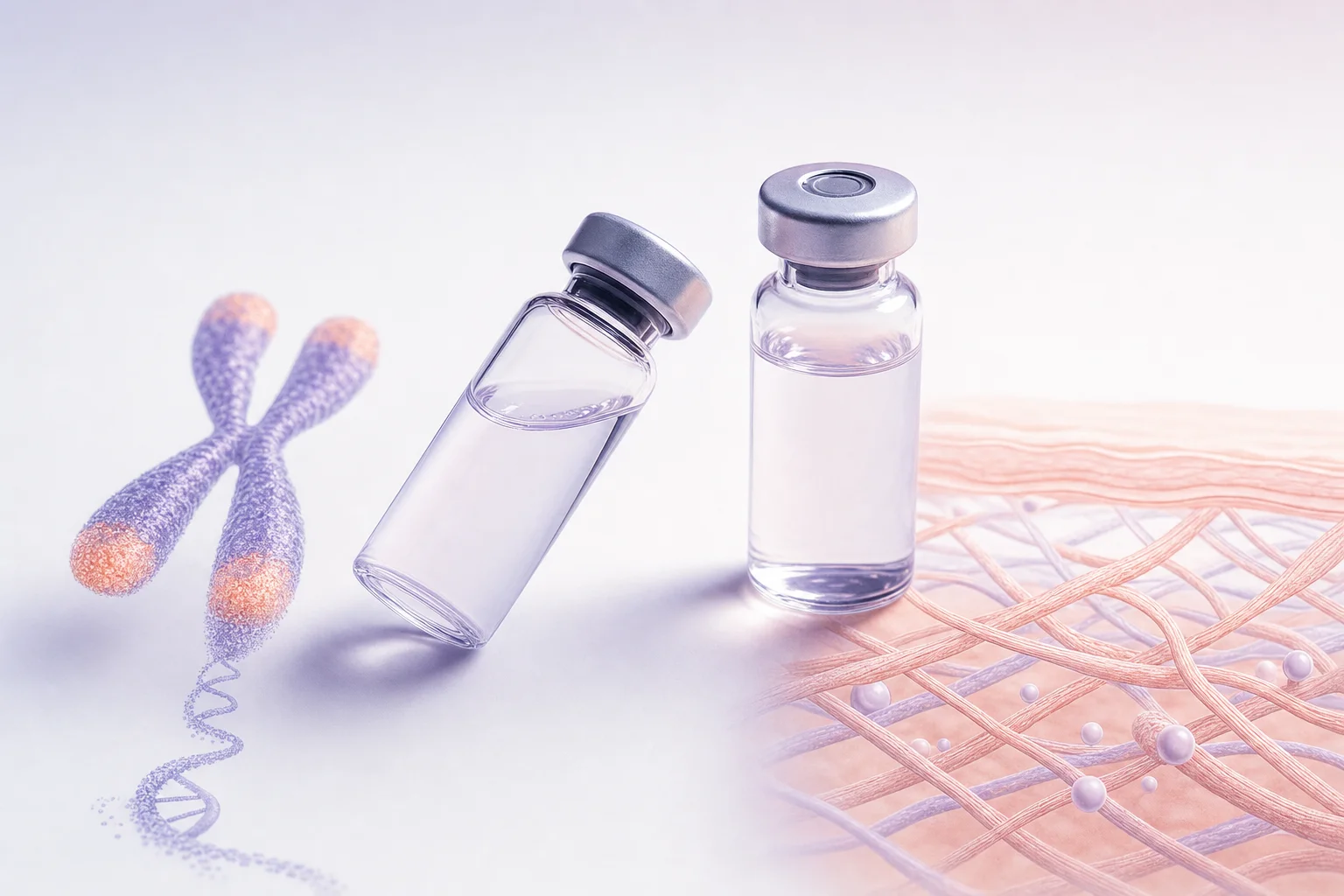
Search "anti-aging peptides" and these two names both come up, which makes them look like competitors. They're really answering different questions. Epitalon is studied for the deep, cellular side of aging, the kind you can't see in a mirror. GHK-Cu is studied for the visible side, the skin and tissue you can. Comparing them is useful mainly to figure out which kind of aging you're actually trying to address, because the answer points clearly to one or the other.
What Epitalon and GHK-Cu have in common
Both are short, naturally inspired peptides researched under the broad heading of aging, and both are sold as research compounds rather than approved medications. Both also tend to attract big, sweeping longevity claims online, which is a good reason to look at each carefully rather than taking the marketing at face value. Beyond the shared "anti-aging" banner, though, they target very different things.
How Epitalon works
Epitalon, also spelled Epithalon, is a four-amino-acid peptide based on a substance produced by the pineal gland, a small gland in the brain involved in regulating sleep and circadian rhythm. Its most-discussed research interest is telomerase, an enzyme that helps maintain telomeres, the protective caps on the ends of chromosomes that shorten as cells divide and age. The theory is that supporting telomerase could influence cellular aging itself. It's also studied for regulating melatonin and circadian rhythm. Much of the existing research is older, comes from a relatively narrow set of sources, and is limited in size, so the longevity claims around it run well ahead of robust human evidence.
How GHK-Cu works
GHK-Cu is a copper tripeptide, a three-amino-acid molecule bound to a copper ion, that occurs naturally in the body and declines with age. Its research centers on tissue: supporting collagen and elastin production, antioxidant activity, and wound healing, along with cosmetic improvements in skin firmness and texture. It's used both topically in skincare and, in the research world, in injectable form. Compared with Epitalon, its mechanisms are more concrete and its visible-skin benefits are more directly observable, which gives it a more grounded, if narrower, story.
Key differences
The defining difference is internal versus visible. Epitalon is aimed at cellular and systemic aging, telomeres, circadian rhythm, the machinery you can't watch in the mirror. GHK-Cu is aimed at the tissue you can see and feel: skin, collagen, repair. Someone whose interest is firmer skin and fewer fine lines wants a very different compound than someone whose interest is cellular longevity, and these two split almost perfectly along that line.
Evidence quality is the second difference, and it cuts in GHK-Cu's favor for concreteness. GHK-Cu's skin and repair effects are relatively well studied and at least partly visible, even if cosmetic results are modest and gradual. Epitalon's headline claims are far more ambitious, but they rest on thinner, older, and more limited research, so confidence should scale accordingly. Ambitious mechanism plus limited evidence is a combination that calls for caution, not excitement.
Practical use differs too. GHK-Cu has an everyday on-ramp through topical skincare, where it's widely available and low-stakes to try. Epitalon has no such cosmetic form; it's used as an injectable research compound, typically in short research cycles, which makes it a bigger commitment with less to show for it in the near term. Both are unapproved for human use in their research-compound forms, with the usual source-quality concerns that entails.
| Epitalon | GHK-Cu | |
|---|---|---|
| Aging angle | Cellular, internal | Skin and tissue, visible |
| Main research focus | Telomerase, circadian rhythm | Collagen, repair, antioxidant |
| Evidence base | Limited, older, narrow | More concrete, partly visible |
| How it's used | Injectable research cycles | Topical and injectable (research) |
| Claim vs. data | Claims run ahead of evidence | Modest, gradual, observable |
| Best for | Cellular longevity curiosity | Visible skin support |
Bottom line
GHK-Cu is the better fit if your anti-aging interest is the part you can see: skin firmness, texture, fine lines, and tissue repair. It has the more concrete mechanism, an easy topical entry point, and visible (if modest) results, which makes it the practical choice for most people thinking about aging skin.
Epitalon is for the person specifically curious about the cellular, longevity side of aging, and who is comfortable acting on early, limited research rather than solid human evidence. It's an intriguing compound with a big story, but the story is bigger than the data, so it belongs in the category of informed experimentation rather than dependable benefit. Match your choice to which kind of aging you actually care about, and keep your expectations calibrated to the evidence behind each.
Where to go from here
If skin is your focus, GHK-Cu vs. Matrixyl compares two skin peptides head to head, and the guide on peptides and women's health covers the broader picture of aging and peptides. To compare per-milligram pricing across vendors before trying either, the Peptide Price Lab tool tracks the research market in one place.