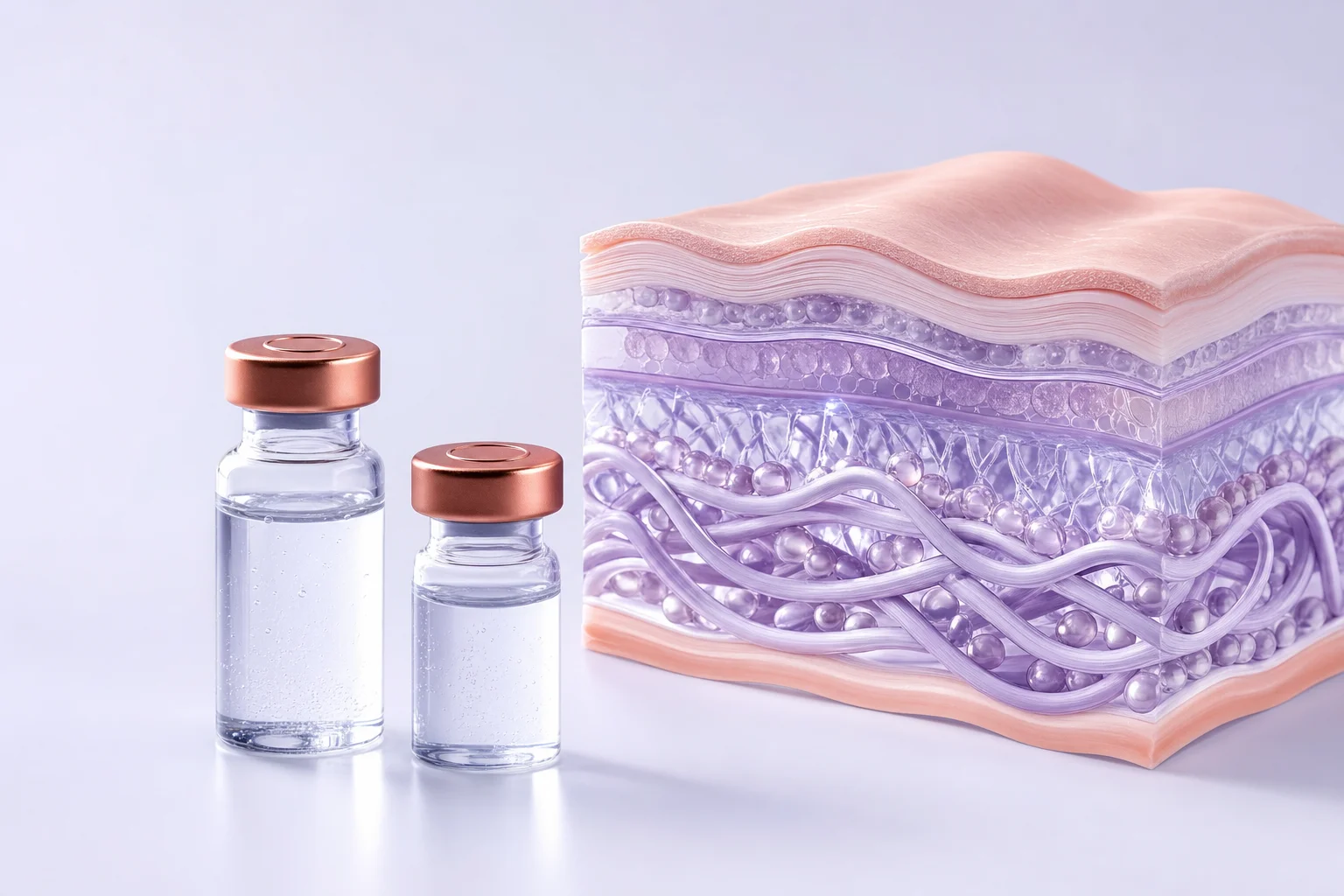
If you've gone looking for peptides that genuinely help skin rather than just sounding impressive on a label, these two keep surfacing. GHK-Cu is the copper peptide that skincare enthusiasts talk about with real enthusiasm, and Matrixyl is the quiet ingredient already sitting in a huge number of anti-aging serums. Both are studied for firmer, smoother, better-supported skin, but they go about it differently enough that the right pick depends on what you want from your routine.
What GHK-Cu and Matrixyl have in common
Both are peptides that signal skin cells to ramp up collagen and other structural proteins, the scaffolding that keeps skin firm and resilient and that naturally declines with age. Both are used topically in skincare, both are aimed at the same broad goals of reducing the look of fine lines and improving texture and firmness, and both have more research behind them than most ingredients marketed for skin. That overlap is why they end up on the same shortlist.
How GHK-Cu works
GHK-Cu is a copper tripeptide, a small naturally occurring molecule (three amino acids) bound to a copper ion. Levels of it in the body fall as we age. In research it acts as something of a repair signal: it supports collagen and elastin production, has antioxidant activity, and is studied for wound healing as well as cosmetic skin improvement. The copper it carries is part of its function, not just a passenger. GHK-Cu shows up both in topical skincare and, in the research-compound world, in injectable form, which gives it a wider footprint than a purely cosmetic ingredient.
How Matrixyl works
Matrixyl is a brand name for a family of cosmetic peptides, most often palmitoyl pentapeptide-4 and the popular Matrixyl 3000 blend. It works as a messenger: it signals skin to produce more collagen by mimicking a fragment that appears when collagen breaks down, essentially prompting the skin to repair as if it needs to rebuild. It is purely a topical cosmetic ingredient, with a long track record of being formulated into serums and creams, and it's known for being gentle and well tolerated by most skin types.
Key differences
The biggest practical difference is scope. Matrixyl lives entirely in the world of topical skincare, where it's a proven, stable, easygoing performer. GHK-Cu spans both topical skincare and research-grade injectable use, and it's a more biologically active molecule with effects, like wound healing and antioxidant activity, that reach beyond the cosmetic. If your interest is strictly a serum on your face, both qualify; if you're curious about peptides as broader skin-repair compounds, GHK-Cu is the one with that wider story.
Formulation friendliness is the second difference, and it matters more than it sounds. Matrixyl plays well with almost everything in a routine, which is part of why it's so widely used. GHK-Cu, because of its copper, can be trickier to combine: it's often advised to separate it from strong direct-acid vitamin C and a few other actives, since they can interfere with each other. Matrixyl asks less of you in building a routine.
Then there's the regulatory and evidence picture. Matrixyl is a long-established cosmetic ingredient, used in countless over-the-counter products under standard cosmetic regulation. GHK-Cu is also used in approved cosmetics topically, but its injectable research-compound form is not approved for human use and sits in the same unregulated space as the rest of this site's peptides. The strength of evidence for visible skin benefit from topical use is reasonable for both, while keeping in mind that cosmetic results are generally modest and gradual rather than dramatic.
| GHK-Cu | Matrixyl | |
|---|---|---|
| What it is | Copper tripeptide | Cosmetic signal peptide |
| Main action | Repair, collagen, antioxidant | Signals collagen production |
| How it's used | Topical and injectable (research) | Topical only |
| Routine friendliness | Separate from some actives | Plays well with most |
| Regulatory status | Cosmetic use; injectable unapproved | Established cosmetic ingredient |
| Best for | Broader skin repair interest | An easy, reliable serum |
Bottom line
Matrixyl is the better choice for most people who simply want an effective, low-fuss anti-aging serum ingredient. It's gentle, stable, easy to layer with the rest of a routine, and backed by a long cosmetic track record. If you want something that quietly supports collagen without complicating your shelf, this is the practical pick.
GHK-Cu appeals to people drawn to its broader repair profile and its copper-driven activity, and who don't mind being a little more careful about what they pair it with. As a topical it's a strong, well-regarded option; as an injectable research compound it carries the same unapproved, source-quality caveats as everything else in that category. Choose it if the wider skin-repair story is what interests you, and keep the formulation quirks in mind.
Where to go from here
For the broader context on peptides and skin aging, including which approaches the research actually supports, the guide on peptides and women's health is a useful next read. If you're weighing GHK-Cu against another anti-aging peptide, see Epitalon vs. GHK-Cu. To compare per-milligram pricing across vendors, the Peptide Price Lab tool tracks the research market in one place.