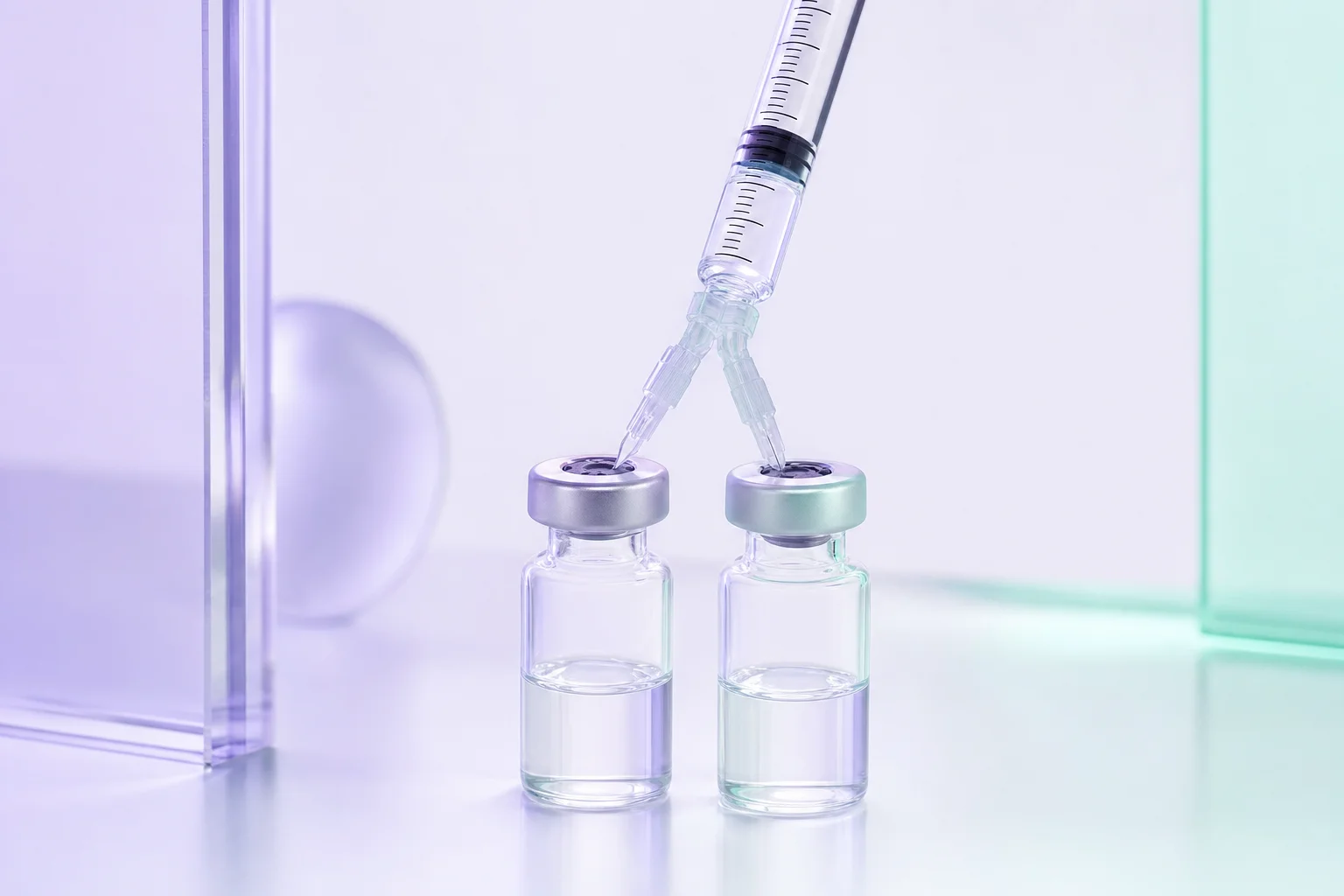
Say your protocol calls for TB-500 and BPC-157 at the same time. You have two separate vials. Do you have to inject twice? Usually, no. Most commonly researched peptide combinations can be drawn into the same syringe without issue. But "usually" matters here, and it takes about two minutes to understand why.
The short answer
Two peptides can share a syringe when they are compatible. Compatibility comes down to three things: they are reconstituted in the same type of solvent, they are stable at the same pH range, and there is no known chemical interaction between them. When all three are true, combining them is straightforward.
The TB-500 and BPC-157 pairing you mentioned checks all three boxes. Both are typically reconstituted in bacteriostatic water (BAC water), both are stable in the same pH range, and no known incompatibility exists between them. This is one of the most frequently researched pairings, and combining them in one syringe is standard practice for researchers running both.
Other common pairings follow the same logic. CJC-1295 and Ipamorelin, for example, are also both reconstituted in BAC water with no known incompatibility. Same principle applies.
What to check before you combine
Before drawing two peptides into the same syringe, confirm these four things:
- Same solvent. If both peptides were reconstituted with bacteriostatic water, you are aligned. If one used sterile water and the other used BAC water, you are mixing different preservative chemistry. It usually will not cause harm, but it is an unnecessary variable. Stick to matching solvents when possible.
- No known incompatibility. Most research peptides have no published incompatibility data with each other. That absence is not a green light, but for commonly paired peptides, years of documented research experience exists and is worth noting.
- Both solutions are clear. If either reconstituted peptide is cloudy, discolored, or has visible particles, that is a signal something is off with that vial before you even think about combining it.
- Your volumes fit the syringe. Insulin syringes hold 0.3 to 1 mL depending on the barrel. Make sure your combined volume fits before you start drawing.
How to draw two peptides into one syringe
The process is simple. The one rule worth remembering: draw the smaller volume first.
Here is why that order matters. If you draw the smaller dose first and then draw the larger dose into the same syringe, any tiny trace of the first peptide that gets carried back into the second vial is negligible. If you do it the other way, you risk introducing a larger amount of the second peptide into the first vial, which contaminates it for future use.
Step by step:
- Reconstitute both peptides separately and let each vial sit until fully dissolved. Do not rush this step.
- Draw the smaller dose from vial one into your syringe first.
- Without replacing the needle, insert into vial two and draw the second dose. The two solutions mix in the barrel.
- Inject as normal.
Some researchers prefer to use a fresh needle between vials to avoid any trace cross-contamination of the vials themselves. This is a reasonable precaution, particularly if you want to keep both vials completely clean for the duration of a longer research period.
When to keep them separate
There are situations where two separate syringes are the right call.
Different reconstitution solvents. If one peptide required acetic acid solution (some peptides in the growth hormone-stimulating family and certain others are reconstituted this way) and another is in BAC water, mixing them changes the chemistry of both solutions. Keep those separate.
A reaction occurs when they meet. If the solution turns cloudy, changes color, or forms any visible particles when combined in the syringe, that is a sign of incompatibility. Stop, draw a separate syringe for each, and note the combination for future reference.
You are working with a less common pairing. For well-researched combinations, documented experience exists. For something more unusual, it is worth researching that specific pair before combining. Two injections is never the wrong choice when you are uncertain.
A note on pre-blends
Some suppliers sell pre-blended vials that contain two peptides already combined at a fixed ratio. A TB-500 + BPC-157 blend is a common example. Pre-blends eliminate the two-vial draw entirely, but they lock you into a specific ratio. If your protocol calls for a different ratio than what the blend provides, you will need to source them separately anyway. Drawing from separate vials gives you full control over the dose of each.
Where to go from here
If you are still getting comfortable with reconstituting peptides, the guide on reconstituting peptides with BAC water walks through the math and process from the beginning.
If you want to understand why TB-500 and BPC-157 are such a common research pairing, the research notes on BPC-157 and TB-500 cover what each peptide is being studied for and why researchers often run them together.