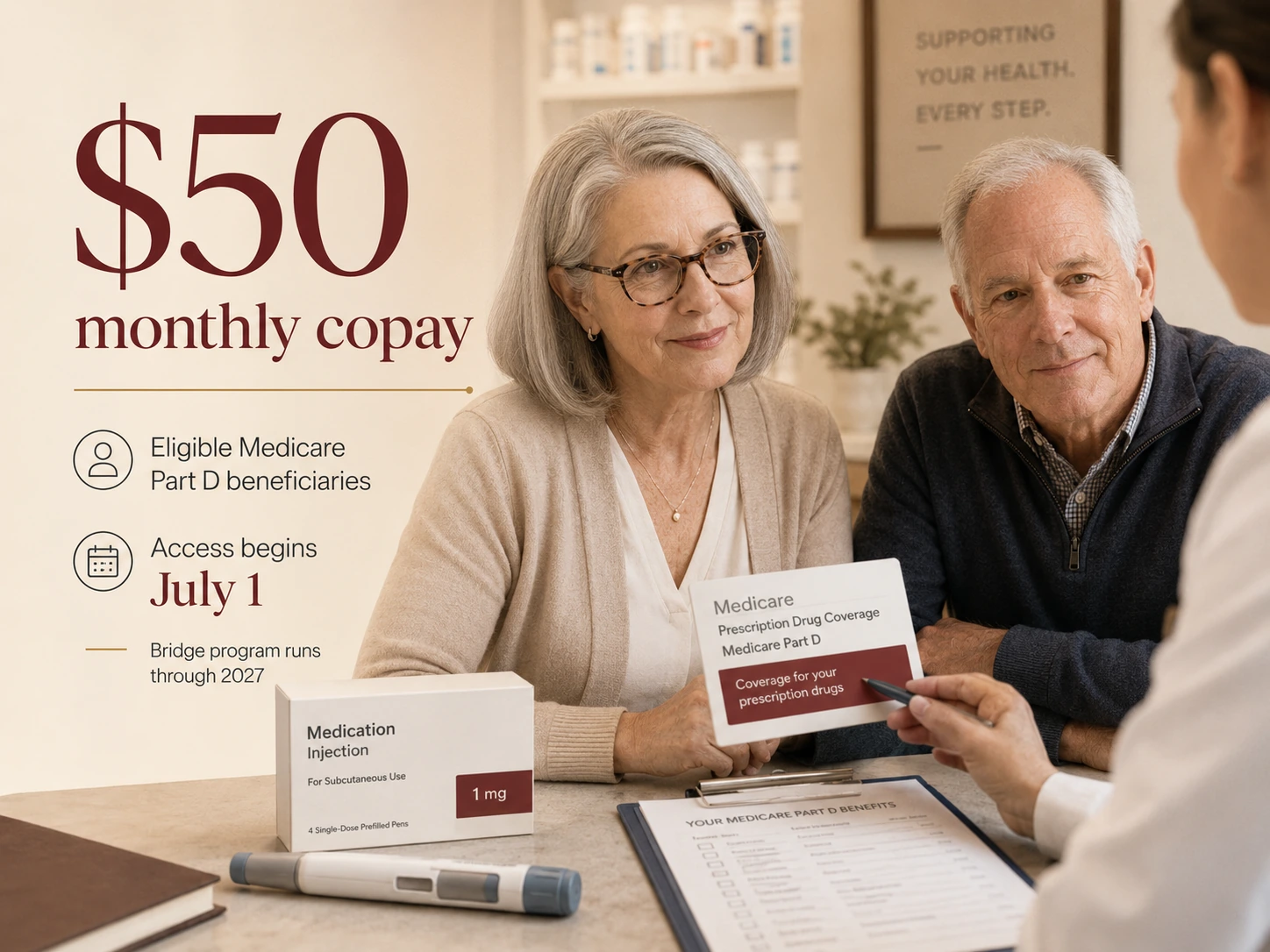
The program is called the Medicare GLP-1 Bridge, announced by the Centers for Medicare & Medicaid Services on May 6 and framed by CMS Administrator Dr. Mehmet Oz as a fix for seniors priced out of "a major medical advancement." It runs as a temporary demonstration from July 1, 2026 through December 31, 2027, and the $50 copay is the beneficiary's total out-of-pocket cost — though additional coupons or discounts cannot be stacked on top of it.
Who qualifies
This is not a blanket benefit. Beneficiaries must be enrolled in a standalone Part D plan or a Medicare Advantage plan with drug coverage, and must meet prior-authorization criteria in one of three tiers: a BMI of 35 or higher; a BMI of 30 or higher plus heart failure, uncontrolled hypertension, or chronic kidney disease; or a BMI of 27 or higher plus pre-diabetes, a previous heart attack, a previous stroke, or symptomatic peripheral artery disease. Clinical criteria are assessed as of when GLP-1 therapy was first started, so people already on therapy before July 1 can qualify.
Covered products are Wegovy (injection and tablets), Zepbound, and Foundayo, when prescribed to reduce excess body weight. Humana will run prior authorization and claims as CMS's central processor, outside the normal Part D payment flow.
One important correction to the headlines
Some early coverage described this as a Medicare and Medicaid program. The $50 Bridge is Medicare-only. A separate demonstration — the BALANCE Model, which is intended to bring GLP-1 coverage to Medicare Part D and give state Medicaid programs a path to join — has been pushed back, with the Medicare portion delayed indefinitely according to KFF's analysis. The Bridge was extended through the end of 2027 to fill that gap. Medicaid coverage of GLP-1s for obesity remains a state-by-state option, and only about 13 states currently offer it.
The price math
For readers who track cost per milligram, the comparison is stark. Manufacturer direct-to-consumer channels — LillyDirect for Zepbound and NovoCare for Wegovy — currently put cash prices for most doses in roughly the $350–$500 per month range, and that was already considered a major discount from list prices near $1,000. At $50 a month, an eligible Medicare beneficiary pays roughly 85–90% less than the prevailing cash price for the identical FDA-approved product, with the dose strength no longer affecting what they pay.
It also lands in the same window as the FDA's proposal to close the door on compounded semaglutide and tirzepatide. As brand-name access gets cheaper through official channels — TrumpRx discounts, direct-purchase programs, and now the Bridge — the practical case for gray-market alternatives keeps narrowing, at least for the populations these programs reach.
What to watch
CMS says additional beneficiary guidance is coming before the July 1 launch, and pharmacies are still waiting on claims-process instructions. The demonstration's fate after 2027 likely depends on whether the BALANCE Model is revived. We'll update this story as implementation details land.
Sources
- 1. CMS Press Release: "Coming Soon — CMS to Provide $50 Monthly Access to GLP-1 Medications for Medicare Beneficiaries" (May 6, 2026). cms.gov
- 2. CMS: Medicare GLP-1 Bridge program page. cms.gov
- 3. KFF: "What to Know About the BALANCE Model for GLP-1s in Medicare and Medicaid and the Medicare GLP-1 Bridge" (updated May 11, 2026). kff.org
- 4. Sheppard Mullin Healthcare Law Blog: "Medicare's $50 Per Month GLP-1 Bridge — What You Need to Know" (May 15, 2026). sheppard.com