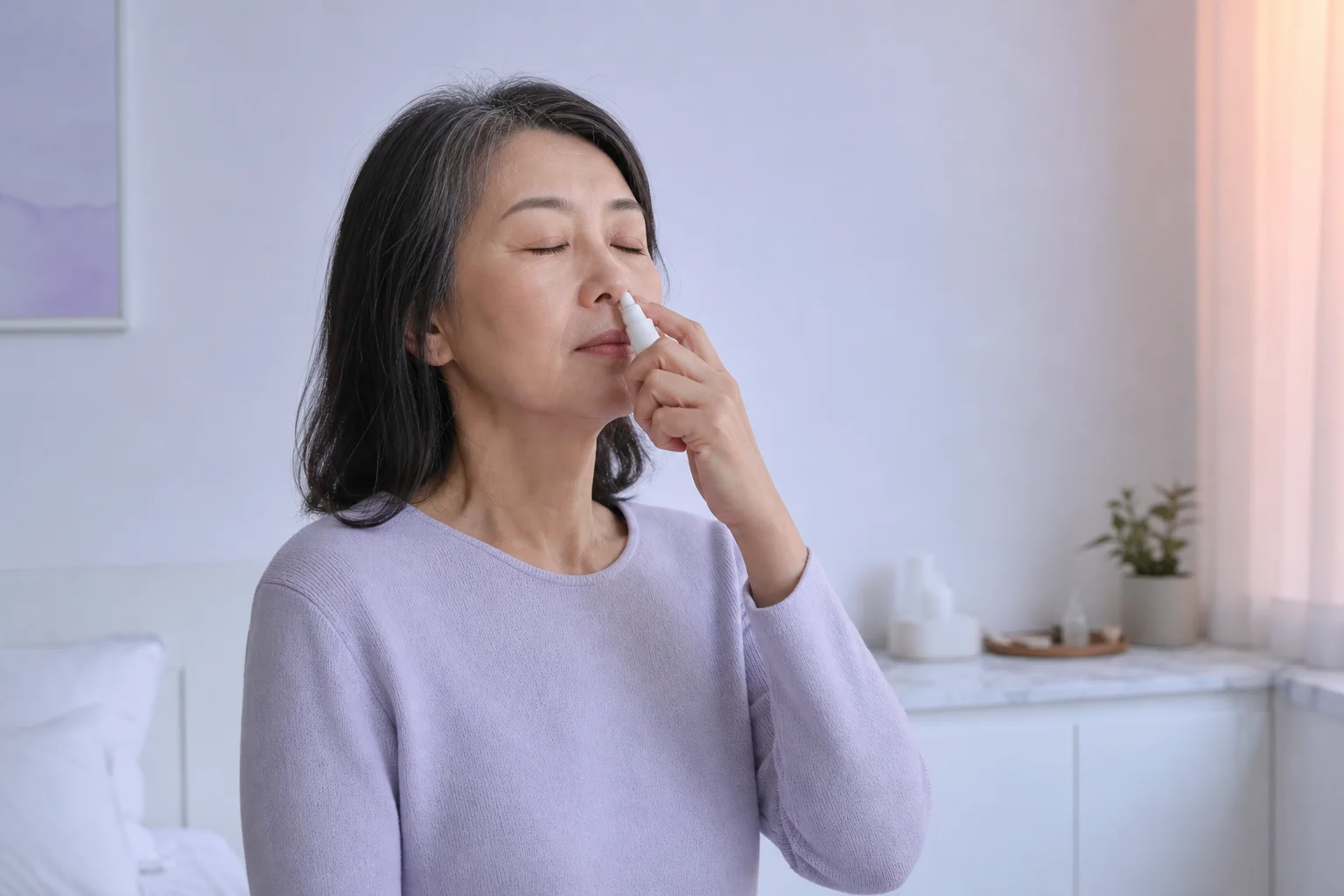
Selank is unusual on this site in a way that's easy to miss: it isn't a research chemical looking for evidence, it's an approved medicine in Russia, sold in pharmacies there as a nasal spray for anxiety. That approval is real and it's a higher bar than almost anything else here clears. It also comes with a catch most vendor pages skip, which is that the approval, the human study and the dosing all belong to the nasal spray, and what research vendors sell you is powder for injection.
Vial size isn't part of what follows, since the amount of bacteriostatic water you add sets your concentration either way. Our reconstitution calculator handles that math for whatever vial and target amount you're working with.
What it is
Selank is a short synthetic peptide, seven amino acids long, built by Russian researchers from tuftsin, a fragment of an antibody the immune system makes. Natural tuftsin falls apart quickly; the additions on selank were made to hold it together and let it reach the brain.
What it's for is anxiety, and the interesting part of its profile is what it doesn't do. Benzodiazepines work well and carry sedation, tolerance and a withdrawal problem. The animal work on selank describes an anxiety-reducing effect of a similar size without the sedation, and without the tolerance that builds over repeated use. That is the entire claim, and it's why the compound exists.
It was developed at a Moscow institute and approved by the Russian health ministry as a nasal spray. It has no FDA or European approval, and the powder sold by research vendors isn't the approved product.
What people use it for
Anxiety, mostly, and specifically the everyday kind rather than a diagnosed disorder: the low hum that makes it hard to settle, the 4am spin, the sense of being braced against nothing in particular. That's what people describe reaching for it for, and it's close to what the research actually looked at.
A second, quieter reason is that it doesn't sedate. For anyone who has tried something for anxiety and lost their afternoon to it, a compound described as taking the edge off without the fog is a specific and appealing proposition. Whether it delivers that in a given person is another question, but it is what the pharmacology predicts rather than a marketing invention.
Interest in memory and focus exists too and is much thinner, resting on animal work about a growth factor in the brain. That's the thread semax owns more convincingly, and people wanting focus rather than calm usually end up there instead.
Formulations
Two forms, and which one you have changes what the evidence is worth to you.
The nasal spray is the approved Russian product, a dilute solution dosed in drops per nostril. This is the form the human research used and the form the approval covers.
Lyophilized powder is what most research vendors we track sell. Across them 10 mg vials dominate, with 5 mg the common alternative and a long tail of larger sizes. The powder is reconstituted and injected subcutaneously, or mixed into a nasal spray bottle at home.
Ready-made research nasal sprays are carried by a smaller number of vendors and arrive already in solution, advertised by the total milligrams in the bottle. They're the closest thing on the open market to the approved route, with two catches: the per-spray dose is usually nowhere on the listing, and some are a modified version of the molecule rather than selank itself. Both are worked through in the dosing section.
That gap is worth sitting with for a second. The compound has real evidence behind it, and the evidence is for a route and a product that isn't the one arriving in the post. Injection is well established in the animal work, so it isn't unreasonable, it just isn't the thing that got approved.
Dosing protocols
Selank is one of the few compounds here where a dosing figure traces to a product a regulator approved, rather than to the market talking to itself. The table keeps the routes separate, because the amounts don't transfer cleanly between them.
See the Selank research notes for the research behind these figures.
| Pattern | Amount | How often | Where it comes from |
|---|---|---|---|
| The approved nasal product | Drops of a dilute solution | Daily, in divided doses, for a course of 10 to 14 days | The Russian approved product's own labelling, and the form the one published human study used. The short defined course is the part worth carrying across, more than the number. |
| Injected, most commonly referenced | 250–500 mcg | Once daily | The research-vial convention, repeated across vendor education pages, with no named clinician behind it. |
| Split through the day | 150–250 mcg | Two or three times daily | Describes the same daily total spread out, mirroring how the nasal product is taken. No source establishes a difference. |
| Ready-made nasal spray | Depends entirely on the bottle | One or two sprays, once or twice daily | Sold by total milligrams, with the per-spray amount rarely stated. Work it out from the fill volume before using it, with the arithmetic below. |
| Home-mixed nasal | Not established | — | Powder mixed into an empty spray bottle. The concentration is whatever you made it and the absorbed fraction is unmeasured, so neither the injected nor the ready-made figures carry across. |
Injected patterns above are subcutaneous.
Working out what's in a nasal spray, and what's actually in the bottle
Ready-made selank sprays exist and are advertised by the total milligrams loaded in, almost never by the dose per push. The arithmetic is simple once you have two numbers: per-spray dose = total milligrams ÷ number of sprays, and a standard nasal pump gives about ten sprays per millilitre, so an 8 mL bottle is roughly 80 sprays and a 30 mL bottle roughly 300. A 40 mg spray in an 8 mL bottle is about 500 mcg a push; the same 40 mg in 30 mL is about 133. Same label, nearly four times the difference. Ask the vendor for the fill volume if the listing doesn't say.
Check the molecule as well as the milligrams. Some sprays sold as selank are N-Acetyl Selank Amidate, a modified version built to resist breakdown and cross into the brain more readily. It's a reasonable modification and it is not the compound the Russian approval or the human study covers, so amounts and expectations from plain selank don't transfer to it unexamined. The same applies to semax, where the modified version is even more common.
The course is the part that transfers
What the approved product establishes most usefully isn't a microgram figure, it's a shape: a short defined course of about ten days to a fortnight, rather than something taken indefinitely. That shape survives the change of route, and it's the piece of this protocol with the most behind it.
It also happens to line up with what you can buy. At 300 mcg daily a fortnight's course uses 4.2 mg, so a 5 mg vial is almost exactly one course, and the 10 mg vials most vendors push are two. That's a rare case of the market's default sizing matching the protocol rather than fighting it.
How much to reconstitute at once. A reconstituted vial keeps about 28 days refrigerated, and at 300 mcg daily that window only reaches 8.4 mg, so a 10 mg vial slightly overshoots it while a 5 mg vial is comfortably inside. Working example: 5 mg into 2 mL of bacteriostatic water gives 2,500 mcg per mL, so 300 mcg is 300 divided by 2,500, times 100, which is 12 units on a standard U-100 insulin syringe, and 250 mcg is 10 units. See how much to reconstitute at once for the general math.
Cycling guidelines
A course of ten to fourteen days, then a break, is the pattern described everywhere, and unusually for this site it comes from the approved product rather than from convention. Courses are described as repeatable after a gap of a few weeks.
The reasoning for not running it continuously is worth knowing because it's the opposite of the usual one. With most compounds the worry is tolerance. Here the animal work specifically suggests tolerance doesn't build the way it does with the benzodiazepines selank is measured against, so the short course isn't a defence against that. It's simply how the product was studied and approved, and nobody has tested what happens beyond it.
Signs a course is commonly stopped or reconsidered:
- Drowsiness or a flattened, blunted feeling, which is the opposite of the effect people come for
- Irritability or low mood appearing over a course
- Nasal irritation, where a home-mixed spray is being used
- A fortnight with no change, which is the point the convention itself suggests stopping and reassessing
Stacking
Most commonly paired stack: Selank with Semax.
Rationale: they come from the same Russian research programme and are treated as a matched pair, one for calm and one for focus. The argument is that they address opposite halves of the same bad day, and that neither sedates.
Protocol as run: semax in the morning for focus, selank later in the day or in the evening for the settling effect, each on its own short course. They're sold premixed as well, which fixes the ratio and the timing together and takes away the main reason to run them as a pair.
Lighter stacks: pinealon and cartalax come up from the same family of short Russian peptides. Where sleep is the actual problem rather than daytime anxiety, DSIP appears, though its own record is weak enough that selank is the better-supported half of that pairing by a distance.
Combinations to approach carefully: anything else acting on the same calming system, including benzodiazepines and alcohol. The animal work found selank increased the effect of a benzodiazepine rather than merely sitting alongside it, which is exactly the kind of interaction worth taking seriously, and nobody has studied it in a person.
Expected results timeline
First few days: where people report anything, it's early, within the first two or three days. The effect is described as a lowering of the background hum rather than anything dramatic, and people often notice it in hindsight, by realising something that would normally have bothered them didn't.
Across a course: reports settle into either that modest steadying continuing, or nothing. Ten to fourteen days is long enough to know.
After the course: the effect is generally described as fading over the following weeks rather than stopping abruptly, which is part of why courses are described as repeatable.
What to expect realistically: the human evidence here is one study, in Russian, comparing selank against a benzodiazepine in people with anxiety disorders and finding the two comparable with fewer side effects from selank. That is a genuinely encouraging result and it is also a single study, published in one language, that no one outside that research programme has repeated. Treat it as the reason to be interested rather than as a settled finding, and remember it was testing the nasal spray.
Administration technique
- The lyophilized powder is reconstituted with bacteriostatic water, at a concentration set by the reconstitution calculator for the target amount.
- The solution is swirled gently to dissolve rather than shaken, since agitation can degrade the peptide.
- The calculated volume is drawn into an insulin syringe, which at 10 to 12 units is the only thing that measures this accurately.
- A subcutaneous site is chosen, commonly the abdomen, with sites rotated day to day.
- The skin is pinched and the injection given at roughly a 45-degree angle.
- Timing is unconstrained, unlike the growth hormone compounds: there's no meal or sleep dependency here, and people place the dose wherever the anxiety actually sits in their day.
- Where a home-mixed nasal spray is used instead, be aware that the absorbed fraction is unknown, so it isn't a like-for-like substitution for an injected amount.
Side effects and safety
Common: very little is reported, and the tolerability is the compound's strongest suit. Where anything comes up it's drowsiness, mild headache, or nasal irritation from a home-mixed spray.
Less common: a flattened or blunted feeling, and low mood over a course. Both are described infrequently and both are reasons people stop.
What we know, unusually: the approved product has been in use in Russia for years, which is a real body of experience even though it isn't published in a form most people here can read. The one comparative human study found fewer side effects than the benzodiazepine it was measured against.
What we don't know: essentially everything about the injected route in people, since the human work used the nasal spray. Long-run use beyond repeated short courses hasn't been studied. And the research literature is concentrated in one country and one research programme, which is a narrower base than a compound with an approval usually rests on.
Contraindications: pregnancy, breastfeeding and use in minors have no basis here. Anyone taking a benzodiazepine or other prescribed anxiety medication is in the interaction described below rather than a simple addition.
Drug interactions: the animal work found selank amplified a benzodiazepine's effect. Alcohol falls in the same category on general grounds. Neither combination has been studied in a person, and both are worth genuine caution rather than a shrug.
Selank vs. Semax
Semax is the natural comparison and the two are almost always discussed together: same country, same era, same nasal-spray format, opposite jobs.
| Selank | Semax | |
|---|---|---|
| What it's for | Calm. Anxiety without sedation | Focus, attention and recovery of function after injury |
| Derived from | Tuftsin, an immune fragment | A fragment of a stress-axis hormone |
| Approval | Approved in Russia as a nasal spray for anxiety | Approved in Russia, with a broader set of indications |
| Human evidence | One published comparative study, in Russian | More published human work, also concentrated in Russia |
| When it's taken | Placed wherever the anxiety sits, often later in the day | Morning, since it's the stimulating half of the pair |
Choose selank if: the problem is being wound up rather than being unfocused, and you want the option with an anxiety approval specifically behind it.
Choose semax if: attention and mental stamina are the target, and you'd rather have the compound with the deeper human record even though it's from the same narrow source.
Running both: this is the common pairing, semax in the morning and selank later. See the semax guide and protocols for its own dosing.
Storage and handling
Lyophilized powder: refrigerate at 2 to 8°C and protect from light. Kept frozen, the unreconstituted powder is commonly described as stable considerably longer, which is the practical answer to a 10 mg vial that outlasts its own reconstituted window. Take lot-specific stability from the vendor's certificate of analysis.
Reconstituted solution: refrigerate and use within about 28 days. Vendors sometimes quote 30 days for this compound; the difference is immaterial at the amounts described here.
A home-mixed nasal spray sits in a bottle that gets opened repeatedly and is generally treated as shorter-lived than a sealed vial. There's no established figure for it.
Signs of degradation:
- Cloudiness or visible particles in a solution that was previously clear
- Discoloration of the powder or the reconstituted liquid
- Powder that has clumped or gone sticky, which usually means moisture reached it
FAQ
Is it actually approved somewhere? Yes, in Russia, as a nasal spray for anxiety. Not by the FDA or in Europe, and the approval covers the spray rather than the powder vendors sell.
How much do people run? 250 to 500 mcg daily injected is the circulating convention, often split across the day. The approved product is dosed as drops of a dilute solution instead.
How long is a course? Ten to fourteen days, then a break, repeatable after a few weeks. That shape comes from the approved product and is the best-supported part of the protocol.
Will it make me sleepy? It isn't meant to, and the absence of sedation is the whole argument for it over a benzodiazepine. Drowsiness is reported occasionally and is a reason people stop.
Can I use it as a nasal spray? Ready-made sprays are sold, and people also mix the powder into a spray bottle themselves. For a ready-made one, work out the per-spray dose by dividing total milligrams by the number of sprays, reckoning about ten sprays per millilitre of fill. For a home-mixed one, nobody has measured the absorbed fraction, so the injected amounts don't transfer.
Is a selank spray always selank? Not always. Some are N-Acetyl Selank Amidate, a modified version made to last longer and reach the brain more readily. It's a sensible modification, but it isn't what the approval or the human study covers.
Is it safe with my anxiety medication? The animal work found it amplified a benzodiazepine rather than just adding to it. That combination hasn't been studied in people and deserves real caution.
Selank or semax? Selank for calm, semax for focus. Many people run both, semax in the morning and selank later.
Which vial should I buy? A 5 mg vial is close to a single fortnight course at 300 mcg daily, and fits inside the 28-day reconstituted window. A 10 mg vial is two courses and slightly overshoots that window.
Bottom line
Key dosing takeaways:
- 250 to 500 mcg daily is the injected convention, often split through the day, with no named source behind the figure
- The ten-to-fourteen-day course comes from the approved product and is the best-supported part of this protocol, more than any microgram figure
- The evidence belongs to the nasal spray; the injectable powder is the improvised version, reasonable but not the thing that was approved
Best practices:
- Buying a 5 mg vial for a single course rather than a 10 mg vial that outlasts its own 28-day window
- Running a defined course with a decision at the end, rather than taking it indefinitely
- Treating any combination with a prescribed anxiety medication as a real interaction rather than an addition
Works best for people who:
- Want something for everyday anxiety that isn't meant to sedate
- Value having an actual approval behind a compound, and can hold that it's an approval in one country for a different product
- Are willing to run it as a short course and stop
Selank is sold here for research, the human evidence is a single study in one language, and it tested a form you probably aren't buying. You already know that. You're an adult making an informed call about your own body, and that's yours to make.
Sources
- Medvedev VE, Tereshchenko ON, Israelian AIu, et al. [A comparison of the anxiolytic effect and tolerability of selank and phenazepam in the treatment of anxiety disorders]. Zhurnal nevrologii i psikhiatrii imeni S.S. Korsakova. 2014;114. The single published human study referenced throughout this page, comparing the nasal product against a benzodiazepine. PubMed ↗
- Kasian A, Kolomin T, Andreeva L, et al. Peptide Selank Enhances the Effect of Diazepam in Reducing Anxiety in Unpredictable Chronic Mild Stress Conditions in Rats. Behavioural Neurology. 2017;2017. The source of the interaction caution above: selank amplified a benzodiazepine rather than simply adding to it. PubMed ↗
- Filatova E, Kasian A, Kolomin T, et al. GABA, Selank, and Olanzapine Affect the Expression of Genes Involved in GABAergic Neurotransmission in IMR-32 Cells. Frontiers in Pharmacology. 2017;8. The proposed molecular basis for the calming effect. PubMed ↗
- Kolik LG, Nadorova AV, Antipova TA, et al. Selank, Peptide Analogue of Tuftsin, Protects Against Ethanol-Induced Memory Impairment by Regulating of BDNF Content in the Hippocampus and Prefrontal Cortex in Rats. Bulletin of Experimental Biology and Medicine. 2019;167. The animal work behind the memory thread mentioned above. PubMed ↗