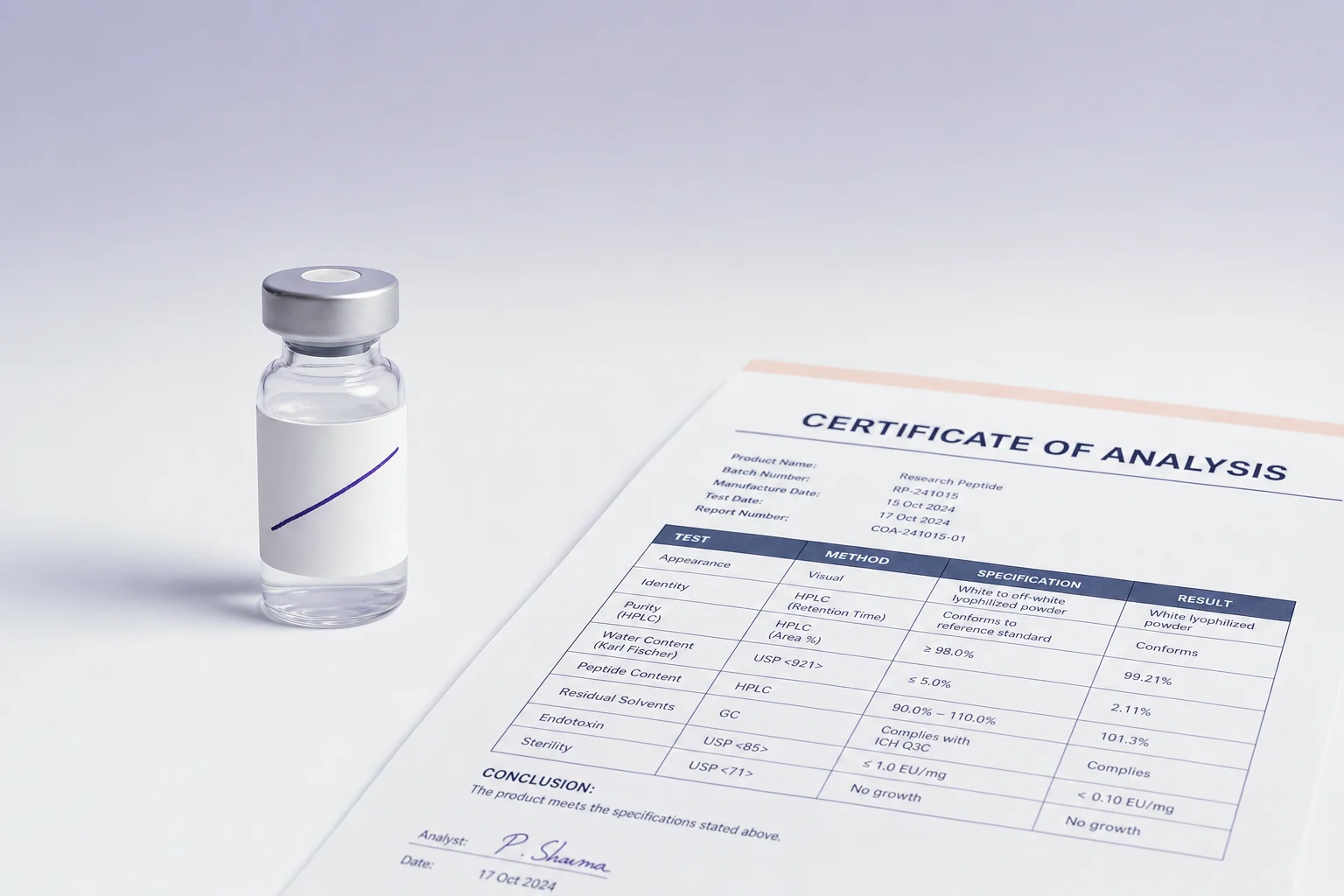
Vendors are dropping recognizable compound names, even informal shorthand like "GLP-2," in favor of invented house names ("pp-2T," "X-2," "Perfect T"). The real compound identity now lives in the Certificate of Analysis, if it shows up anywhere at all. This is a deliberate response to FDA enforcement, payment processor keyword blacklisting, and pharmaceutical company lawsuits, all of which get triggered more easily by an explicit compound name than by an opaque house label. What that means for you is simple. The COA isn't just a quality check anymore, it's the only thing standing between you and a guess.
How the labels quietly changed
If you're a woman comparing GLP-1 vendors right now, you've probably felt this shift firsthand even if you couldn't name it. A few years ago, vendor listings were straightforward. Search for tirzepatide, find "Tirzepatide 10mg." By 2024, a lot of vendors had shifted to informal shorthand, "GLP-2" or "GLP-2 T," which wasn't a real medical term but at least pointed you in the right direction. By 2025 and into 2026, plenty of vendors dropped even that. Now you'll see "pp-2T" or "Perfect T" or a house brand name with a letter tacked on, and the actual compound never appears in the listing at all. It's living in the COA now, assuming the COA is real and not just an in-house PDF.
| Era | Listing Name | How to Verify |
|---|---|---|
| 2023–2024 | Tirzepatide 10mg | COA confirms |
| 2024 | "GLP-2" or "GLP-2 T" | COA confirms |
| 2025–2026 | "pp-2T," "X-2," "[brand]-T" | COA only, the listing gives you nothing |
Why this is happening (and it's not about you)
A few pressure vectors converged on the research peptide market in 2025 at once, and every one of them hits harder when a compound name is sitting right there on the product page.
FDA enforcement went from letters to raids. In December 2024, the FDA issued warning letters to at least four peptide vendors, Xcel Peptides, SwissChems, Summit Research, and Prime Peptides, specifically for listing semaglutide, tirzepatide, and retatrutide by name while marketing them for human use. The agency also started using automated tools to scrape vendor websites for compound names. By June 2025, enforcement escalated from warning letters to physical warehouse raids. Amino Asylum got hit that month and was forced offline overnight. The pattern is plain. A visible compound name creates targeting exposure, and an obfuscated house name reduces it.
Payment processors are blocking on keywords. Stripe, PayPal, and Square routinely freeze accounts tied to peptide sales, especially anything connected to GLP-1 compounds, and the screening is largely automated and keyword-based. A listing that says "Tirzepatide 10mg" triggers account review far faster than one that says "pp-2T." Vendors who switched to house names were buying themselves time with their own payment processors.
Pharmaceutical companies are suing. Eli Lilly filed federal lawsuits against telehealth companies distributing tirzepatide in April 2025. Novo Nordisk followed with suits against 14 semaglutide distributors that August. Using a compound's actual name, or a widely recognized shorthand, leaves a paper trail for trademark and IP claims. A product called "pp-2T" is a lot harder to name in a trademark infringement filing than one plainly labeled "Tirzepatide (Mounjaro)."
The compounding loophole closed. The FDA's drug shortage designation for semaglutide and tirzepatide ended in 2025. Once that happened, "research use only" became the main legal argument left standing for vendors still selling these compounds, and naming the compound prominently undercuts that argument directly. A house name buys a thin layer of deniability.
Is this actually deliberate?
Almost certainly, for most vendors who've made the switch. The structure is too clean to be accidental. The listing carries a vague house name with no compound reference anywhere, while the COA identifies the real compound and its purity. Automated screening, FDA scraping, payment processor keyword matching, pharma company crawlers, never sees the listing itself. Buyers who actually check the COA can still get a straight answer. It's a rational move in an adversarial environment. The COA exists as a legitimate quality-assurance document, which gives vendors real cover for putting the compound identity there and nowhere else.
What this changes for you
The COA was already the right way to verify what you're buying. What's different now is that it's the only way. A 2023 listing that said "GLP-2" still gave you a strong informal signal. A 2026 listing that says "pp-2T" gives you almost nothing to work with on its own.
Here's the practical part. If a vendor's COA is in-house only, missing, or vague about compound identity, there's no backup plan, the listing certainly won't save you. A third-party lab COA that names the compound and confirms purity matters more now than it did a couple of years ago. A COA from a recognized lab like Janoshik, one you can actually verify against their public database, is the gold standard. An in-house PDF with no verifiable test number was never good enough, it's just more dangerous now that the listing itself gives you nothing to fall back on.
A missing or unverifiable COA has always been a red flag. In this naming environment, it's a dealbreaker, full stop.