Why sourcing matters more than anything else
Before you think about dose, timing, or protocol, there is a more fundamental question: what is actually in the vial? Research peptides are sold outside the pharmaceutical supply chain. There is no FDA oversight of the manufacturing process, no standardized labeling requirements, and no mandatory testing. That means quality is entirely vendor-dependent, and vendor quality varies from excellent to genuinely dangerous.
This is not a reason to avoid researching peptides. It is a reason to spend real time evaluating where they come from. The rest of this guide explains how to do that.
The document that matters: certificate of analysis
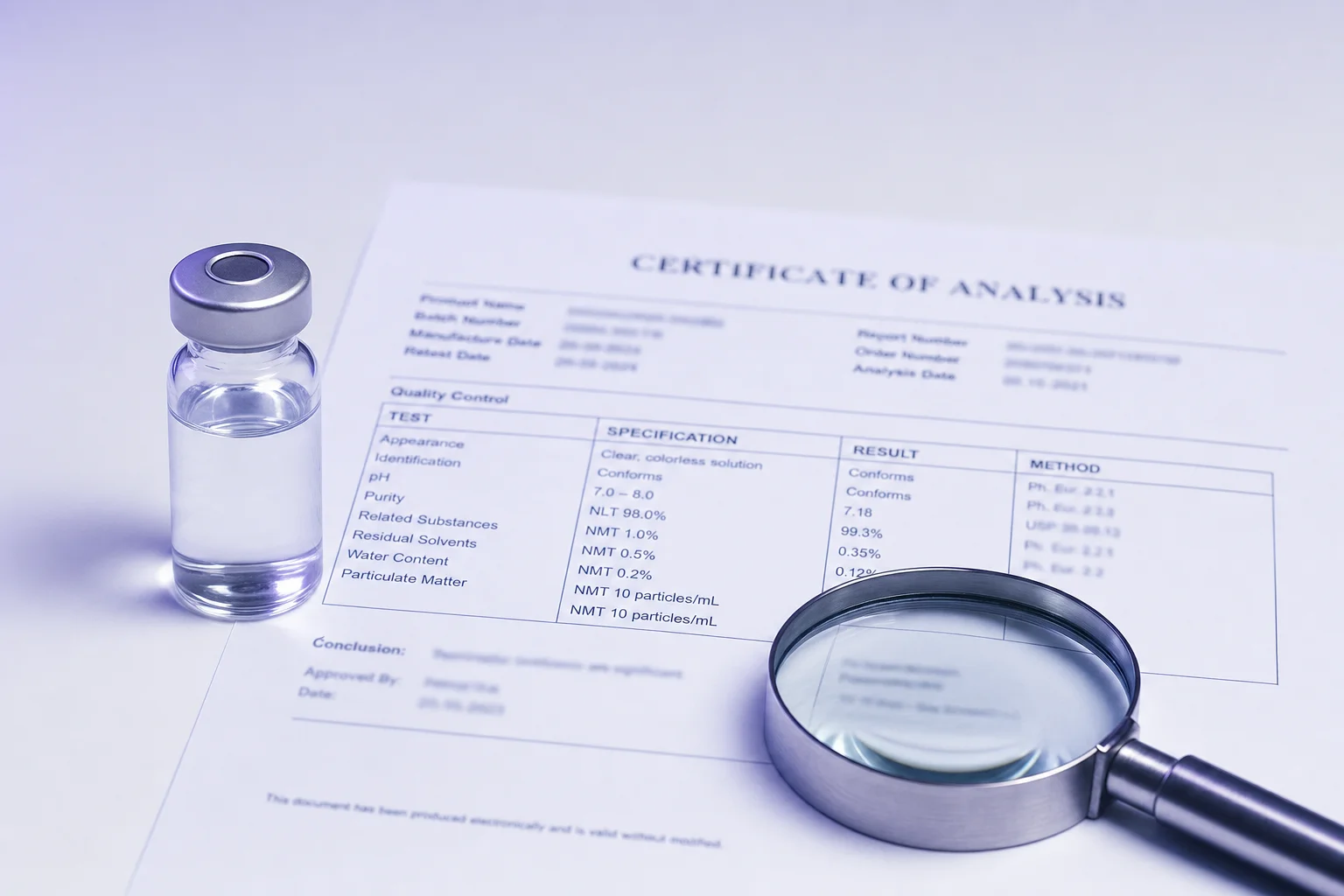
A certificate of analysis (CoA) is a lab report showing what testing was done on a specific batch of a compound and what the results were. It is the single most important piece of documentation a vendor can provide, and the most important thing to understand when evaluating a source.
Start with the check most people skip: is the vendor you are buying from named on the document? The most common problem is not a forged certificate. It is a real certificate that belongs to somebody else, a manufacturer's document or another shop's, posted on a product page as though it were the seller's own. The lab is real, the testing happened, the numbers are true, and none of it describes the vial you are about to receive. If the shop you are ordering from appears nowhere on the certificate, you are looking at someone else's paperwork, and it is not telling you anything about your vial.
Beyond that, a useful CoA includes several things. It should show the compound name and the specific batch number being tested, and that batch number should match the one printed on the vial when it arrives. It should show purity as a percentage, typically measured by HPLC (high-performance liquid chromatography), which separates the compound into its components and measures their relative amounts. A purity of 98% or higher is generally considered acceptable for research use; 99% or higher is preferable. It should also show the test date and, critically, the name of the testing laboratory.
A CoA that names no external laboratory is a weak document too, since any vendor can produce an internal report with numbers on it. In practice that is a less common problem than the borrowed certificate above, and both come back to the same two questions: does this document describe the vial you are getting, and can you trace it back to the lab that issued it? A certificate that leads back to the lab through a QR code, a lookup page, or an email address at the lab itself is doing its job. One that exists only as an image on the vendor's own site is a claim rather than a test result.
We have written those three checks out in full, in the order worth running them and with what to do when one of them does not hold, in how to tell whether a certificate of analysis is real.
Third-party testing: what it means and why it matters
Third-party testing means the vendor sent their product to an independent laboratory that has no financial relationship with the vendor. The lab tests the sample and issues a report based solely on what they found.
This is the standard that separates credible vendors from everyone else. A vendor claiming "in-house testing" or "quality control" without external lab verification cannot make any meaningful purity claim. They are simply telling you their product is good without any independent evidence.
Reputable testing laboratories include Janoshik (Czech Republic), Core Peptides, and a handful of others that specialize in this space. When a CoA names a lab you can look up, with a verifiable address and track record, that is a meaningful signal.
Mass spectrometry: the second test to look for
HPLC measures purity. Mass spectrometry (MS) confirms identity: it tells you the molecular weight of what is actually in the vial, which you can check against the known molecular weight of the compound you ordered.
A vendor offering both HPLC purity data and mass spectrometry identity confirmation provides substantially stronger documentation than one offering only HPLC. Not all vendors do both, but the best ones do. When you are comparing options, this is one of the clearest quality differentiators.
Red flags that should stop you
Some things in a vendor's presentation should give you pause. No CoA available, or a CoA that cannot be linked to a specific batch, is a serious problem. Generic "purity certificates" without lab names or batch numbers are not worth the paper they are printed on.
Prices that seem dramatically lower than market rate are another flag. Peptide synthesis has real costs. Vendors selling at a significant discount relative to established competitors are cutting costs somewhere, and the most likely place is testing and quality control.
Vendors who make medical claims or suggest dosing protocols for human use are operating outside the research-use framework that governs this market. That is both a legal problem and a sign the vendor is not being careful about how they represent their products.
Finally, pay attention to how a vendor responds when you ask questions. Reputable vendors will answer questions about their testing process clearly and specifically. Evasive or generic responses to direct questions about batch-specific testing are informative.
What good vendor presentation looks like
Beyond the documentation, a few other signals tend to distinguish established vendors from newer or lower-quality ones.
Batch-specific CoAs available on request or posted on the product page, rather than a single generic document. A clear description of storage and reconstitution requirements (most peptides ship lyophilized, meaning freeze-dried, and require refrigeration). Responsive customer service that can answer technical questions without a script. A track record in the community, evidenced by discussion in research forums and review sites, not just the vendor's own testimonials.
None of these signals is individually conclusive. Together, they build a picture.
Where pricing fits in
Price per milligram is not a quality signal by itself. Expensive peptides are not automatically high-quality, and mid-range prices do not imply corners were cut. What matters is price relative to documentation quality. A vendor charging a reasonable price and providing strong third-party testing data is almost always a better choice than a vendor charging a lower price with weak or absent documentation.
The Peptide Price Lab calculator lets you compare price per milligram across vendors, which helps you spot outliers in both directions.
Where to go from here
The Vendor Directory on this site lists research vendors with notes on their testing documentation and what compounds they carry. It is a reasonable starting point for comparing options.
Once you have a handle on how to evaluate sources, the Research Notes section covers individual compounds: what researchers study them for, what the evidence actually shows, and what the typical price range looks like across vendors.