Snap-8
The skin-care peptide sold as a topical answer to Botox, and what the evidence behind that nickname actually covers.
What is Snap-8?
Snap-8 price today
The five lowest per-mg prices we found in this morning's check, one listing per vendor, with each vendor's confidence label.
- Glow Aminos 10 mg · $21.45 $2.15/mg
- Flawless Compounds 10 mg · $21.45 $2.15/mg
- Alpha Labs 10 mg · $23.09 $2.31/mg
- Skye Peptides 20 mg · $54.00 $2.70/mg
- Peptide Crafters 10 mg · $27.00 $2.70/mg
Codes change often, so check the price at checkout. The cheapest sticker isn't always the cheapest milligram.
Tell me when Snap-8 gets cheaper
Free. We'll email you when the lowest price we track drops 10% below today's, with the vendor and the link.
One click to confirm. Your alert lives in a free account under this email, so you can change or stop it in the app. We'll also send a few short emails on buying smart, and you can unsubscribe from those anytime without losing your alert.
What people use Snap-8 for
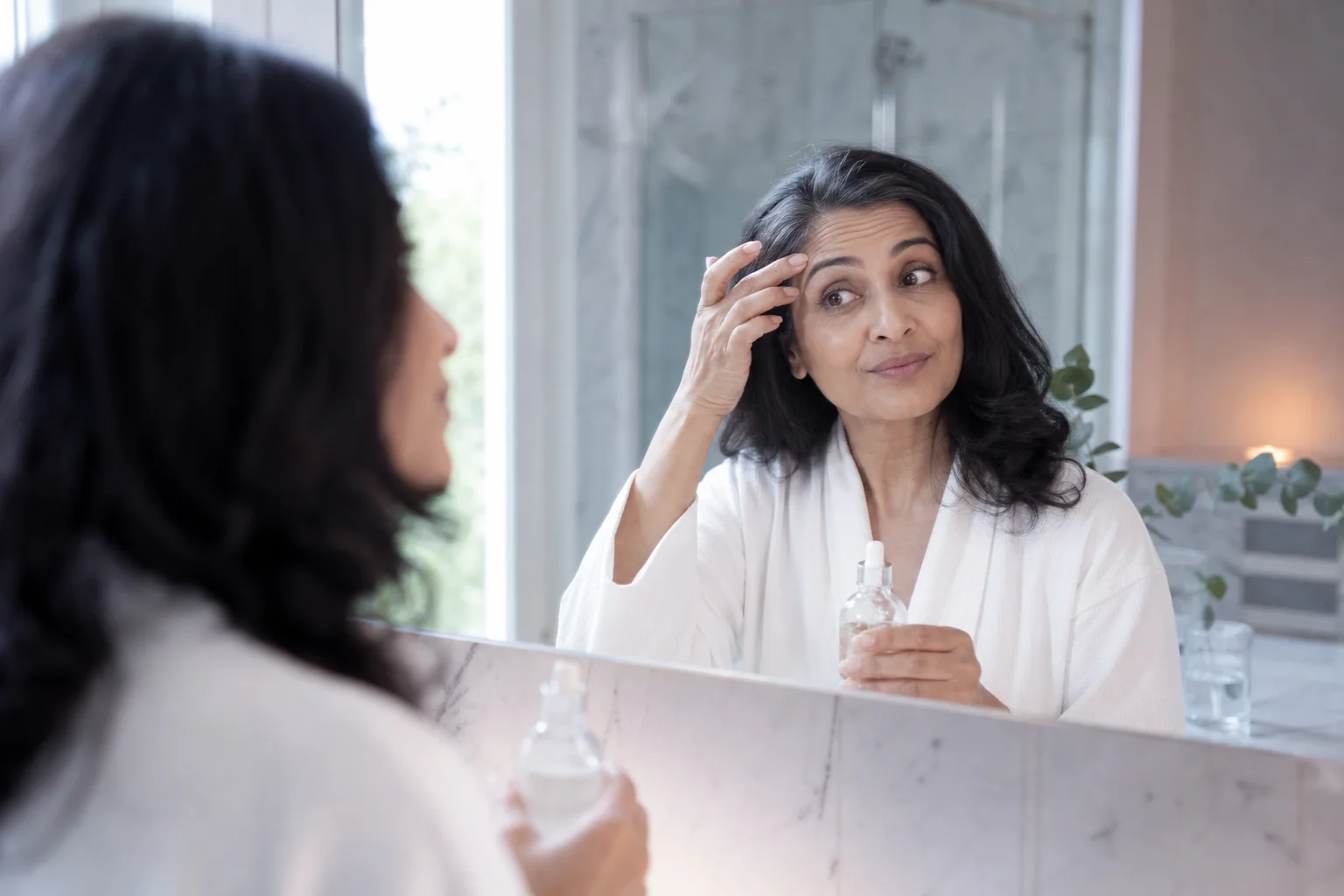
People reach for Snap-8 for expression lines, the ones that come from years of frowning at screens, squinting in the sun and laughing at the group chat. The two between the eyebrows, the lines across the forehead and the crow's feet that show up when you smile are the usual targets. It's sold as the gentle, no-needle alternative to Botox, and that nickname is most of why people search for it. The searches run from "Snap-8 serum" and "Snap-8 results" to how to use the powder on your face, and a surprising number ask about injecting it.
It appeals to women in midlife for an obvious reason. Those lines tend to deepen in exactly the years when skin is also getting thinner and drier, and plenty of women would rather try a serum before booking an injection, or want something to use between appointments. Snap-8 shows up in peptide serums at every price point, often alongside its older cousin Argireline, and in the US the raw ingredient is also sold as a research powder, which is how many readers find it.
It's a lines peptide rather than a collagen one. If the goal is firmer skin rather than softer lines, GHK-Cu and Matrixyl are the peptides people weigh instead, and our skin and beauty page lists the rest.
How Snap-8 works, in plain words
Every expression starts with a nerve telling a small facial muscle to tighten. To pass that message on, the nerve ending uses a little bundle of proteins, a kind of docking clamp, to release the signal. One of those proteins is called SNAP-25, and Snap-8 is built to look like the end of it. The idea is that Snap-8 gets into the clamp in place of the real piece, the clamp works less well, and the muscle gets a quieter signal and relaxes a little, so the line it keeps folding into softens.
Think of it as turning down the volume on the message rather than cutting the wire, which is closer to what Botox does. In lab dishes, Lipotec reported that Snap-8 cut the release of that signal and was more active than Argireline, the six-amino-acid peptide it was built from. Snap-8 is Argireline with two more amino acids on the end.
The open question is whether enough of it gets through the skin to reach those nerves. We haven't found a measurement of that for Snap-8. When researchers tested Argireline on donated human skin in the lab, less than 1% of it made it into the skin, and Snap-8 is a larger molecule. That doesn't mean it can't work, but it's the gap between the lab result and the mirror.
The skin results come from the maker too. In Lipotec's own test, volunteers used a cream made with 10% of its solution twice a day for four weeks, and their lines were on average about 35% shallower, against about 27% for Argireline in the same test. There was no placebo group, and the results weren't published in a journal.
How Snap-8 is used, in a serum or cream
Snap-8 is a skin-care ingredient, so it goes on the skin, in a serum or cream, usually twice a day on the forehead and around the eyes. Cosmetic makers buy it as a dilute solution, and the ingredient supplier's guidance is to use that solution at 3 to 10% of a finished formula, added once the product has cooled, and not to put it on skin straight. The maker's own tests used it twice a day for four weeks.
Research vendors sell something different: the pure peptide as a freeze-dried powder, mostly in 10 mg vials, with a few 20 mg and 200 mg listings. 20 of the vendors we track carry it. People who buy a vial report mixing it into a plain serum base at home, and that's where the math matters. The maker's solution is only 0.05% peptide, so a cream made with 10% of it holds about 0.005% Snap-8. A 10 mg vial mixed into 10 mL of serum is 0.1%, about twenty times stronger than that.
Some people also use it with microneedling, through patches or a roller, to help it into the skin, and they report doing this once or twice a week. Rolling at home carries an infection risk of its own, so clean tools matter more than the peptide does.
Is Snap-8 safe?
As a cosmetic ingredient at the strengths in finished products, Snap-8 has a quiet record. It's listed in the EU's cosmetic ingredient database with no restrictions, and we haven't found published reports of it causing harm in skin care. The US panel that reviews cosmetic ingredients hasn't assessed Snap-8 itself. It has assessed Argireline, and found it safe up to 0.005%, the strength of a cream made at the top of the supplier's range, while saying there wasn't enough data to judge anything stronger.
That's the part to keep in mind with a home-mixed serum from a research vial, because the vial math above lands about twenty times past that strength. There's no published data on irritation at those levels, and none on pregnancy or breastfeeding. A patch test on the inside of the arm before it goes near your eyes is the sensible first step, and redness or stinging that lasts is the cue to stop.
Injecting it is a different matter. There's no safety data of any kind for Snap-8 under the skin or into a muscle, and the vials aren't made or tested as injectable products.
The two forms of Snap-8
You'll meet Snap-8 in two forms. In a finished serum it's a dilute solution, often next to Argireline, Matrixyl or other peptides, and the strength is set by the formula. As a research powder it's the pure peptide, and the strength is whatever you make it, which is why the math in the section above matters.
If you're comparing vials, compare the price per milligram, and look for a vendor that posts a recent third-party certificate of analysis, the lab report that shows what's in the vial and how pure it is. For something going on your face every day, purity matters.
Is Snap-8 legal?
Yes. In the US and the EU, Snap-8 is a cosmetic ingredient, and cosmetics don't need FDA approval before they're sold. It isn't a drug and isn't approved to treat anything. A product that promised it would relax muscles or work like Botox would be making a drug claim, which is why serums talk about the look of lines instead.
The powder from research vendors carries a research-use label, the same as every compound on our site. Quality varies by vendor, and that's the gap our vendor checks are built for. We look at independent lab testing, posted certificates of analysis, vendor history and community reputation, and every vendor is held to the same standard whether or not it pays us.
Snap-8 compared
Snap-8 is almost always weighed against Argireline, the shorter peptide it came from, and our Snap-8 vs Argireline page sets the two side by side. Argireline has the bigger evidence file, including independent studies, and Snap-8 is the longer version its maker says works a little better. For firmness rather than lines, GHK-Cu vs Matrixyl covers the two collagen peptides people compare most.
In a serum Snap-8 is a cosmetic ingredient, the vials are sold for research, and the only wrinkle results come from the company that makes it. You knew that, it's why you're reading this and not the label.
Snap-8 compared
Questions people ask about Snap-8
Is Snap-8 like Botox?
It's aimed at the same lines, but it works differently and far more gently. Botox is injected and blocks the signal to the muscle for months, while Snap-8 sits in a serum and, in lab tests, turned that signal down a little. We haven't found a study comparing the two.
Can you inject Snap-8?
There's no injection research on Snap-8 at all, no study, no label and no safety data. It was made and tested as an ingredient for skin, and research vials hold the same peptide as a powder, not an injectable product.
Is Snap-8 better than Argireline?
In the maker's own small test, Snap-8 smoothed lines a little more than Argireline did over four weeks. Argireline is the one with independent studies behind it, though, and many serums simply use both.
How do you use Snap-8 on your face?
In finished products it's a serum or cream applied twice a day, usually to the forehead and the skin around the eyes. The ingredient supplier's guidance is to mix the maker's solution into a formula rather than put it on the skin neat.
How long does Snap-8 take to work?
The maker's tests ran for four weeks of twice-daily use, so that's the timeline its numbers describe. No study has followed people for longer.
Everything we've written on Snap-8
Your next step
Also on Android