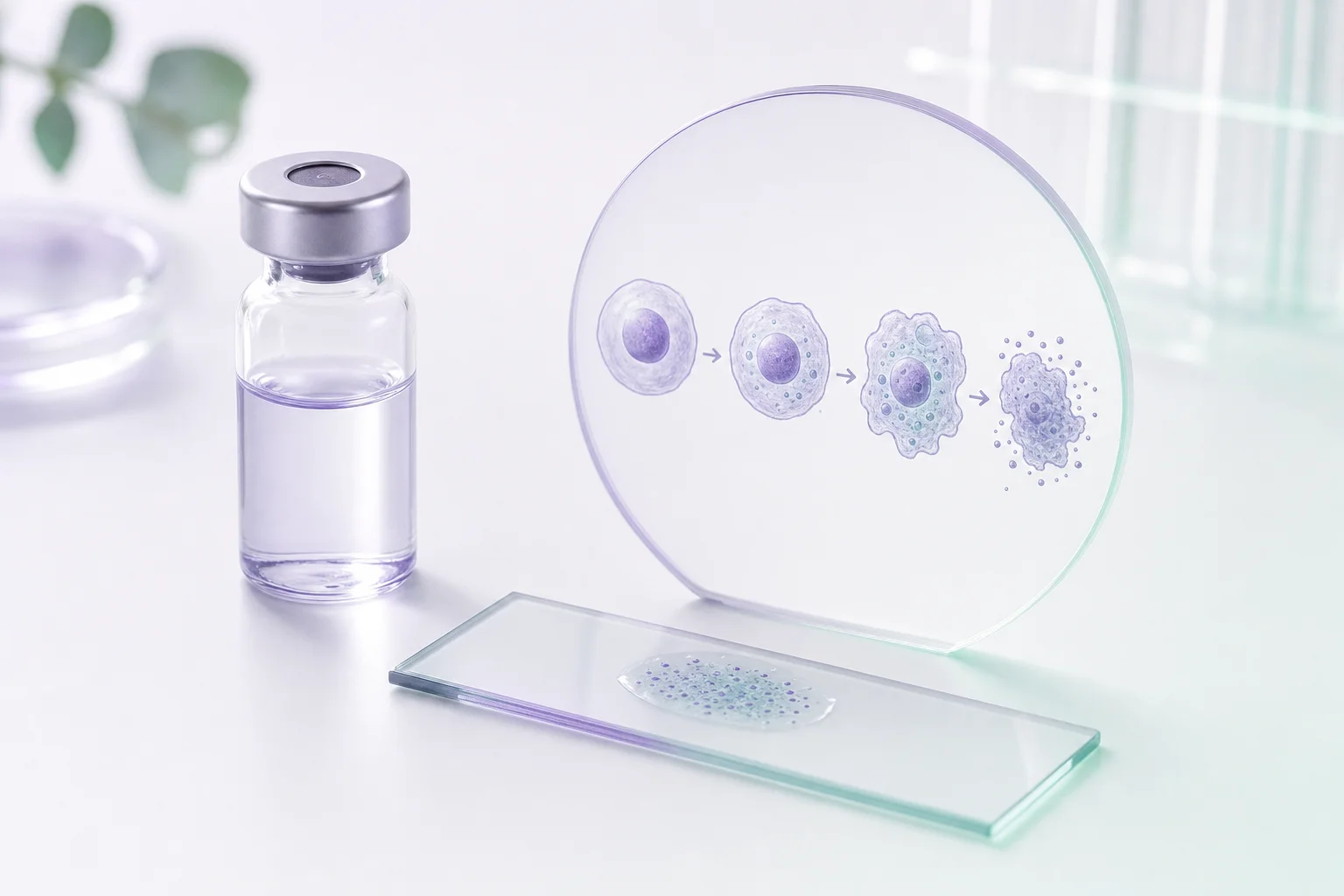
Cartalax is the brand name for the synthetic tripeptide Ala-Glu-Asp (AED), also described in the scientific literature as alanyl-glutamyl-aspartic acid. It is a short-chain amino acid sequence developed by the research group at the St. Petersburg Institute of Bioregulation and Gerontology in Russia, led by Vladimir Khavinson, a laboratory that has produced the majority of the published work on this compound.
Cartalax belongs to a family of short regulatory peptides developed by the Khavinson group. Several of these compounds share a similar tripeptide structure and have been studied in parallel using closely related experimental models. It should not be confused with GHK-Cu (glycyl-L-histidyl-L-lysine copper complex), which is a structurally different copper-binding peptide with a substantially larger independent body of research.
- Gene expression in aging stem cells In vitro research using human bone marrow mesenchymal stem cells has examined whether AED (Cartalax) and related short peptides modulate expression of genes associated with cellular aging, including IGF1, FOXO1, and TERT, at nanomolar concentrations.[1]
- Skin fibroblast aging and matrix remodeling Cell culture studies have examined whether AED and related peptides affect proliferation, apoptosis, and matrix metalloproteinase activity in aging skin fibroblasts, with researchers measuring changes in Ki-67 (a proliferation marker), caspase-3 (an apoptosis marker), and MMP-9 (involved in collagen matrix breakdown).[2]
- Cellular senescence markers in renal tissue Research in aging rat kidney cell cultures has examined AED's effect on senescence-associated proteins, including p16, p21, and p53, and on SIRT-6, a sirtuin protein associated with DNA repair and metabolic regulation in aging cells.[3]
- Thymic aging and immune cell function A study examining short peptides including AED in aging human thymocyte cultures assessed effects on thymocyte proliferation, differentiation, and apoptosis, contributing to the broader research question of how small peptides may influence age-related thymic involution.[4]
The published evidence on Cartalax is narrow in scope and source. All verifiable PubMed-indexed studies on AED (Ala-Glu-Asp) originate from a single Russian research group, the St. Petersburg Institute of Bioregulation and Gerontology, which has studied a family of short regulatory peptides over several decades. [1][2] All studies are in vitro (cell culture); no animal in vivo studies or human clinical trials have been published in indexed literature as of mid-2026.
The research findings are internally consistent within this body of work, showing effects on aging-related gene expression and cellular markers across multiple cell types (stem cells, skin fibroblasts, kidney cells, thymocytes). [3][4] However, the absence of independent replication, the exclusive reliance on cell culture models, and the single-group publication history mean that the evidence base for Cartalax is substantially thinner than for peptides such as BPC-157, GHK-Cu, or the GLP-1 analogs. Researchers considering this compound should weigh those limitations carefully.
| Parameter | Detail |
|---|---|
| Common vial sizes | 5 mg, 10 mg; availability is limited compared to more widely studied peptides |
| Supplied as | Lyophilized (freeze-dried) powder |
| Storage | Lyophilized powder: room temperature or refrigerated; reconstituted solution: refrigerated |
| Stability | Lyophilized: typically 24 months or more; reconstituted: 4 to 6 weeks refrigerated |
| Administration studied | Cell culture research uses solution application; route of administration in whole-organism research has not been established in indexed literature |
- [1] Ashapkin V, Khavinson V, Shilovsky G, Linkova N, Vanuyshin B. Gene expression in human mesenchymal stem cell aging cultures: modulation by short peptides. Molecular Biology Reports. 2020;47. PubMed ↗
- [2] Lin'kova NS, Drobintseva AO, Orlova OA, Kuznetsova EP, Polyakova VO, Kvetnoy IM, Khavinson VKh. Peptide Regulation of Skin Fibroblast Functions during Their Aging In Vitro. Bulletin of Experimental Biology and Medicine. 2016;161. PubMed ↗
- [3] Khavinson VKh, Tarnovskaia SI, Lin'kova NS, Poliakova VO, Durnova AO, Nichik TE, et al. [Tripeptides slow down aging process in renal cell culture]. Advances in Gerontology. 2014;27. PubMed ↗
- [4] Lin'kova NS, Polyakova VO, Trofimov AV, Kvetnoy IM, Khavinson VKh. Peptidergic regulation of thymocyte differentiation, proliferation, and apoptosis during aging of the thymus. Bulletin of Experimental Biology and Medicine. 2011;151. PubMed ↗