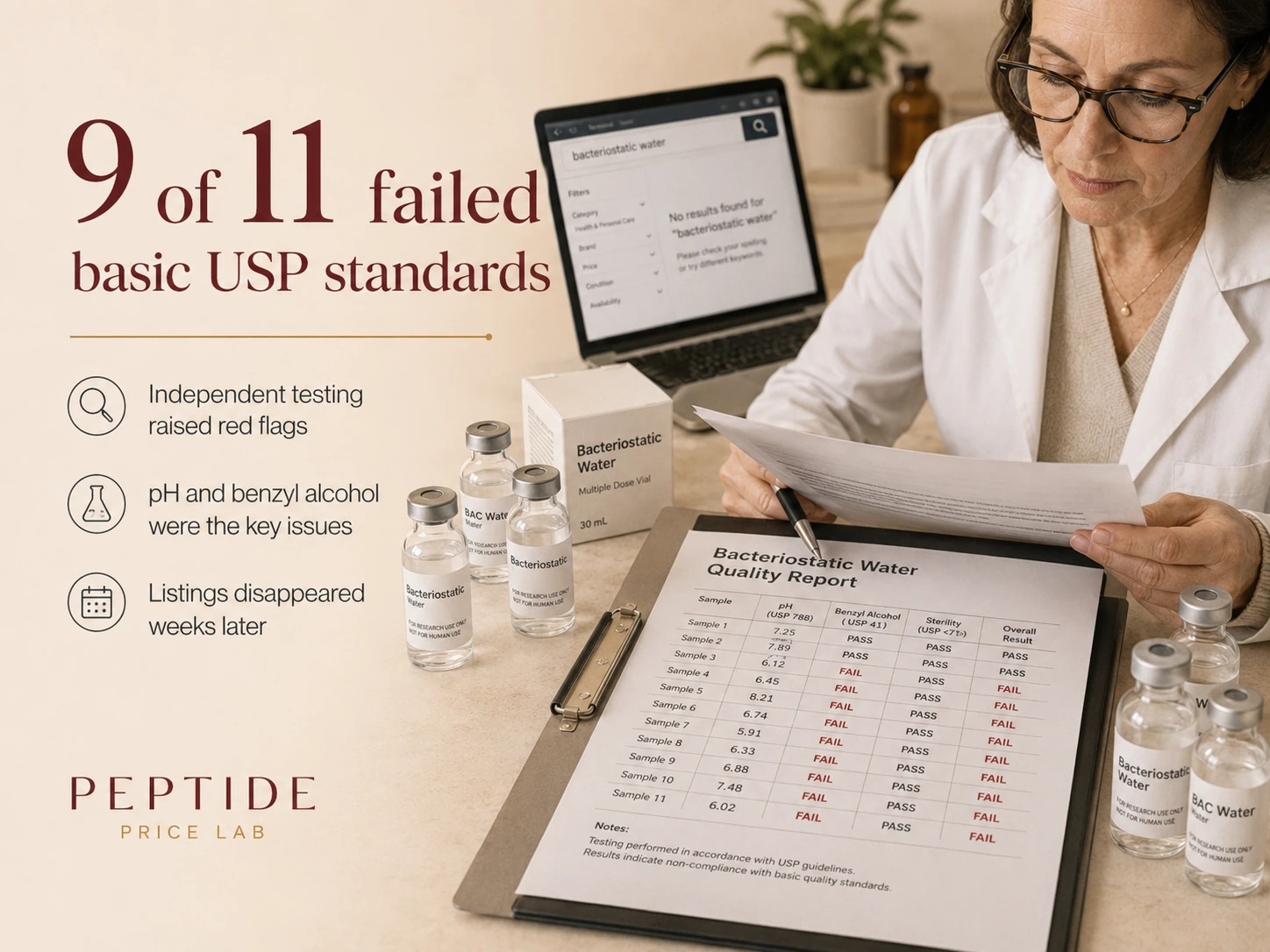
If you've searched Amazon for bacteriostatic water recently and come up empty, you're not imagining it. BAC water quietly disappeared from the platform in early 2026. No recall notice, no announcement from Amazon. The listings just stopped appearing.
The story behind the removal starts with a round of independent testing that made its way through the research community in March 2026 — and the numbers were hard to look past.
The testing data
In March 2026, Peptide Crafters commissioned third-party testing of 11 bacteriostatic water products purchased directly from Amazon. Testing was performed by Vanguard Laboratory, an A2LA-accredited, ISO 17025-certified lab. The results were shared publicly by researcher Derek Pruski in his Peptide Price Substack on March 18, 2026.
The two parameters tested were pH and benzyl alcohol concentration — the two variables that determine whether BAC water actually does its job. USP acceptable ranges: benzyl alcohol 0.72%–1.08%, pH 4.0–7.0.
Two products passed. Nine failed.
The pH failures are what stand out. Seven of the nine failing products came in above pH 7.5, with Awat Science at 8.8 and AaBaCa LLC at 8.69. Those aren't borderline misses — a pH of 8.8 creates actively alkaline conditions that accelerate peptide degradation the moment you reconstitute. Two products (JR Globals and the Lot TE202601 product) also failed on benzyl alcohol, meaning they lacked adequate preservative concentration to inhibit microbial growth in a multi-use vial.
Why pH and benzyl alcohol matter
Bacteriostatic water serves two functions: it reconstitutes your peptide, and it preserves it during storage. When pH climbs above 7.0 into alkaline territory, it accelerates hydrolysis and degradation at the molecular level. High-pH reconstitution can cause peptide aggregation — the cloudiness some researchers notice in a vial after reconstitution. That's not harmless particulate. In many cases it's aggregated or partially degraded peptide. You've compromised your compound before the first dose.
Benzyl alcohol below the USP floor of 0.72% loses its bacteriostatic efficacy. A multi-use vial reconstituted with under-spec BAC water is a vial where microbial growth becomes a real possibility over the course of 28 days of storage.
The failure mode most researchers don't connect: they use a high-quality peptide with out-of-spec BAC water, the peptide degrades or aggregates faster than expected, and they blame the peptide. The reconstitution fluid was the variable the whole time.
Amazon's removal
On March 31, 2026 — roughly two weeks after the testing data circulated publicly — Pruski reported that Amazon appeared to be pulling BAC water from the platform entirely. His read on it: either the FDA was pressuring Amazon on pharmaceutical compliance, or Amazon's marketplace team looked at the quality picture and realized most of what was being sold shouldn't have been listed. Probably both.
Dr. Ashley Froese covered the removal and its practical implications in her video "Where Did All the Bacteriostatic Water Go?" posted to her YouTube channel This Is Not Covered shortly after the listings came down. Her framing aligned with the data: the products that were removed weren't products researchers should have been relying on in the first place.
Amazon has not officially commented on the removal. Bacteriostatic water for injection is regulated as a pharmaceutical product under 21 CFR, and the compliance picture for sellers making sterility-related claims on a general marketplace was already complicated before this round of testing made it worse.
What this means in practice
The short version: the BAC water that was most convenient to buy was also, by a wide margin, the most likely to be out of spec. The removal adds friction but removes a genuinely problematic supply from the sourcing picture.
Reputable options are available through peptide-dedicated vendors, specialty reconstitution suppliers, and pharmaceutical-grade sources — all of which carry product with documented specifications and, in some cases, COAs. The price is higher than what Amazon was listing. The quality is not comparable.
Sources
- 1. Pruski, Derek. "BAC Water Amazon Testing — March 2026 | Only 2 of 11 Passed | Data Shared by Peptide Crafters." Peptide Price (Substack), March 18, 2026. derekpruski.substack.com
- 2. Pruski, Derek. "No More Bac Water on Amazon." Peptide Price (Substack), March 31, 2026. derekpruski.substack.com
- 3. Froese, Ashley (Dr.). "Where Did All the Bacteriostatic Water Go? Dr. Explains." This Is Not Covered (YouTube), 2026. youtube.com
- 4. Peptide Crafters / Vanguard Laboratory. BAC Water Testing COAs, March 2026 (Round 3). Full COAs (Google Drive)