Start with the building blocks
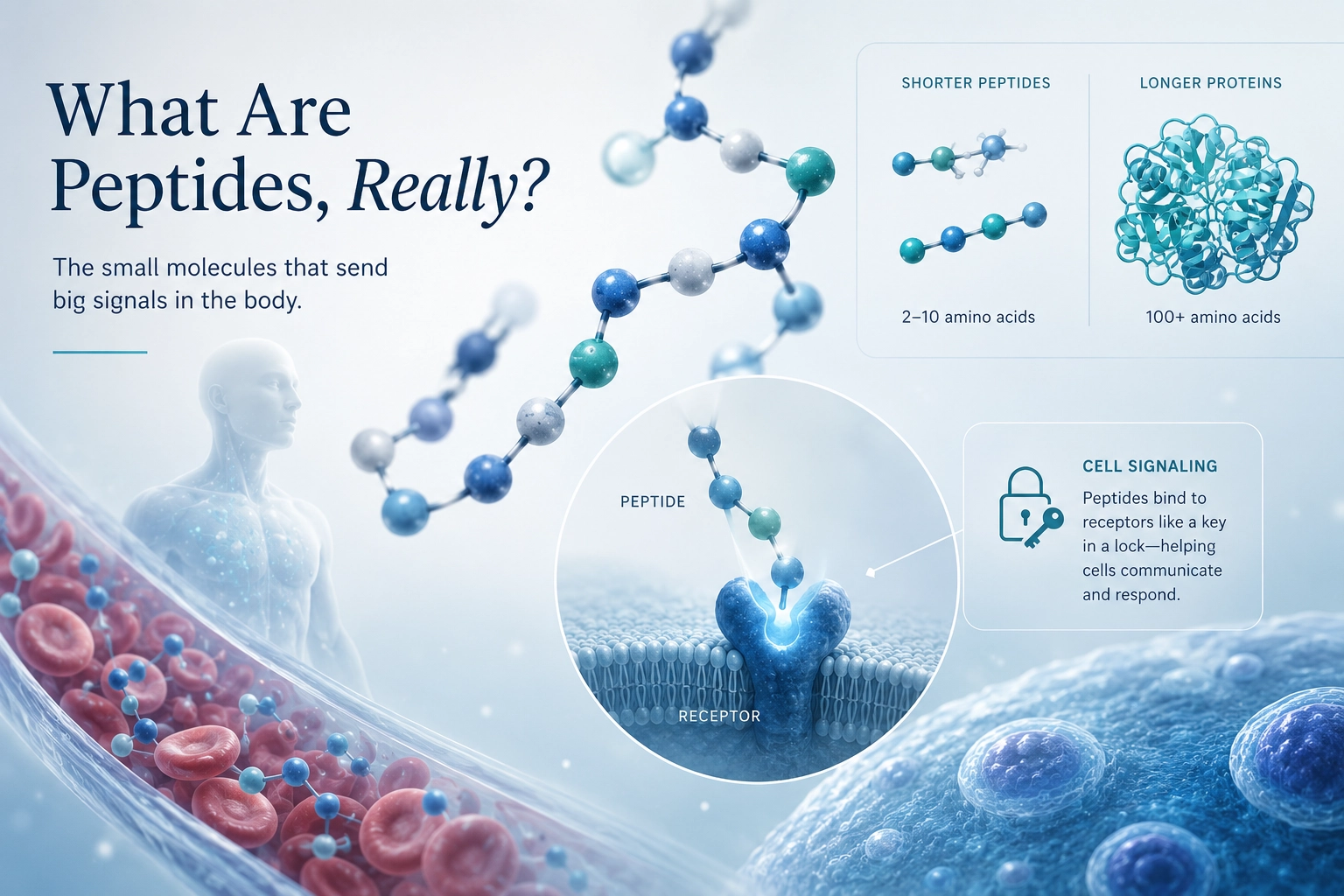
Your body uses about 20 amino acids as its core building blocks. Think of them as letters in an alphabet. Proteins are the long words. Peptides are the short ones. Both are made from the same letters, strung together in different lengths and sequences. That's really the whole structural story.
Technically, a peptide is a chain of 2 to roughly 50 amino acids. A protein is a longer chain (usually 50 or more) that folds into a complex three-dimensional shape. The length matters because it affects what the molecule can do, how quickly it breaks down, and whether it can pass through certain barriers in the body.
What do peptides actually do?
Peptides are, at their core, signaling molecules. They don't just exist in your body. They communicate in it. A peptide might travel through the bloodstream and bind to a receptor on a distant cell, triggering a specific response. Think of it like a key fitting a lock: the peptide (key) is shaped to bind a specific receptor (lock), and when it does, something happens.
What "something happens" means depends entirely on the peptide and the receptor. One might tell your pituitary gland to release growth hormone. Another might signal your gut lining to reduce inflammation. Another might direct cells to produce more collagen. The specificity is what makes peptides interesting to researchers.
Peptides your body already makes
You're already running on peptides. Some familiar examples:
- Insulin: a 51-amino-acid peptide (technically a protein by some definitions, but peptide-class) that manages blood glucose. This one is FDA-approved and widely prescribed.
- Oxytocin: the so-called "bonding hormone," a 9-amino-acid peptide released during childbirth, breastfeeding, and social connection. Also FDA-approved in certain medical uses.
- Endorphins: the natural pain-relief peptides your brain releases during exercise, laughter, and stress.
- GLP-1 (Glucagon-Like Peptide-1): a gut-derived peptide that signals satiety and regulates insulin. The basis of the semaglutide and tirzepatide drugs that are currently all over the news.
The point isn't to impress you with a list. It's to show that peptides are native to your biology. Researchers studying synthetic peptides are often trying to mimic or amplify what the body does naturally, or to deliver a targeted signal the body may be producing less of.
So how is a "research peptide" different?
A research peptide is a synthetic version, manufactured in a lab, that either replicates a peptide your body makes, or is engineered to behave similarly. Most research peptides are sold for laboratory research, not for human use. A smaller number have gone through clinical trials and received FDA approval for specific medical conditions.
The distinction matters. An FDA-approved peptide like semaglutide (brand names Ozempic, Wegovy) has been through extensive trials and is prescribed by doctors for defined indications. Most research peptides being discussed online have not gone through that process. That doesn't automatically mean they're ineffective or dangerous, but it does mean the evidence base is different, and so is the legal status.
Why are researchers so interested in them?
Peptides have a few properties that make them compelling for research. They're highly specific: because they work by binding to particular receptors, a well-designed peptide can have a targeted effect without disrupting unrelated systems. They also tend to break down naturally in the body (into amino acids), which is generally less disruptive than small-molecule drugs that may accumulate.
The flip side: that fast breakdown means peptides are often difficult to take orally (stomach acid destroys many of them before they can be absorbed), which is why injectable or intranasal delivery is common in research. Several labs are working on modified peptides that resist degradation, and this is an active area of pharmaceutical development.
The other reason for the surge of interest right now: GLP-1 drugs proved the category out in a mainstream way. When semaglutide became a household name, it opened the door to much broader public awareness that peptides are real, that they work, and that the research is worth paying attention to.
Where to go from here
If you want to understand a specific compound (how it works, what the research shows, what the typical dosing looks like in studies, and what it costs), head to the Research Notes section. Each page covers one compound in as much depth as the published evidence allows.
If you want to understand the difference between research peptides and FDA-approved drugs in more detail, the next guide covers exactly that: Research Peptides vs. FDA-Approved Compounds.