Pancragen dosage per day
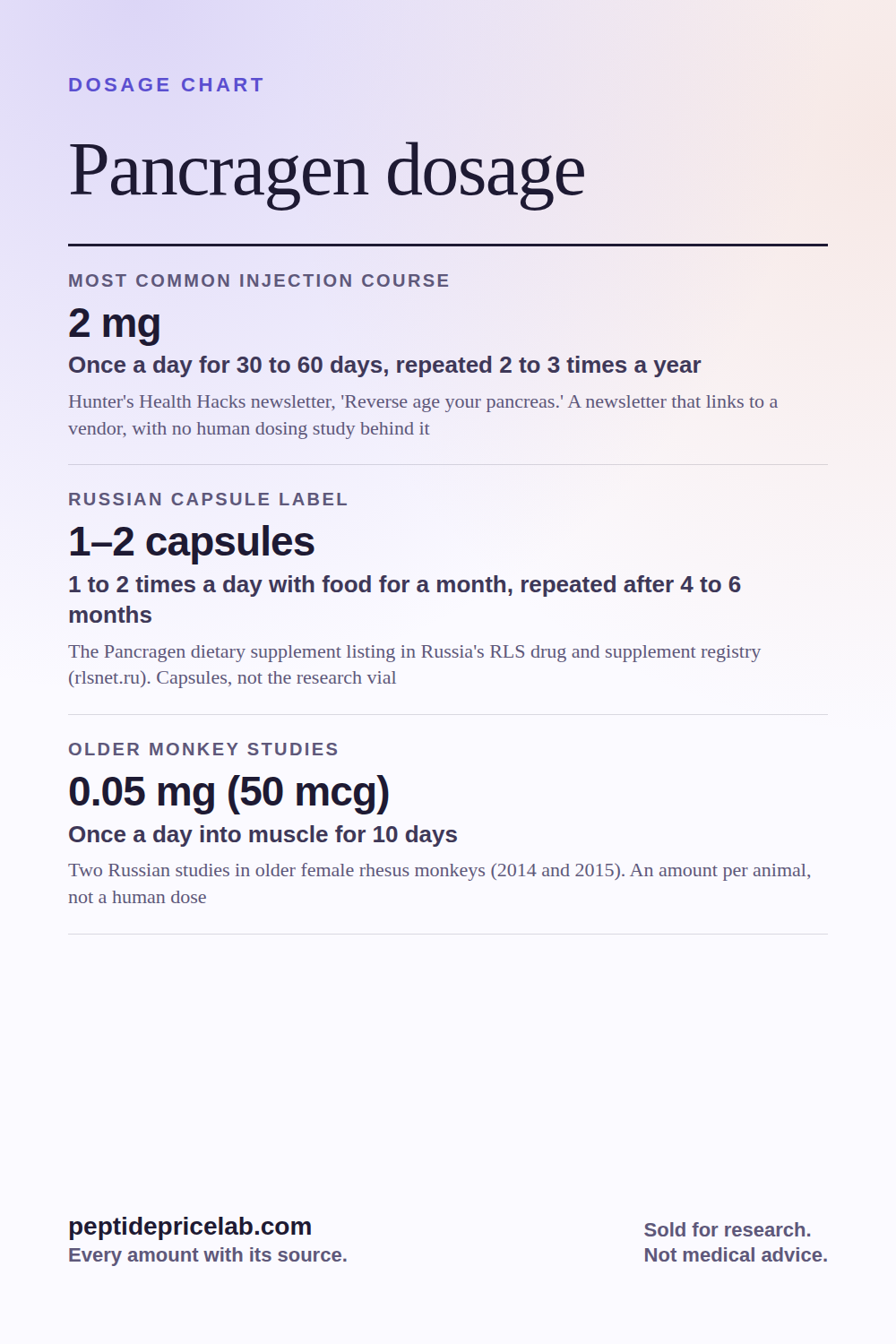
The injection amount most often repeated is 2 mg a day for 30 to 60 days. It comes from a longevity newsletter, and no published study has dosed the research vial in people.
How much Pancragen do people take?
Amount
2 mgonce a dayTiming
Once a dayevery day of the courseCourse
30–60 daysrepeated 2–3 times a yearRoute
Injectionunder the skin or into muscleAmount, timing, course and route come from Hunter Williams's Hunter's Health Hacks newsletter, in the issue titled 'Reverse age your pancreas,' which links to a vendor that isn't one we track. No approved label and no human dose-finding study sets any of them.
Pancragen dosage chart
Where each amount comes from
Three patterns are in circulation, and they come from three very different places. The injection course is what most people who buy the research vial follow. The capsule label belongs to a Russian supplement that shares the name. The monkey amount is the only injected dose that's been published, and it's far smaller than what people use. Read the source column before the amount column, because it tells you how much weight each number can carry. Background on the peptide itself is on the Pancragen page.
The gap between 0.05 mg in a monkey and 2 mg in a person isn't explained anywhere we could find. The newsletter that gives the 2 mg figure doesn't say how it was arrived at, and nobody has published a study that tried different amounts to see which one works. That's the normal state of things for the bioregulators, the family of short peptides developed in Russia by Vladimir Khavinson, and it's why the chart shows all three instead of picking one.
The injection course is written up by Hunter Williams in his Hunter's Health Hacks newsletter, which points readers to a vendor for the vial. It's the most specific source we found: a 20 mg vial, 2 mL of water, 2 mg a day, 30 to 60 days, two or three times a year. Other peptide sites repeat versions of it, often without saying where it came from.
The capsule label is the one pattern with a product label behind it, but it's a label for a different product. The Russian Pancragen capsule is registered as a dietary supplement, and its listing tells adults to take one or two capsules once or twice a day with meals for a month. It doesn't say how much of the peptide is in each capsule, so it can't be used to size a vial dose.
The human study doesn't help with the number either. The Ukrainian study in older adults with type 2 diabetes reported lower fasting glucose and insulin resistance, but its published summary doesn't give the amount or the route, so there's no human figure to put in the chart.

Pancragen injection dosage and mixing
Pancragen is sold as a freeze-dried powder, most often in 20 mg vials. You mix it with bacteriostatic water, which is sterile water with a preservative so one vial can be drawn from more than once. Add the water slowly down the side of the vial and swirl gently rather than shaking. The newsletter course describes injecting under the skin or into a muscle, and the monkey studies used muscle.
The table shows the units to draw on a U-100 syringe, which holds 100 units in 1 mL, for 1, 2 and 3 mL of water. The amount is the 2 mg from the chart. The newsletter itself uses 2 mL, which makes every 10 units 1 mg.
| Water | Strength | 2 mg dose |
|---|---|---|
| 1 mL | 20 mg per mL | 10 units |
| 2 mL | 10 mg per mL | 20 units |
| 3 mL | 6.7 mg per mL | 30 units |
Units are math from the chart amount, with the strength column rounded to one decimal. With 3 mL, 2 mg is exactly 30 units because the vial holds 20 mg in 300 units.
Small draws are easier to misread, and with 1 mL of water the dose is only 10 units on a syringe marked in 2-unit steps. 2 or 3 mL makes each dose a bigger, easier draw, and 2 mL is what the newsletter uses. For a different vial, amount or volume, the reconstitution calculator does the same math.
The monkey amount, 0.05 mg, would be half a unit with 2 mL of water, which is too small to draw accurately on a standard syringe. That's one more sign it was a research amount for an animal rather than something meant to carry over to a person.
When and how often
Once a day. The injection course uses one dose a day, every day of the course, according to the newsletter that describes it.
Thirty to sixty days. The same source gives a course of 30 to 60 days. The Russian capsule label sets one month, and the monkey studies ran for just 10 days, with part of the effect still measurable three weeks after the last dose.
Two to three courses a year. The newsletter describes repeating the course 2 to 3 times a year. The capsule label puts 4 to 6 months between courses. Neither comes from a study that compared schedules.
Time of day. No study or label sets one for the injection. The capsule label says to take it with food. Pick a time you can repeat every day, and if you track your blood sugar, keep the reading at the same time too, so the numbers are comparable from week to week.
For planning, a 30-day course at 2 mg a day is 60 mg in all, and a 60-day course is 120 mg. Compare vendors on price per milligram against that total, not on the sticker price of one vial.
How long a vial lasts
A mixed vial goes on a 28-day clock in the fridge from the day the water goes in. At 2 mg a day, a 20 mg vial runs out in 10 days, well inside that window, so nothing is wasted mid-course.
That makes the counts tidy. A 30-day course is three 20 mg vials, and a 60-day course is six. Each vial is mixed when the last one runs out, not all at once, so every vial gets its own 28-day clock. The syringes are a separate count: one per dose, so 30 for a 30-day course and 60 for a 60-day course, even though the vial count is only 3 or 6.
Unmixed powder keeps far longer. Most vendors say to store it in the fridge or freezer, dry and out of the light, and that's where the rest of a course's vials wait until they're needed.
Signs the amount or timing is off
These are reported experiences from people who use Pancragen and general signs of low blood sugar, not findings from a Pancragen study.
Shaky, sweaty or suddenly hungry. Those are the classic signs of low blood sugar. Pancragen is studied because it seems to lower glucose, so this matters most for anyone already on metformin, insulin, a sulfonylurea or a GLP-1 medication. People who see it check a reading and bring it up with whoever prescribes their medication.
Redness or itching where you injected. People report it, usually mild and gone within a day. They rotate the spot each day, and some move from muscle to under the skin, or the other way round.
Nothing at all. This is the most common report. The monkey studies measured a change in glucose response on lab tests rather than anything the animals could feel, so people who want to know whether it's doing anything usually compare a fasting reading, or an A1C from their doctor, at the start and end of a course.
No completed human safety study exists for the research vial, and the open questions are on the Pancragen page.
It's sold for research, and the big human trials haven't been run yet.
Questions people ask about Pancragen dosage
What is the Pancragen dosage per day?
The most common injection amount is 2 mg once a day, under the skin or into a muscle. It comes from a longevity newsletter, and no label or human dosing study sets it.
How much bacteriostatic water for a 20 mg vial of Pancragen?
Any of 1, 2 or 3 mL works, because the water only changes the size of each draw. A 2 mg dose is 10 units with 1 mL, 20 units with 2 mL and 30 units with 3 mL on a U-100 syringe.
How long is a Pancragen course?
The injection course people describe runs 30 to 60 days and repeats 2 to 3 times a year. The Russian capsule label sets one month with a repeat after 4 to 6 months, and the monkey studies ran for 10 days.
Can you take Pancragen every day year-round?
No study or label sets continuous daily use. Every pattern in circulation is a course with months off between, so year-round use is outside anything described.
Can you take Pancragen with other bioregulators like Epithalon?
No study or label sets a combined schedule. People who use more than one bioregulator, like Epithalon or Cartalax, describe running them as separate courses, and that's reported use rather than tested use.
Is the capsule dose the same as the vial dose?
No. The capsule label counts capsules of a supplement product, not milligrams of the peptide, so there's no way to convert one to the other.
Where to buy Pancragen
The five lowest per-mg prices in this morning's check, one listing per vendor.
- Evolve BioPep 20 mg · $39.99 $2.00/mg
- Swiss Chems 20 mg · $59.95 $3.00/mg
- LA Peptides 20 mg · $59.99 $3.00/mg
- Core Peptides 20 mg · $63.00 $3.15/mg
Tell me when Pancragen gets cheaper
Free. We'll email you when the lowest price we track drops 10% below today's, with the vendor and the link.
One click to confirm. Your alert lives in a free account under this email, so you can change or stop it in the app. We'll also send a few short emails on buying smart, and you can unsubscribe from those anytime without losing your alert.
More on Pancragen
Your next step
Also on Android