Ovagen dosage for injection and capsules
Ovagen amounts in circulation run from 100 mcg to 2 mg a day by injection, or 10 to 20 mg a day as capsules. Here's where each comes from and the math for a 20 mg vial.
How much Ovagen do people take?
Amount
100 mcg–2 mga day, injectedTiming
Once a dayevery day of the courseCourse
4–12 weeksor 30–60 days at 1–2 mgRoute
Under the skinor 10–20 mg capsulesThe 100 to 500 mcg amount and 4 to 12 week course come from a peptide education site. The 1 to 2 mg amount and 30 to 60 day course come from a peptide newsletter's 20 mg vial protocol. The capsule amount comes from a peptide database describing the Russian capsule. No approved label in the US and no dose-finding study sets any of them.
Ovagen dosage chart
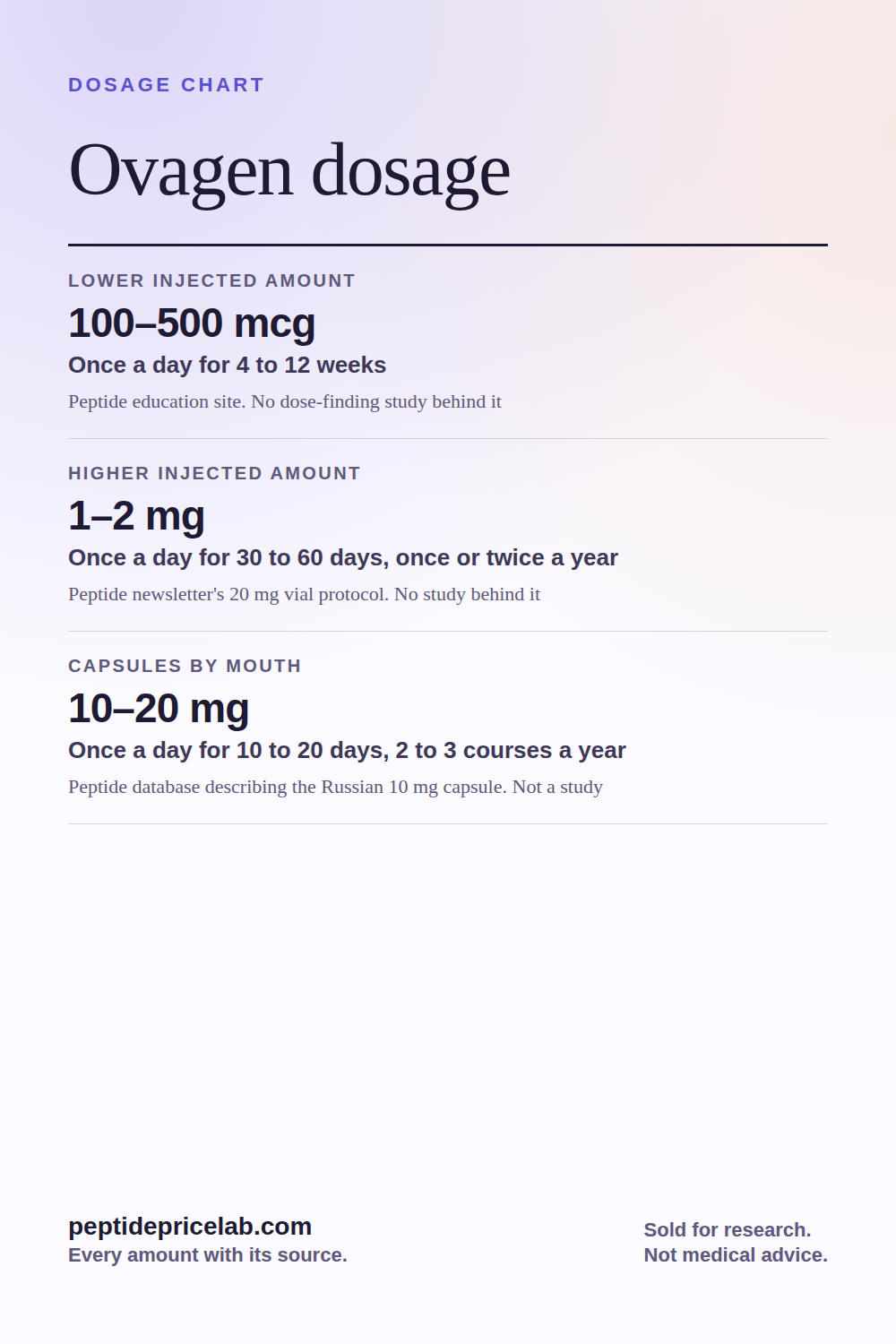
Where each amount comes from
Three patterns are in circulation, two by injection and one by mouth, and they don't agree with each other, which is why each one gets its own row instead of an average. Read the source column with the amounts, because none of these figures comes from a human trial. Background on the peptide itself, including why most of its published research is about the kidneys, is on the Ovagen page.
The spread is wide because each source starts from a different place. The education site works in micrograms, the way most injected peptides are dosed. The newsletter divides a 20 mg vial into daily milligrams. The capsule figures follow the Russian product, which is taken by mouth and has to survive the gut. No one has tested these against each other in people, so a lower pattern isn't a weaker version of a higher one, it's simply a different convention.
Ovagen injection dosage and mixing
Vendors sell Ovagen as a freeze-dried powder, mostly in 20 mg vials. You mix it with bacteriostatic water, which is sterile water with a preservative so one vial can be drawn from more than once, and inject it under the skin. The two injected patterns are 100 to 500 mcg a day, from a peptide education site, and 1 to 2 mg a day, from a peptide newsletter.
The table shows the units to draw on a U-100 syringe, which holds 100 units in 1 mL, for 1, 2 and 3 mL of water across those amounts.
| Water | Strength | 100 mcg | 500 mcg | 1 mg | 2 mg |
|---|---|---|---|---|---|
| 1 mL | 20 mg per mL | 0.5 units, hard to read | 2.5 units | 5 units | 10 units |
| 2 mL | 10 mg per mL | 1 unit, hard to read | 5 units | 10 units | 20 units |
| 3 mL | 6.7 mg per mL | 1.5 units, hard to read | 7.5 units | 15 units | 30 units |
Units are math from the chart amounts, with strength rounded to one decimal. Amounts come from a peptide education site (100 and 500 mcg) and a peptide newsletter (1 and 2 mg).
The 1 to 2 mg pattern reads cleanly at 2 mL, where 1 mg is 10 units and 2 mg is 20 units. The lower pattern is the awkward one, because 100 mcg is a sliver of a unit at these volumes. More water spreads the dose out, and with 5 mL in a 20 mg vial, 100 mcg is 2.5 units and 500 mcg is 12.5 units. For any other vial, water or amount, the reconstitution calculator does the same math.
Mixing itself is simple. Let the vial come to room temperature, wipe the stopper with an alcohol swab, and run the water slowly down the inside of the glass rather than straight onto the powder. Then swirl gently until it's clear, the way you'd dissolve instant coffee without a spoon, and don't shake it. Use a fresh syringe for every dose, so a 20-day vial means 20 syringes.
For storage, the peptide database that describes the capsule gives 2 to 8°C (36 to 46°F) for powder and mixed solution, which is an ordinary fridge. Keep the mixed vial out of the door, where the temperature swings most, and out of the light.
Ovagen capsule dosage
The Russian capsule holds 10 mg of the peptide. A peptide database describing it gives 10 to 20 mg a day, which is one or two capsules, for 10 to 20 days, with 2 to 3 courses a year. Capsules keep at room temperature, per the same source.
Those amounts are for swallowing only. A swallowed peptide is partly broken down before it's absorbed, so the capsule amount is at least five times the top injected amount, and it doesn't carry over to a vial.
Choosing between the two forms is mostly practical. Capsules need no water, no syringes and no fridge, and a box of 20 or 60 covers a course. Vials are what US research vendors sell, and they're the only form the injected patterns above apply to. If you're comparing costs across the two, compare milligrams per course, not milligrams per box, because a capsule course uses many more milligrams than an injected one. A 10-day capsule course at 20 mg a day is 200 mg, while a 30-day injected course at 1 mg a day is 30 mg.
Whichever form you choose, pick one for the whole course. None of the sources describes switching between capsules and injection partway through, and the amounts aren't interchangeable.
When and how often
Once a day. Every pattern above uses one dose a day for the length of the course.
Course length depends on the pattern. The education site gives 4 to 12 weeks at 100 to 500 mcg. The newsletter gives 30 to 60 days at 1 to 2 mg. The capsule description gives 10 to 20 days.
Months off between courses. The newsletter describes one or two courses a year, and the capsule description 2 to 3. None of those schedules comes from a study that compared them.
Time of day. No study or label sets one. Pick a time you can repeat every day of the course.
Keep a simple log. Write down the day, the amount and the spot you injected. On a course that runs for weeks with nothing to feel, the log is how you know you took it, and it keeps the site rotation honest.
For planning, a 30-day course at 1 mg a day is 30 mg in all, and a 60-day course at 2 mg a day is 120 mg. Compare vendors on price per milligram against that total, not on the price of one vial.
How long a 20 mg vial lasts
A mixed vial goes on a 28-day clock in the fridge the day water goes in, however much of it gets used.
At 1 mg a day a vial lasts 20 days, and at 2 mg a day it lasts 10, both well inside the clock. At 100 to 500 mcg a day the clock runs out first. At 500 mcg a day you'd use 14 mg of the 20 in 28 days, and at 100 mcg a day just 2.8 mg, so most of the vial goes unused. That's the buying decision on the low pattern: a smaller vial, if a vendor sells one, wastes less.
On the lower pattern, the vial count follows the calendar rather than the dose. A 4-week course is one vial, an 8-week course is two and a 12-week course is three, because each mixed vial expires at 28 days whether you've used 2.8 mg of it or 14 mg.
A 30 to 60 day course at 1 to 2 mg a day takes 2 to 6 vials of 20 mg. At 1 mg a day, 30 days is one and a half vials and 60 days is three. At 2 mg a day, 30 days is three vials and 60 days is six.
Taking it with other bioregulators
No source in the chart sets Ovagen alongside another peptide. People who use the Khavinson family report spreading courses through the year, one organ at a time, rather than running several at once. The siblings have their own pages: Vesugen dosage for blood vessels, and the Pinealon and Cartalax pages for the brain and for cartilage and skin.
Signs the amount or timing is off
These are reported experiences from people who inject peptides in this family, not findings from a study.
Redness or itch where you injected. People report it, usually mild and gone within the hour. They rotate the spot each day, and some stop the course if it lingers or spreads.
A headache or an unsettled stomach. It's reported less often. People usually pause the course and restart at the low end, or stop if it comes back.
Nothing at all. This is the most common report, and it isn't a sign the amount is too low. Ovagen is taken as maintenance, and nobody has published a marker that shows it working week to week, so raising the amount to feel something has no source behind it.
No completed human safety study exists for Ovagen, and the open questions are on the Ovagen page.
It's sold for research, and the big human trials haven't been run yet.
Questions people ask about Ovagen dosage
How much Ovagen should I take per day?
The injected amounts in circulation are 100 to 500 mcg a day on a peptide education site and 1 to 2 mg a day in a peptide newsletter's protocol. Capsule takers use 10 to 20 mg a day. No label or dose-finding study sets any of them.
How much bacteriostatic water for a 20 mg vial of Ovagen?
For 1 to 2 mg a day, 2 mL is the simplest, since 1 mg is then 10 units on a U-100 syringe and 2 mg is 20 units. For 100 to 500 mcg a day, 5 mL makes the draw easier to read, since 100 mcg is 2.5 units and 500 mcg is 12.5 units.
Can you take Ovagen every day without a break?
No study or label sets year-round daily use. Every pattern in circulation is a course with a stop date and months off before the next one.
Can you take Ovagen with other Khavinson bioregulators?
No study or label sets a combined schedule. People report running courses of Ovagen, Pinealon, Vesugen or Cartalax at different points in the year, and that's reported use rather than tested use.
Are the capsule and injected Ovagen amounts the same?
No. Capsule amounts run at least five times higher, because swallowed peptides are partly broken down in the gut. Don't move a capsule amount over to a vial.
Where to buy Ovagen
The five lowest per-mg prices in this morning's check, one listing per vendor.
- Modern Aminos 20 mg · $54.00 $2.70/mg
- Verified Peptides 20 mg · $55.00 $2.75/mg
- Swiss Chems 20 mg · $57.50 $2.88/mg
- LA Peptides 20 mg · $59.99 $3.00/mg
- Core Peptides 20 mg · $62.00 $3.10/mg
Tell me when Ovagen gets cheaper
Free. We'll email you when the lowest price we track drops 10% below today's, with the vendor and the link.
One click to confirm. Your alert lives in a free account under this email, so you can change or stop it in the app. We'll also send a few short emails on buying smart, and you can unsubscribe from those anytime without losing your alert.
More on Ovagen
Your next step
Also on Android