IGF-1 LR3 dosage
People most often describe 20 to 40 mcg once a day, drawn from a 1 mg vial, and the amounts come from vendor and information pages.
How much IGF-1 LR3 do people take?
Amount
20–40 mcgonce a dayTiming
After exercisewith food, pages differCourse
4–6 weeksthen at least as long offRoute
Under the skininjectionAmounts, timing and course are the convention on vendor and information pages, with no approved label and no human study behind them. Some of those pages say plainly that their ranges come from first-person online posts. Under the skin is the route the animal studies and the pages describe. Nothing published sets a break, and the pages disagree on its length.
IGF-1 LR3 dosage chart
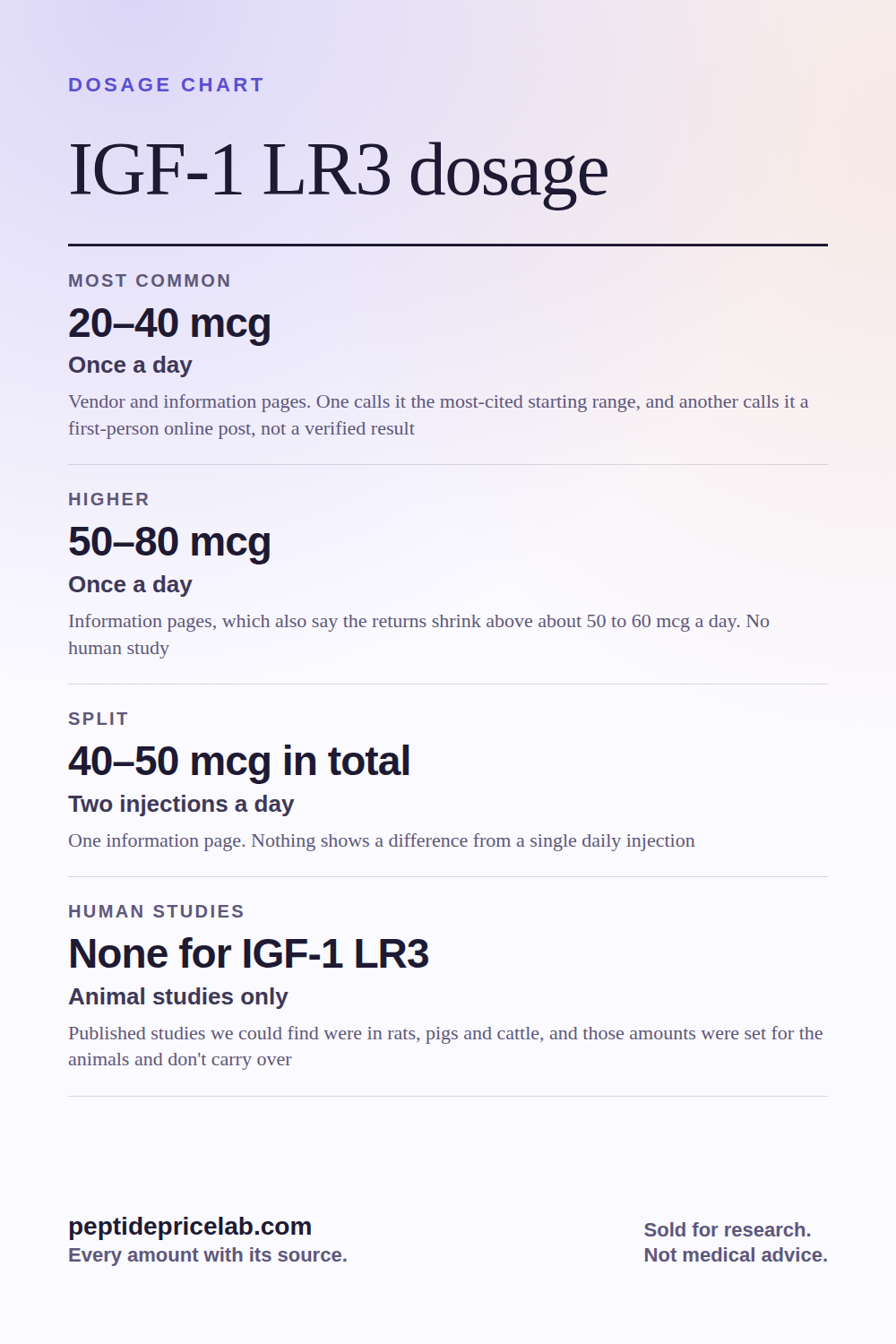
How to read the IGF-1 LR3 chart
IGF-1 LR3 is a lab-made version of IGF-1, a growth signal your body makes when growth hormone rises, and background on it lives on the IGF-1 LR3 page. Every row is what vendor and information pages describe, and the source column says how firm each one is. Read that column before the amounts.

IGF-1 LR3 injection dosage and mixing
IGF-1 LR3 is sold as a freeze-dried powder, usually in a 1 mg vial, for injection under the skin. The information pages mix it with bacteriostatic water, which is sterile water with a preservative so one vial can be drawn from more than once. Vendor listings often say to use a dilute acetic acid solution instead, so follow the paperwork that came with your vial. The math below is identical for any liquid, because only the volume matters. Our guide to bacteriostatic water, sterile water and acetic acid covers the difference.
The tables show the units to draw on a U-100 syringe, which holds 100 units in 1 mL, for 1, 2 and 3 mL of liquid. These are tiny draws. At 20 mcg a dose, 1 mL of liquid means 2 units, which is hard to read on a syringe, so more liquid makes each draw bigger and easier to measure.
| Water | Strength | 20 mcg | 40 mcg | 80 mcg |
|---|---|---|---|---|
| 1 mL | 1,000 mcg per mL | 2 units | 4 units | 8 units |
| 2 mL | 500 mcg per mL | 4 units | 8 units | 16 units |
| 3 mL | about 333 mcg per mL | 6 units | 12 units | 24 units |
The easy way to keep the units straight is that on a U-100 syringe, 1 mL of liquid makes every unit 10 mcg, 2 mL makes it 5 mcg and 3 mL makes it about 3.3 mcg. Pick the amount of liquid first, then divide your dose by that number to get the units. A 40 mcg dose is 4 units at 1 mL, 8 units at 2 mL and 12 units at 3 mL, which matches the table.
The 1 mg size means a small measuring error is a bigger share of each dose than it would be on a 5 mg vial. For any other vial size, liquid or amount, the reconstitution calculator does the same math.
When and how often
Once a day. Information pages give one injection a day, and some put a half-life of 20 to 30 hours behind that. That figure is a vendor claim, and one page points out that no human study backs it. In the rat study we reviewed, IGF-1 LR3 actually cleared from the blood faster than ordinary IGF-1, so treat the long half-life as unconfirmed.
After exercise, with something to eat. This is the timing the pages describe most, usually with fast carbohydrate alongside. The pages explain that IGF-1 acts a bit like insulin and can lower blood sugar, which is why they say to avoid injecting on an empty stomach and why most advise against right before bed, when you wouldn't notice a drop. One page puts it as morning or after exercise, and another lists bedtime as an alternative. They disagree, and none cites a study.
Four to six weeks, then a break. The course described most often is 4 to 6 weeks on, with at least as long off before another. Pages give the reason as keeping the body from turning down its response, and none shows a study that tested it. The only course-length animal work we found ran two weeks in rats, so nothing published sets a human course or a break.
Where the sources agree, and where they split
They agree on the shape. Everyone describes a small daily amount in micrograms, a short course, a break of at least the same length and a warning about blood sugar, and the 1 mg vial is the common starting point. The 20 to 40 mcg range turns up on nearly every page, which is why it leads the chart, and the pages that go further say the extra amount adds risk faster than it adds anything else.
They split on timing and on how to mix it. One page says morning or after exercise, another puts bedtime beside it, and a third says almost every source advises against bedtime. On mixing, vendor listings usually say dilute acetic acid, the information pages mostly show bacteriostatic water, and one reference uses a dilute hydrochloric acid solution and gives a mixed vial only a week in the fridge. We keep the 28-day clock the rest of this site uses, and the vendor's own instructions win over any of these pages for the liquid and how long it keeps.
The limit on all of it is where the numbers came from. The pages we read don't cite a human dosing study, because there isn't one. One of them says its 20 to 40 mcg range is a plan from a first-person post, and that none of its sources show the range works for muscle. The animal studies that exist ran for two weeks in rats and gave amounts sized for the animals.
How long a vial lasts
A mixed vial goes on a 28-day clock in the fridge the day liquid goes in, however much of it gets used. At 20 mcg a day the vial holds 50 doses, but only 28 fit inside the clock, so about 440 mcg expires, and six weeks at 40 mcg a day takes two vials, mixed one at a time.
One information page gives the unmixed powder a long life frozen and months in the fridge, and a mixed vial that turns cloudy or changes color goes in the trash. Keep a mixed vial in the fridge, and one page says not to freeze it.
Taking IGF-1 LR3 with other peptides
People do pair IGF-1 LR3 with the growth hormone peptides, since the searches for it pair it with CJC-1295 and ipamorelin more than with anything else. The one dosed pairing we found is on a single information page: 40 mcg of IGF-1 LR3 after exercise, with CJC-1295 without DAC at 100 mcg two or three times a week and ipamorelin at 200 mcg twice a day. We found no study of any of them together, and the page cites none. That schedule also differs from the usual amounts on the linked dosage pages. Amounts for the other two are on the CJC-1295 dosage page and the ipamorelin dosage page, and our CJC-1295 vs IGF-1 LR3 comparison covers how the two differ.
The same pages are firm on one pairing to avoid, which is insulin or any medication for blood sugar. The pages explain that IGF-1 lowers blood sugar on its own, so the two add up.
Signs the amount or timing is off
These are reported experiences, and no human study measured any of them.
Low blood sugar. People describe shakiness, sweating, sudden hunger, a pounding heart or feeling light-headed, usually within the hours after an injection. The pages say to eat something fast-acting and to inject with food, not on an empty stomach. It's the most common thing they warn about, and it's what the label for the prescription version of IGF-1 warns about most.
Jaw soreness, headaches or achy joints. One page lists them as the next most common after low blood sugar.
No change by the end of the course. No study says what the end of a course should look like, and the pages we read don't either, so the pages we read leave that to you.
It's sold for research, there's no approved IGF-1 LR3 product to read a label from, and every amount here is what people describe.
Questions people ask about IGF-1 LR3 dosage
How much IGF-1 LR3 should I take per day?
Information pages most often give 20 to 40 mcg once a day, and some go to 50 to 80 mcg. No study has dosed IGF-1 LR3 in people, and one page says outright that its range is a plan from an online post, not a verified result.
How much bacteriostatic water for a 1 mg vial of IGF-1 LR3?
You can use 1, 2 or 3 mL, because the liquid only changes the size of each draw. With 2 mL, a 40 mcg dose is 8 units on a U-100 syringe. Vendor listings often say to use dilute acetic acid instead, and the math is the same either way.
Can you take IGF-1 LR3 every day without a break?
The pages describe 4 to 6 weeks on and at least as long off, and discourage continuous use. No study or label sets it either way.
When is the best time to take IGF-1 LR3?
Information pages most often say after exercise, with something to eat. Most advise against right before bed, because low blood sugar is hard to notice asleep. No study tested any timing.
Has IGF-1 LR3 been studied in people?
We found no published human study. The research in living bodies was in rats, pigs and cattle, which is why every amount on this page is what people describe, not what a trial found.
Where to buy IGF-1 LR3
The five lowest per-mg prices in this morning's check, one listing per vendor.
- Flawless Compounds 1 mg · $32.45 $32.45/mg
- Glow Aminos 1 mg · $32.45 $32.45/mg
- Alpha Labs 1 mg · $46.89 $46.89/mg
- Evolve BioPep 1 mg · $49.99 $49.99/mg
- Profound Aminos 1 mg · $51.00 $51.00/mg
Tell me when IGF-1 LR3 gets cheaper
Free. We'll email you when the lowest price we track drops 10% below today's, with the vendor and the link.
One click to confirm. Your alert lives in a free account under this email, so you can change or stop it in the app. We'll also send a few short emails on buying smart, and you can unsubscribe from those anytime without losing your alert.
More on IGF-1 LR3
Your next step
Also on Android