What it is
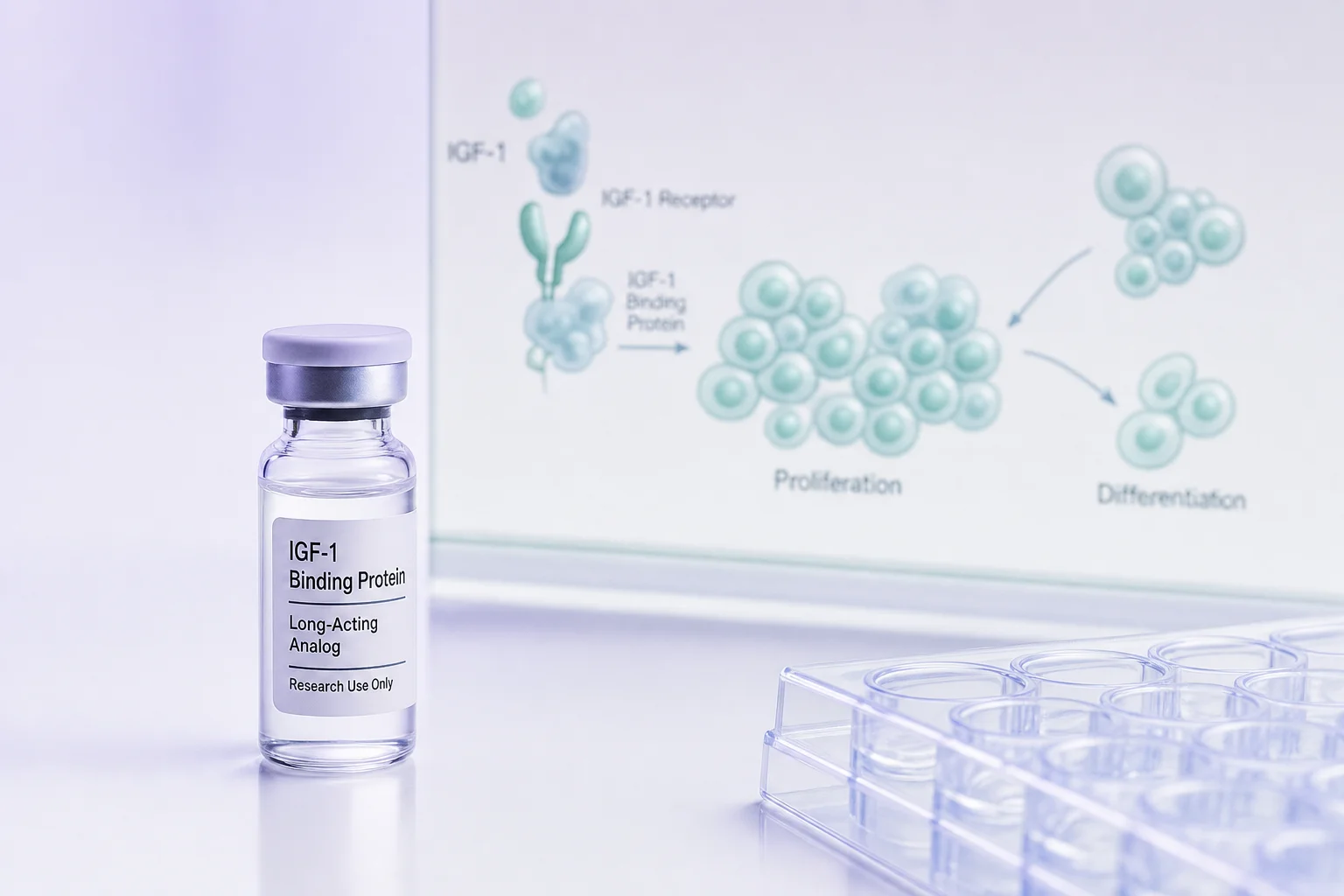
IGF-1 LR3, also written Long R3 IGF-I, is an 83-amino acid synthetic analog of human insulin-like growth factor-1 (IGF-1). It differs from native IGF-1 in two ways: a 13-amino acid extension at the N-terminus and a substitution of arginine (Arg) for glutamic acid at position 3. Together these changes reduce the molecule's affinity for IGF-binding proteins (IGFBPs) by roughly 500-fold compared to native IGF-1. Because IGFBPs sequester most circulating IGF-1 and limit its availability to tissues, the low-binding analog remains biologically active in circulation far longer. [1]
The practical result is a half-life of approximately 20 to 30 hours in animal studies, compared to the 12 to 15 minutes typical of native IGF-1. IGF-1 LR3 was originally developed as a research tool to study IGF-1 biology without the confounding effect of binding proteins, and it remains widely used as a cell culture supplement in tissue engineering and stem cell research. It is not FDA-approved for any use in humans, and unlike native IGF-1 (mecasermin, sold as Increlex), it has no approved pharmaceutical form.
What researchers study it for
- Anti-catabolic effects and muscle protein preservation In rat models of catabolism induced by dexamethasone (a glucocorticoid that rapidly degrades lean tissue), LR3 IGF-I demonstrated superior potency to native IGF-1 in reversing protein breakdown, an effect maintained whether the compound was delivered by continuous infusion or subcutaneous injection. [2] A separate study found that infused LR3 IGF-I attenuated weight loss during food restriction in young and adult rats, though skeletal muscle mass was not fully preserved alongside total body weight. [3]
- Growth restoration in deficient models Across multiple animal models including streptozotocin-induced diabetic rats and neonatal pigs, LR3 IGF-I has been studied for its ability to restore growth parameters that decline in states of IGF-1 deficiency or insulin dysregulation. Researchers observed that LR3 IGF-I promoted growth without reproducing all the characteristic insulin-like metabolic effects of native IGF-1, suggesting partial functional separation of its anabolic and insulin-mimetic pathways. [1] [4]
- Protein metabolism in catabolic states Studies in beef heifers under conditions of protein restriction found that intravenous LR3 IGF-1 infusion was associated with changes in circulating amino acid profiles and reduced urinary nitrogen excretion, consistent with reduced net protein breakdown. [5] Researchers have used these models to characterize how IGF-1 signaling interacts with nutritional status to govern whole-body protein turnover.
- IGFBP resistance as a research tool Because LR3 IGF-I bypasses endogenous IGF-binding proteins, it has been widely used in cell biology to study IGF-1 receptor signaling without the complication of IGFBP competition. This makes it a standard reagent in cell culture protocols for applications including skeletal muscle satellite cell activation, chondrocyte proliferation, and growth factor pathway research. The in vitro literature on LR3 IGF-I is substantially larger than the in vivo literature.
Research context
The key thing to understand about IGF-1 LR3's evidence base is that it is entirely preclinical. Every published study examining its in vivo effects has been conducted in animal models (primarily rats, pigs, and cattle), with no peer-reviewed human clinical trials in the literature. This is a meaningful distinction. The human IGF-1 literature, which is substantial, uses native recombinant IGF-1 (mecasermin), not the LR3 analog. Researchers and consumers who extrapolate from human mecasermin trials to IGF-1 LR3 are treating two different molecules as equivalent, which the pharmacokinetic and receptor data do not fully support. [1] [2]
The animal data are also internally inconsistent in ways worth noting. While rat studies consistently show anabolic and anti-catabolic activity for LR3 IGF-I, at least one pig study found that the analog reduced growth rather than promoting it, apparently by suppressing endogenous GH and IGF-1 feedback loops through a mechanism not observed in rodents. Species differences in IGFBP expression and IGF-1 axis regulation are significant, which limits the confidence with which rodent findings can be generalized to humans. [4] The compound's primary validated role is as a cell culture reagent, and that is where the evidence is most robust.
Typical research parameters
| Parameter | Detail |
|---|---|
| Common vial sizes | 1 mg, 5 mg; larger quantities for cell culture applications |
| Supplied as | Lyophilized (freeze-dried) powder |
| Reconstitution | Typically acetic acid (0.1–1%) or sterile PBS for cell culture grade |
| Storage (lyophilized) | Refrigerated (2–8°C); can be stored at -20°C for longer periods; protect from repeated freeze-thaw cycles |
| Stability (reconstituted) | Generally 7–14 days refrigerated; more stable with carrier protein (e.g., 0.1% BSA) added |
| Administration studied (in vivo) | Subcutaneous injection and continuous intravenous infusion in published animal studies [2] [5] |
| Half-life (animal models) | Approximately 20–30 hours vs. 12–15 minutes for native IGF-1 [1] |
References
- [1] Tomas FM, Knowles SE, Owens PC, Chandler CS, Francis GL, Ballard FJ. Insulin-like growth factor-I and more potent variants restore growth of diabetic rats without inducing all characteristic insulin effects. Biochemical Journal. 1993;291:781–6. PubMed ↗
- [2] Tomas FM, Lemmey AB, Read LC, Ballard FJ. Superior potency of infused IGF-I analogues which bind poorly to IGF-binding proteins is maintained when administered by injection. Journal of Endocrinology. 1996;150:77–84. PubMed ↗
- [3] Tomas FM. Insulin-like growth factor-I (IGF-I) analogue, LR(3)IGF-I, ameliorates the loss of body weight but not of skeletal muscle during food restriction. Growth Hormone and IGF Research. 2001;11(2):117–24. PubMed ↗
- [4] Dunshea FR, Chung CS, Owens PC, Ballard JF, Walton PE. Insulin-like growth factor-I and analogues increase growth in artificially-reared neonatal pigs. British Journal of Nutrition. 2002;87(6):593–601. PubMed ↗
- [5] Hill RA, Hunter RA, Lindsay DB, Owens PC. Action of long(R3)-insulin-like growth factor-1 on protein metabolism in beef heifers. Domestic Animal Endocrinology. 1999;16(3):219–29. PubMed ↗