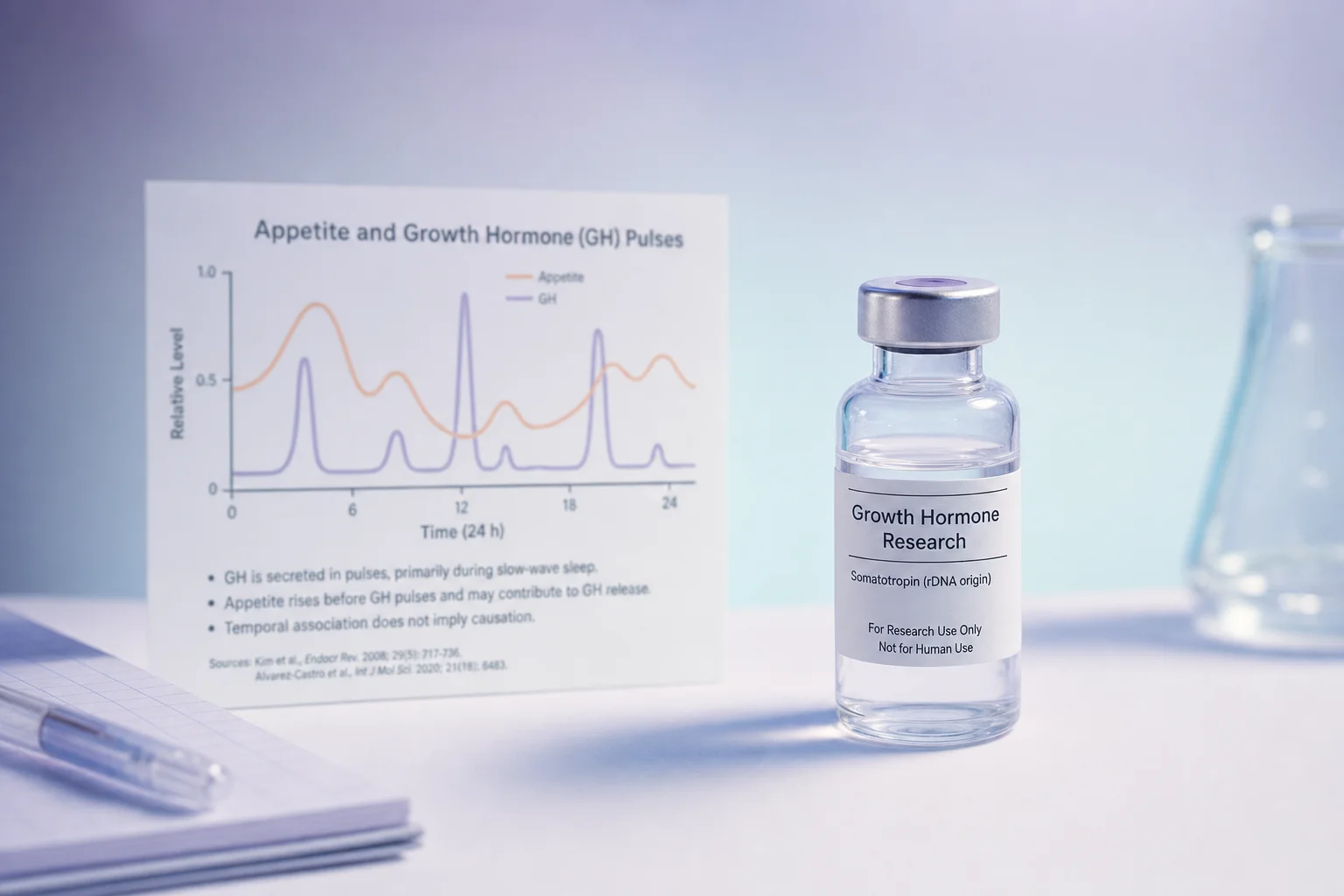
In a controlled study, researchers gave healthy men GHRP-2 and then let them eat as much as they wanted at a buffet. Every single participant ate more than the placebo group. The average increase in food intake was about 36%. If you're considering this compound for body composition or anti-aging reasons, that finding belongs at the top of your reading list, not buried at the bottom.
What it actually is
Your body has a hormone called ghrelin, sometimes called the hunger hormone, that travels from your stomach to your brain and pituitary gland and signals that it's time to eat and, separately, that it's time to release growth hormone. GHRP-2 is a short synthetic peptide that binds the same receptor as ghrelin in the pituitary and hypothalamus. When it binds, it triggers a robust burst of growth hormone release.
GHRP-2 was developed at Tulane University as part of a series of synthetic compounds studying this receptor pathway, alongside related molecules like GHRP-6 and Hexarelin. It's approved in Japan as a pharmaceutical called Pralmorelin for diagnosing growth hormone deficiency. In the US and most other countries, it isn't approved and remains a research compound.
Unlike sermorelin, which mimics the signal your hypothalamus sends to the pituitary, GHRP-2 works at the ghrelin receptor directly. Both stimulate your own pituitary to release growth hormone rather than adding growth hormone from outside. But GHRP-2 also produces concurrent increases in cortisol and ACTH, stress-related hormones, which is something sermorelin and ipamorelin don't do to the same degree.
Why women in midlife are paying attention
Growth hormone production declines with age in both men and women, but the conversation in the peptide world has been dominated by men's performance and body composition goals. The framing you'll encounter most often is about muscle growth, fat loss, and recovery. That's real, but it's not the whole picture for women.
For women navigating perimenopause and post-menopause, the interest in growth hormone secretagogues is less about performance and more about the quiet erosion of lean mass, the body composition shifts that arrive with hormonal change, the skin changes, the fatigue that doesn't respond to sleep. Growth hormone plays a role in all of these systems. GHRP-2 is a potent trigger for GH release, and that's why it gets mentioned in these contexts.
What changes the picture for women specifically: the appetite-stimulating effect isn't separable from the GH-stimulating effect. Both happen through the same receptor. If you're trying to manage your weight while simultaneously trying to support GH levels, a compound that reliably increases hunger by over a third is working against one of your primary goals. This isn't a side effect that can be minimized. It's a core feature of how the compound works.
What the research actually shows
The diagnostic use of GHRP-2 in Japan is well-characterized. Standardized testing protocols exist, with established thresholds for what constitutes a normal versus deficient GH response. Researchers have validated it in both adults and adolescents. This is the most solid part of the evidence base, and it confirms the compound does what researchers say it does at the pituitary level.
For body composition applications, most of the evidence comes from short-term studies, small samples, and retrospective analyses rather than randomized controlled trials. A 2018 review of growth hormone secretagogue literature noted promising signals for lean mass and fat metabolism but concluded that rigorous long-term trials were still limited. The appetite study stands out because it was a controlled human crossover study with a clear, replicable result. The body composition evidence is more suggestive.
GHRP-2 is also consistently one of the most potent GH secretagogues studied in humans, generally producing larger GH responses than GHRP-6 at equivalent amounts. More potency, however, also means more pronounced cortisol co-stimulation. Elevated cortisol over time is associated with the exact body composition outcomes most people are trying to avoid, and that's a real consideration in any long-term protocol.
The appetite effect comes with it
The appetite effect isn't separable. There's no known way to use GHRP-2 and capture only the GH-stimulating effects while leaving the hunger-stimulating effects behind. Researchers have proposed it as a useful tool for studying ghrelin's role in eating behavior precisely because the two effects are so reliably linked. Anyone using this compound for fat loss or body composition while ignoring the hunger data is working from an incomplete picture.
Long-term effects in healthy adults outside of a diagnostic context aren't well-studied. Sustained GH and IGF-1 elevation carries its own set of concerns in the research literature, and the cortisol and ACTH co-stimulation adds another layer of complexity. The Japanese approval is for short-term diagnostic testing, not ongoing use.
If you're considering a growth hormone secretagogue for midlife wellness or body composition, the comparison with ipamorelin and sermorelin is worth doing carefully. Those compounds don't produce the same appetite and cortisol effects. That distinction matters in the real world, not just on paper.