If you've been doing everything the same as always and your weight has gone sideways anyway, you already know "eat less, move more" stopped being real advice a while back. Most of what gets sold to you as the fix is a mouse study and a good story. Cagrilintide isn't that. It has human trials behind it, and the results are hard to shrug off. Here's what's going on, and what it means for you.
What it actually is
Your body already makes a hormone called amylin every time you eat. It comes out of your pancreas right alongside insulin, and its whole job is to tell your brain "okay, that's enough," slow down how fast food leaves your stomach, and keep the hunger signal that usually creeps back an hour later from firing off. You already have a built-in fullness system. The catch is it only sticks around for a few minutes before your body clears it out.
Cagrilintide is a lab-made version of that same signal, built to last about a week instead of a few minutes. Think of it as taking a message your body already knows how to send and giving it a much longer battery life. There's already an approved short-acting version of this idea (pramlintide), but it needs a shot every single day, which is a lot to ask of anyone. Cagrilintide fixes that math. You'll almost always see it studied alongside semaglutide, sometimes called CagriSema, because the two signals work on different switches in your brain.
Why you're paying attention
This isn't the gym-bro, six-pack conversation. If you're in perimenopause or past it, you already know your body is holding onto weight in new places, mostly around your middle, while muscle just quietly disappears no matter what you do about it. And the plan that used to work for you? It doesn't anymore. That's not a willpower problem. Body composition really does shift through this transition, and nobody has fully figured out why yet, which is part of what makes it so maddening to live through.
This is one of the first things in this space that's shown up with real numbers behind it instead of just a theory someone's selling you. That's why it's worth knowing about, even if you never touch it yourself.
What the research actually shows
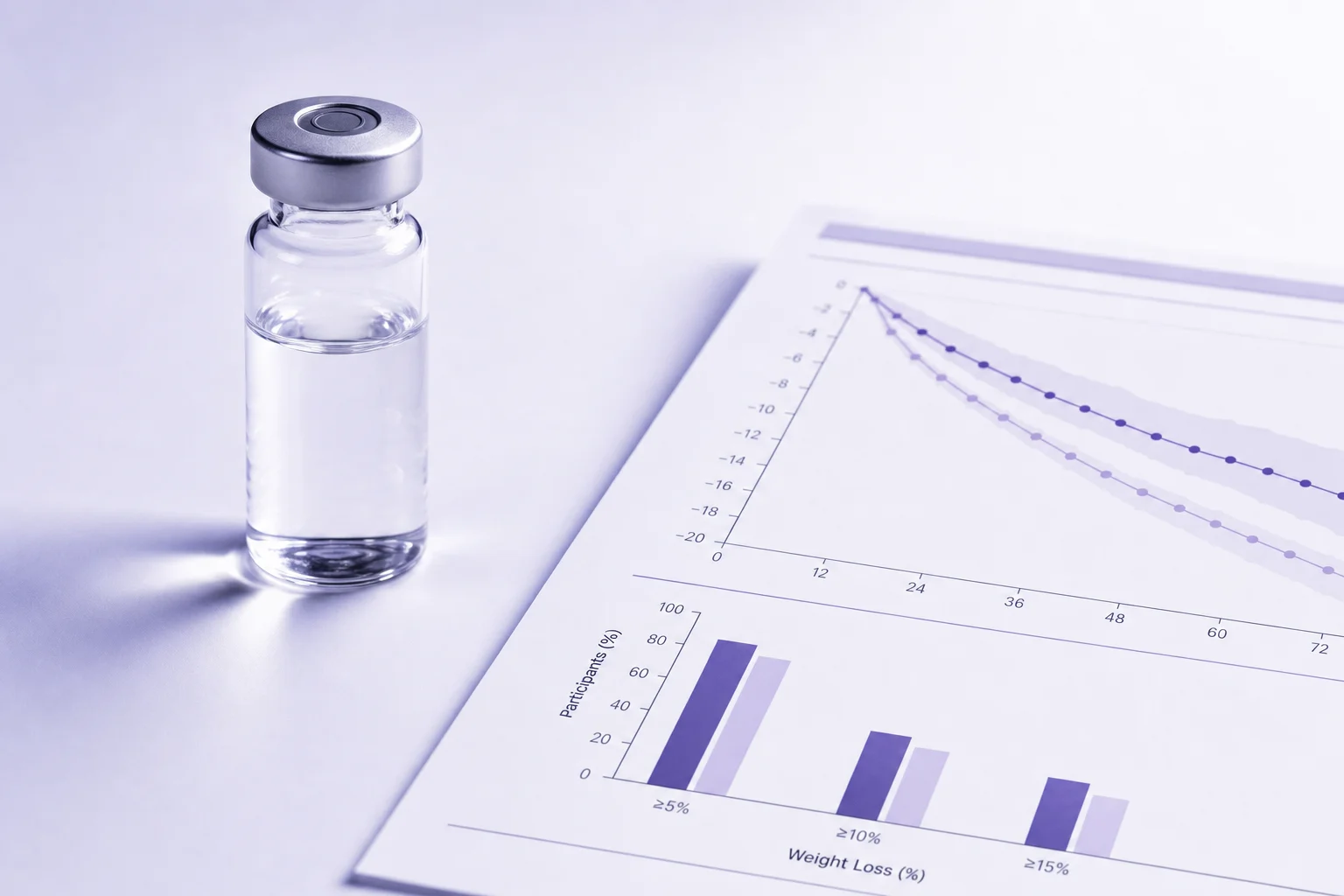
The part that surprised me, too, is that people on the combination lost about 22% of their body weight over more than a year. For comparison, semaglutide by itself in a similar study got people to around 15%. That extra bit seems to come from the amylin signal doing something the GLP-1 signal doesn't do on its own.
There'd already been a smaller trial before this one, showing the combination was tolerated well enough to justify going bigger. That's a reasonable way for evidence to build.
What's worth sitting with, though, is that 22% belongs to the combination, not to cagrilintide by itself. Nobody has really tested what cagrilintide does on its own, at what dose, or for how long. So if you're picturing this as a standalone tool, that hasn't actually been studied yet.
Before you spend money on this
A few things worth knowing before you spend money on this.
Cagrilintide isn't approved anywhere yet. The FDA and EMA haven't signed off on it for anything as of right now. Everything above is trial data, not a bottle you can pick up at a pharmacy.
What you'd actually be buying from a research vendor isn't the pharmaceutical-grade version used in the trials, and purity varies a lot by vendor. You'll sometimes see cagrilintide sold blended with other compounds too, so don't assume what's in the vial matches exactly what was studied unless the COA says so.
Side effects in the trials tracked closely with what semaglutide already does on its own, like nausea, some vomiting, and constipation. Not exactly news if you've been paying attention to the GLP-1 world, but worth having in your head. And the safety data only covers as far out as the trials ran, so anything past that's still an open question.
If you're weighing this seriously, that's a conversation for a healthcare provider who knows your full picture.