What it is
Cagrilintide is a long-acting synthetic analog of amylin, a peptide hormone that is co-secreted with insulin from pancreatic beta cells. It was developed by Novo Nordisk to extend amylin's natural half-life (measured in minutes) to approximately seven days, enabling once-weekly subcutaneous dosing.
Amylin acts on receptors in the brainstem and hypothalamus to promote satiety, slow gastric emptying, and suppress post-meal glucagon secretion. Cagrilintide is structurally related to pramlintide (a shorter-acting approved amylin analog sold as Symlin) but with modifications that dramatically extend its duration of action. In most published research, cagrilintide has been studied as part of a fixed-ratio combination with semaglutide, referred to as CagriSema.
What researchers study it for
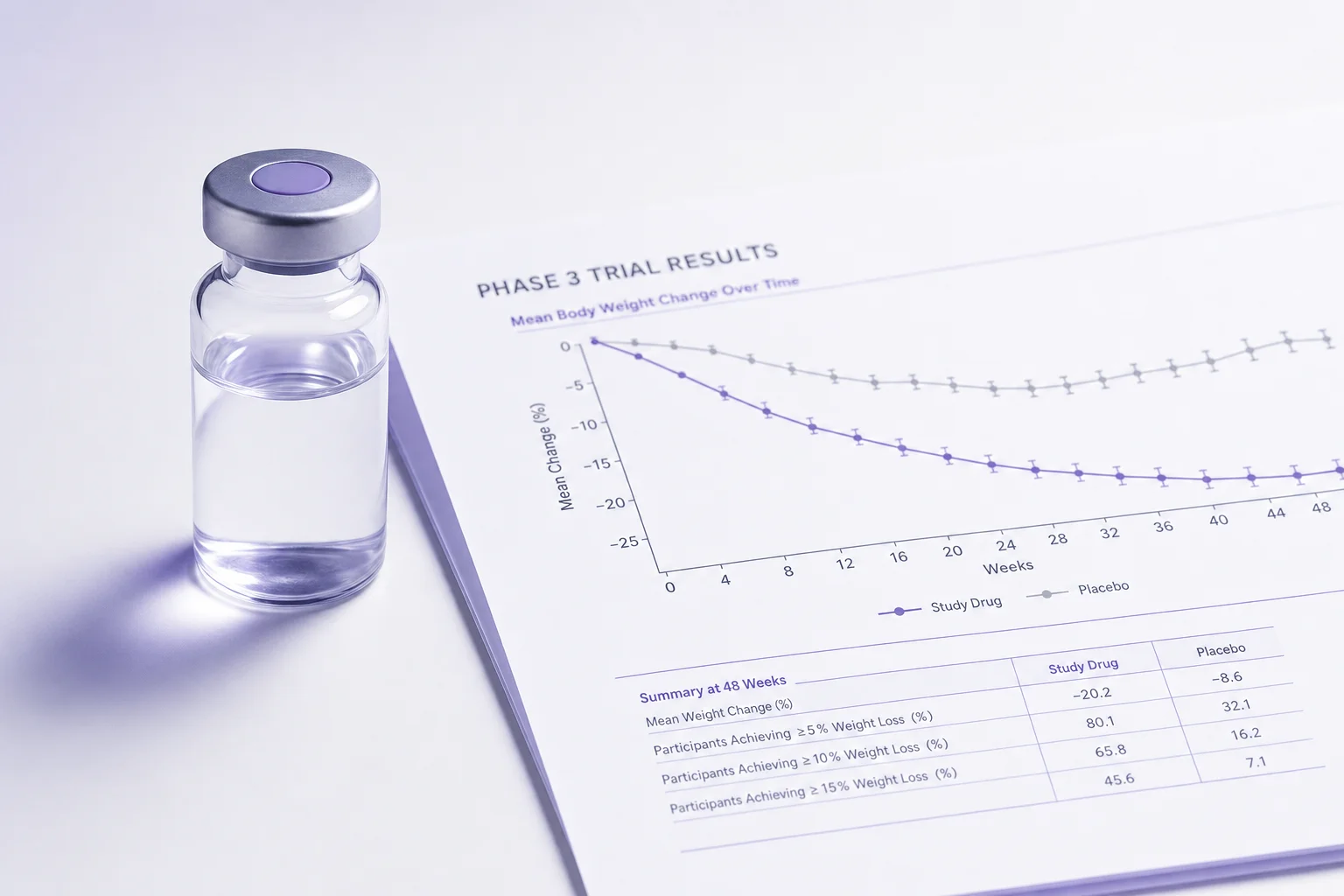
- Weight reduction in adults without diabetes The REDEFINE 1 trial examined CagriSema (cagrilintide 2.4 mg plus semaglutide 2.4 mg) in adults with overweight or obesity, with researchers reporting a mean weight reduction of approximately 22% over 68 weeks. [1]
- Weight reduction in adults with type 2 diabetes The REDEFINE 2 trial studied the same combination in individuals with type 2 diabetes, a population where weight loss with GLP-1 monotherapy is typically attenuated; results showed meaningful reductions compared to semaglutide alone. [2]
- Pharmacokinetics and early safety of the combination A Phase 1b Lancet trial by Enebo et al. examined the tolerability and pharmacokinetic profile of cagrilintide and semaglutide co-administered over multiple doses, establishing a foundational safety dataset that supported progression to Phase 3. [3]
- Amylin receptor signaling and neuroendocrine satiety mechanisms Review literature has characterized how amylin receptor agonism engages brainstem and hypothalamic circuits differently from GLP-1 receptor agonism, with researchers proposing that the two pathways act on complementary satiety nodes rather than redundant ones. [4]
- Amylin analogs for obesity in people without diabetes Panou et al. reviewed the developing landscape of amylin-based therapies targeting weight in non-diabetic populations, noting that cagrilintide represents the furthest-advanced compound in this class. [5]
Research context
The clinical evidence base for cagrilintide is notable for being built almost entirely on human trials rather than animal or in vitro models. The two REDEFINE Phase 3 trials, published in the New England Journal of Medicine in 2025, are the anchor studies for this compound.[1][2] Because cagrilintide has been studied almost exclusively alongside semaglutide rather than as a standalone agent, separating the specific contribution of amylin receptor agonism from GLP-1 receptor agonism in the combination's outcomes is methodologically complex. Most published analyses have not tested cagrilintide monotherapy against placebo in large human trials.
The mechanistic rationale for combining amylin and GLP-1 agonism rests on the observation that these pathways act on different receptor populations in the brainstem and hypothalamus.[4] The Enebo et al. Phase 1b data suggested the combination was generally well-tolerated, with a gastrointestinal side effect profile broadly consistent with semaglutide monotherapy, though direct comparisons across trials carry the usual caveats.[3] As of mid-2026, cagrilintide has not received FDA or EMA approval; regulatory review is ongoing.
Typical research parameters
| Parameter | Typical range |
|---|---|
| Common vial sizes | 0.5 mg, 1 mg (research supply; availability varies by vendor) |
| Supplied as | Lyophilized powder, reconstituted with bacteriostatic water |
| Storage | Lyophilized: refrigerated; reconstituted: refrigerated and used within 28 days |
| Stability | Lyophilized: 12–24 months; reconstituted: approximately 4 weeks refrigerated |
| Administration studied | Subcutaneous injection; weekly dosing studied in all published clinical trials |
References
- [1] Garvey WT, Blüher M, et al. Coadministered Cagrilintide and Semaglutide in Adults with Overweight or Obesity. The New England Journal of Medicine. 2025;393. PubMed ↗
- [2] Davies MJ, Bajaj HS, et al. Cagrilintide-Semaglutide in Adults with Overweight or Obesity and Type 2 Diabetes. The New England Journal of Medicine. 2025;393. PubMed ↗
- [3] Enebo LB, Berthelsen KK, et al. Safety, tolerability, pharmacokinetics, and pharmacodynamics of concomitant administration of multiple doses of cagrilintide and semaglutide in adults with obesity: a randomised, controlled, phase 1b trial. Lancet. 2021;397. PubMed ↗
- [4] Eržen S, Tonin G, Jurišić Eržen D, Klen J. Amylin, Another Important Neuroendocrine Hormone for the Treatment of Diabesity. International Journal of Molecular Sciences. 2024;25. PubMed ↗
- [5] Panou T, Gouveri E, Popovic DS, Papanas N. Amylin analogs for the treatment of obesity without diabetes: present and future. Expert Review of Clinical Pharmacology. 2024. PubMed ↗