Vilon dosage
Vilon is taken in short courses, and the amount depends on whether it's an injection or a capsule. Here's each pattern, where it comes from, and the math for a 20 mg vial.
How much Vilon do people take?
Amount
100–200 mcga day, injectedTiming
Once a dayevery day of the courseCourse
10–20 daysonce or twice a yearRoute
Under the skinor capsules at 10–20 mgThe injected amount, timing, course and repeat are the convention on peptide education pages, which trace it to Russian short-course practice. The capsule amount is from Russian capsule labels. No approved label or dose-finding study sets any of them.
Vilon dosage chart
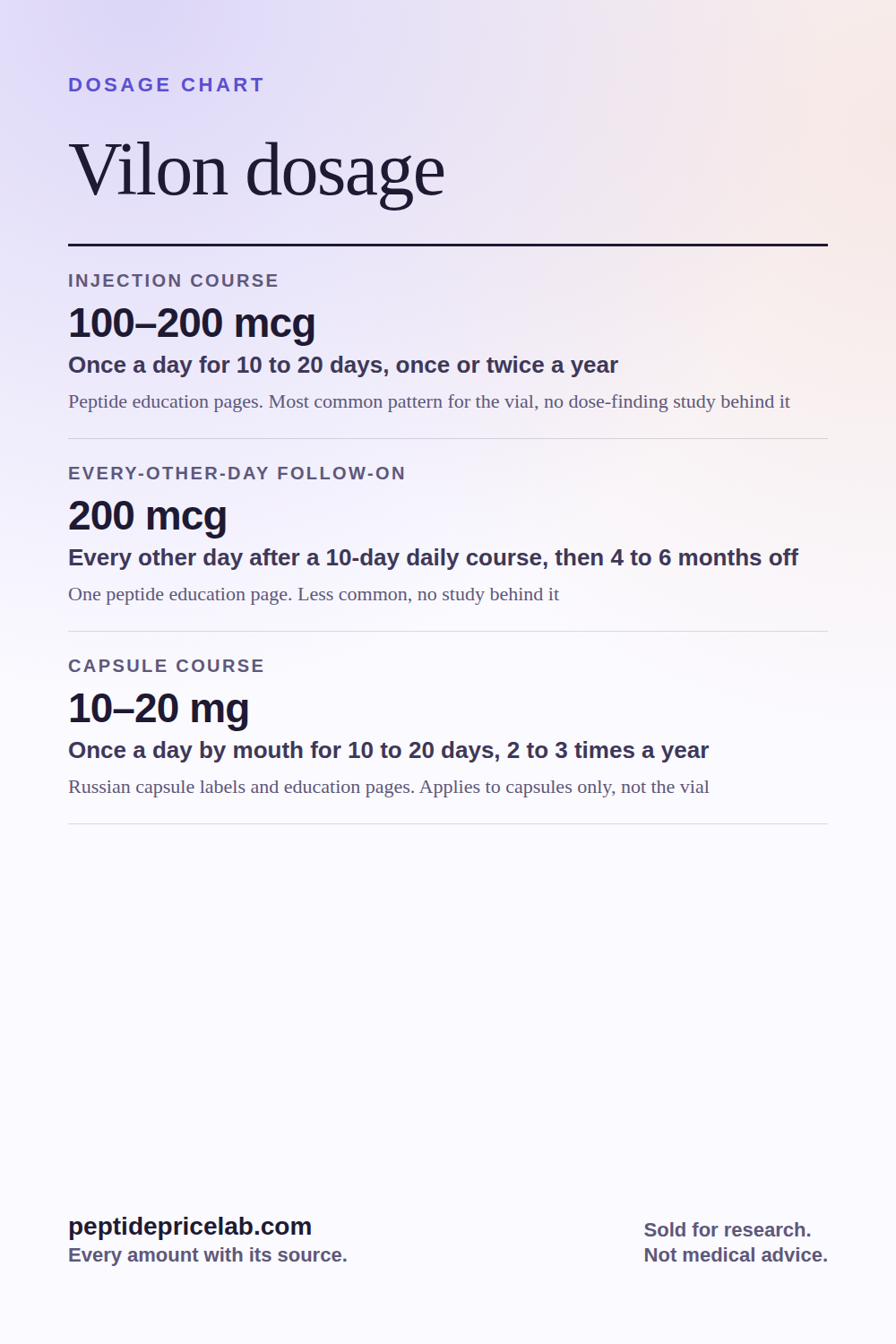
Where each amount comes from
Three patterns are in circulation, and the biggest difference between them is the form. The injection rows use micrograms, the capsule row uses milligrams, and you'll want to keep those two worlds apart. Every figure is a convention from education pages or a capsule label, so read the source column alongside the amount. Background on the peptide is on the Vilon page.

Vilon injection dosage and mixing
Research vendors sell Vilon as a freeze-dried powder, almost always in 20 mg vials. You mix it with bacteriostatic water, which is sterile water with a small amount of preservative so one vial can be drawn from more than once. The injection patterns in the chart are for this powder, injected under the skin.
The table shows the units to draw on a U-100 syringe, which holds 100 units in 1 mL, for 1, 2 and 3 mL of water. The amounts are the two ends of the injection range, 100 mcg and 200 mcg, from peptide education pages.
| Water | Strength | 100 mcg dose | 200 mcg dose |
|---|---|---|---|
| 1 mL | 20 mg per mL | 0.5 units, hard to measure | 1 unit, hard to measure |
| 2 mL | 10 mg per mL | 1 unit, hard to measure | 2 units |
| 3 mL | 6.7 mg per mL | 1.5 units, hard to measure | 3 units |
Amounts are from peptide education pages. Units are math from those amounts, with strength rounded to one decimal. "Hard to measure" means the draw is below about 2 units, smaller than most U-100 syringes mark clearly.
The practical point is that a 20 mg vial is a lot of Vilon for doses this small, so every draw is tiny. More water makes each dose bigger on the syringe and easier to read. At 5 mL, if the vial has room for it, 100 mcg is 2.5 units and 200 mcg is 5 units. For any other water volume or amount, the reconstitution calculator does the same math.
Mixing follows the same steps education pages give for any freeze-dried peptide. Let the vial come to room temperature, wipe the stopper with an alcohol swab, and run the water slowly down the inside wall of the vial rather than straight onto the powder. Then swirl gently until it's clear, without shaking, and write the date on the label so you know when the 28 days run out.
The supplies are the ordinary ones. Bacteriostatic water comes in small multi-use vials, and U-100 insulin syringes are the ones the units in the table refer to. Many people buy short syringes marked in single units, because at these amounts the difference between 2 and 3 units is a 50% change in the dose. A syringe is single use, one per dose, so a 10-day course is ten syringes and one vial, and the counts are supposed to differ.
Vilon capsule dosage
The Russian capsule form, sold in the same family as the Khavinson "cytogen" capsules, is labeled at 10 to 20 mg a day by mouth for 10 to 20 days, repeated two or three times a year. Capsules are commonly 10 mg each, so the label range works out to one or two a day.
That's roughly a hundred times the injected amount. The usual explanation is that a swallowed peptide is mostly broken down in the gut before it can do anything, so capsule makers allow for the loss. Nobody has measured how much Vilon survives, which is why the two forms aren't converted into each other here.
When and how often
Once a day. On dosing days, every pattern in the chart uses a single dose, per peptide education pages and capsule labels.
Ten to twenty days. Education pages give 10 to 20 days in a row for injection, and capsule labels give the same window.
Once to three times a year. Injection courses are described as once or twice a year, and capsule courses as two or three times a year. One education page adds an every-other-day follow-on at 200 mcg after a 10-day course, then 4 to 6 months off. These trace to Russian short-course practice, and none of it comes from a study that compared schedules.
Time of day. No study or label sets one. People pick a time they can repeat every day of the course.
For planning, one injection course at 100 to 200 mcg a day for 10 to 20 days uses 1 to 4 mg of peptide in all. A capsule course at 10 to 20 mg a day for the same length uses 100 to 400 mg.
| Course | Daily amount | Total peptide |
|---|---|---|
| 10 days, injected | 100 mcg | 1 mg |
| 10 days, injected | 200 mcg | 2 mg |
| 20 days, injected | 100 mcg | 2 mg |
| 20 days, injected | 200 mcg | 4 mg |
| 10 days, capsules | 10 mg | 100 mg, 10 capsules |
| 20 days, capsules | 20 mg | 400 mg, 40 capsules |
Daily amounts and course lengths are from peptide education pages (injection) and Russian capsule labels (capsules). Totals are math, with capsules counted at 10 mg each.
The table is the one to keep in mind when you shop. An injection course needs a few milligrams, so any 20 mg vial is more than enough, and the question is only whether the vendor's per-milligram price and lab report hold up. A capsule course needs a box or two, and the per-capsule strength printed on the box sets how many you need.
How long a vial lasts
On paper a 20 mg vial lasts a long time, 200 days at 100 mcg and 100 days at 200 mcg. In practice the mixed vial goes on a 28-day clock in the fridge the day water goes in, and a course runs 10 to 20 days. At 100 mcg a day a course uses 1 to 2 mg and leaves 18 to 19 mg, and at 200 mcg a day it uses 2 to 4 mg and leaves 16 to 18 mg.
That means one vial covers one course, and most of the peptide in it won't keep until the next course, which is months away. It's a buying point rather than a dosing one, because the cost of a course is really the cost of a vial. Unmixed powder keeps far longer, and vendor pages give 2 to 8°C (36 to 46°F) in the fridge as the storage range.
Taking Vilon with other bioregulators
No study or label sets a combined human schedule, and nothing on this page comes from tested pairings. In the Russian mouse studies, Vilon and Epithalon were given together, and people who run both describe separate courses in the same part of the year, each at its own amount. Epithalon's amounts are on the Epithalon dosage page, and they're measured in milligrams, not micrograms, so the two don't share a syringe draw.
Some people also run Crystagen, the other short immune peptide from the same lab. Its patterns are on the Crystagen dosage page.
Signs the amount or timing is off
These are reported experiences from people who use Vilon, not findings from a study.
Redness or itching where you injected. People report it, usually mild and gone within a day. They rotate the spot, and some stop the course if it lingers.
Feeling run-down or achy early in a course. It's reported now and then. People usually pause and check their math, since a slip of the decimal on a 20 mg vial can turn micrograms into milligrams.
Mixing up the two forms. The most serious mistake people describe isn't a side effect, it's applying the capsule amount to the vial. Ten milligrams injected would be 50 to 100 times the injected amount on education pages, and it would empty half a 20 mg vial in one draw. If a dose ever looks like a large share of the vial, people stop and recheck which form the number belongs to.
Nothing noticeable at all. This is the most common report, and it's what you'd expect from a peptide aimed at slow immune changes. People don't usually raise the amount for it, because no source gives a higher injected dose.
No completed human safety study exists for Vilon. What's known and unknown is on the Vilon page. Before buying, the two things to check are the per-milligram price and a recent third-party lab report on identity and purity.
It's sold for research, and the big human trials haven't been run yet.
Questions people ask about Vilon dosage
How much bacteriostatic water for 20 mg of Vilon?
It depends on how small a draw you can measure. With 2 mL, 200 mcg is 2 units, and with 3 mL it's 3 units. At 100 mcg those draws are 1 and 1.5 units, which are hard to read on a U-100 syringe, so some people use more water if the vial has room.
How much Vilon should I take per day?
Education pages give 100 to 200 mcg a day for the injectable powder. Capsule labels give 10 to 20 mg a day, and the two amounts don't swap, because each belongs to its own form.
Can you take Vilon every day without a break?
No study or label sets daily use with no stop date. Every pattern in circulation is a short course followed by months off.
Can you take Vilon with Epithalon?
No study or label sets a combined human schedule. Vilon and Epithalon were given together in some Russian mouse studies, and people describe running separate courses of each in the same season, which is reported use rather than tested use.
Is Vilon better taken orally or injected?
No study has compared the two in people. Capsules use amounts roughly a hundred times larger, which is the usual allowance for a peptide being broken down in the gut.
Where to buy Vilon
The five lowest per-mg prices in this morning's check, one listing per vendor.
- Evolve BioPep 20 mg · $39.99 $2.00/mg
- Oros Research 20 mg · $49.99 $2.50/mg
- Modern Aminos 20 mg · $54.00 $2.70/mg
- LA Peptides 20 mg · $59.99 $3.00/mg
- Core Peptides 20 mg · $74.00 $3.70/mg
Tell me when Vilon gets cheaper
Free. We'll email you when the lowest price we track drops 10% below today's, with the vendor and the link.
One click to confirm. Your alert lives in a free account under this email, so you can change or stop it in the app. We'll also send a few short emails on buying smart, and you can unsubscribe from those anytime without losing your alert.
More on Vilon
Your next step
Also on Android