LL-37 dosage chart and protocol
Injected LL-37 is most often given as 100 to 200 mcg a day, five days a week, while the only human trials put it on wounds as a gel. Here are both, with where each number comes from.
How much LL-37 do people take?
Amount
100–200 mcginjected, a dayTiming
Once a dayfive days on, two offCourse
2–4 weeksthen two weeks offRoute
Under the skintrials used a wound gelThe amount, timing, course and injected route are the pattern repeated in community dosing guides, with no study behind them. The only human trials applied LL-37 to leg ulcers as a gel, and no trial has tested it injected.
LL-37 dosage chart
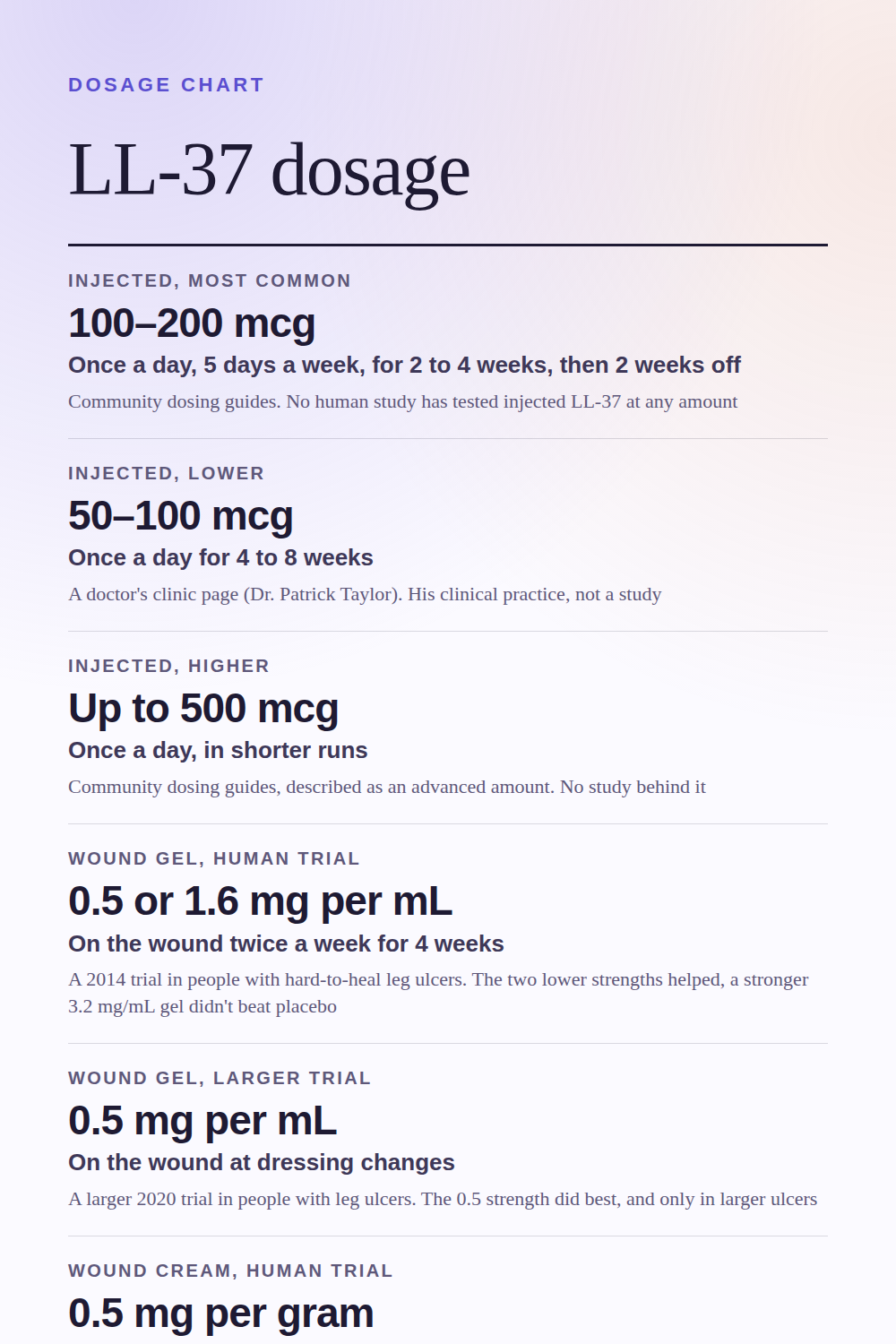
LL-37 dosage chart
LL-37 has two dosage stories, and they don't overlap. The injected rows are community practice, and the wound rows are human trials of a gel or cream on ulcers, so read the source column before comparing amounts. What the peptide is and why people want it lives on the LL-37 page.
LL-37 injection dosage and mixing
LL-37 is sold as freeze-dried powder, most often in 5 mg vials, with 10 mg vials less common. You mix it with bacteriostatic water, which is sterile water with a preservative so one vial can be drawn from more than once. The tables show the units to draw on a U-100 syringe, which holds 100 units in 1 mL, for 1, 2 and 3 mL of water. The amounts across the top are the chart's injected amounts, from community guides and one clinic page.
| Water | Strength | 50 mcg | 100 mcg | 200 mcg | 500 mcg |
|---|---|---|---|---|---|
| 1 mL | 5,000 mcg per mL | 1 unit, too small to read | 2 units | 4 units | 10 units |
| 2 mL | 2,500 mcg per mL | 2 units | 4 units | 8 units | 20 units |
| 3 mL | about 1,667 mcg per mL | 3 units | 6 units | 12 units | 30 units |
Because the common amounts are small, more water helps here. At 3 mL, even 100 mcg is a readable 6 units.
| Water | Strength | 100 mcg | 200 mcg | 500 mcg |
|---|---|---|---|---|
| 1 mL | 10,000 mcg per mL | 1 unit, too small to read | 2 units | 5 units |
| 2 mL | 5,000 mcg per mL | 2 units | 4 units | 10 units |
| 3 mL | about 3,333 mcg per mL | 3 units | 6 units | 15 units |
For any other vial, water or amount, the reconstitution calculator does the same math.
LL-37 on a wound
The only human trials of LL-37 so far put it on a wound. In the first, people with leg ulcers that hadn't healed had a gel spread on twice a week for four weeks, at 0.5, 1.6 or 3.2 mg per mL. The two weaker gels shrank the ulcers more than placebo, the strongest didn't, and the researchers reported no safety concerns over those four weeks. A larger follow-up settled on 0.5 mg per mL, with the benefit mostly in bigger ulcers, and a later diabetic foot ulcer trial used a 0.5 mg per gram cream on the same twice-a-week schedule, where new tissue built faster than on plain cream.
Those gels were made for the trials, on open wounds, under a care team. A strength in milligrams per mL on a wound doesn't tell you anything about an injected amount, which is why the two halves of the chart can't be compared.
When and how often
Once a day, five days on and two off. That's the injected pattern in the community guides, and we found no study that tests it or explains the days off.
Two to four weeks, then two weeks off. It's the run described most often, again from community guides. The clinic page describes a longer, lower run of four to eight weeks.
Twice a week on a wound. That's the trial schedule for the gel and cream, set to match routine dressing changes.
No source we found names a time of day, so take that as your own call.
How long a vial lasts
A mixed vial goes on a 28-day clock in the fridge the day water goes in, and at LL-37's small amounts that clock usually runs out first.
A 5 mg vial at 200 mcg five days a week would last five weeks, so it expires at 28 days with about 1 mg left. At 100 mcg, about 3 mg goes to waste. A 10 mg vial is hard to use up at these amounts, and at 200 mcg five days a week it expires with 6 mg unused. For the common pattern, the 5 mg vial is the sensible buy, and a four-week run at 200 mcg five days a week uses 4 mg of it.
Signs the amount or timing is off
These are reported experiences from community guides and clinic pages, not findings from a study of research vials.
Redness, itching or burning where you injected. It's the most common report, and people rotate the spot, add more water so each draw is less concentrated, or drop the amount.
Flushing or a hive-like reaction. Lab studies show LL-37 can set off mast cells, the cells that release histamine, so education pages tell people with allergies or a mast cell condition to be careful. People stop if it happens.
A headache. It's listed as uncommon, and most wait a few days to see whether it passes.
A flare of an inflammatory skin condition. LL-37 runs high in psoriasis and rosacea skin, so clinic pages advise against it for those conditions, and people who see a flare stop.
It's sold for research, and the big human trials haven't been run yet. You knew that, it's why you're reading this and not the label.
Questions people ask about LL-37 dosage
What is the LL-37 dosage per day?
The amount most often given is 100 to 200 mcg injected under the skin once a day, five days a week. It comes from community dosing guides, and no human study sets an injected amount.
How much bacteriostatic water for a 5 mg vial of LL-37?
Community guides usually mix it with 2 mL, which makes 2,500 mcg per mL. At that strength 100 mcg is 4 units and 200 mcg is 8 units on a U-100 syringe.
Can you take LL-37 every day without a break?
No study or label sets a continuous schedule. The community guides build in two days off a week and two weeks off after each run, and nobody has tested whether the breaks matter.
Is the LL-37 wound gel dose the same as the injection?
No. The trials measured a gel strength in milligrams per mL spread on an open ulcer, not an amount that enters the body, so it doesn't convert to an injected dose in mcg.
Can you put reconstituted LL-37 on the skin?
People do, and no study sets an amount for intact skin. The trials used a prepared gel or cream on open ulcers, which isn't the same as dabbing vial solution on skin.
Where can I buy LL-37?
The price card in the Where to buy section shows current prices when we have them, and the app compares every vendor we track. The vendor directory shows who we check and how.
Where to buy LL-37
The five lowest per-mg prices in this morning's check, one listing per vendor.
- Evolve BioPep 5 mg · $19.99 $4.00/mg
- Simple Peptide 10 mg · $54.00 $5.40/mg
- Flawless Compounds 5 mg · $29.70 $5.94/mg
- Glow Aminos 5 mg · $29.70 $5.94/mg
- Glacier Aminos 5 mg · $34.99 $7.00/mg
Tell me when LL-37 gets cheaper
Free. We'll email you when the lowest price we track drops 10% below today's, with the vendor and the link.
One click to confirm. Your alert lives in a free account under this email, so you can change or stop it in the app. We'll also send a few short emails on buying smart, and you can unsubscribe from those anytime without losing your alert.
More on LL-37
Your next step
Also on Android