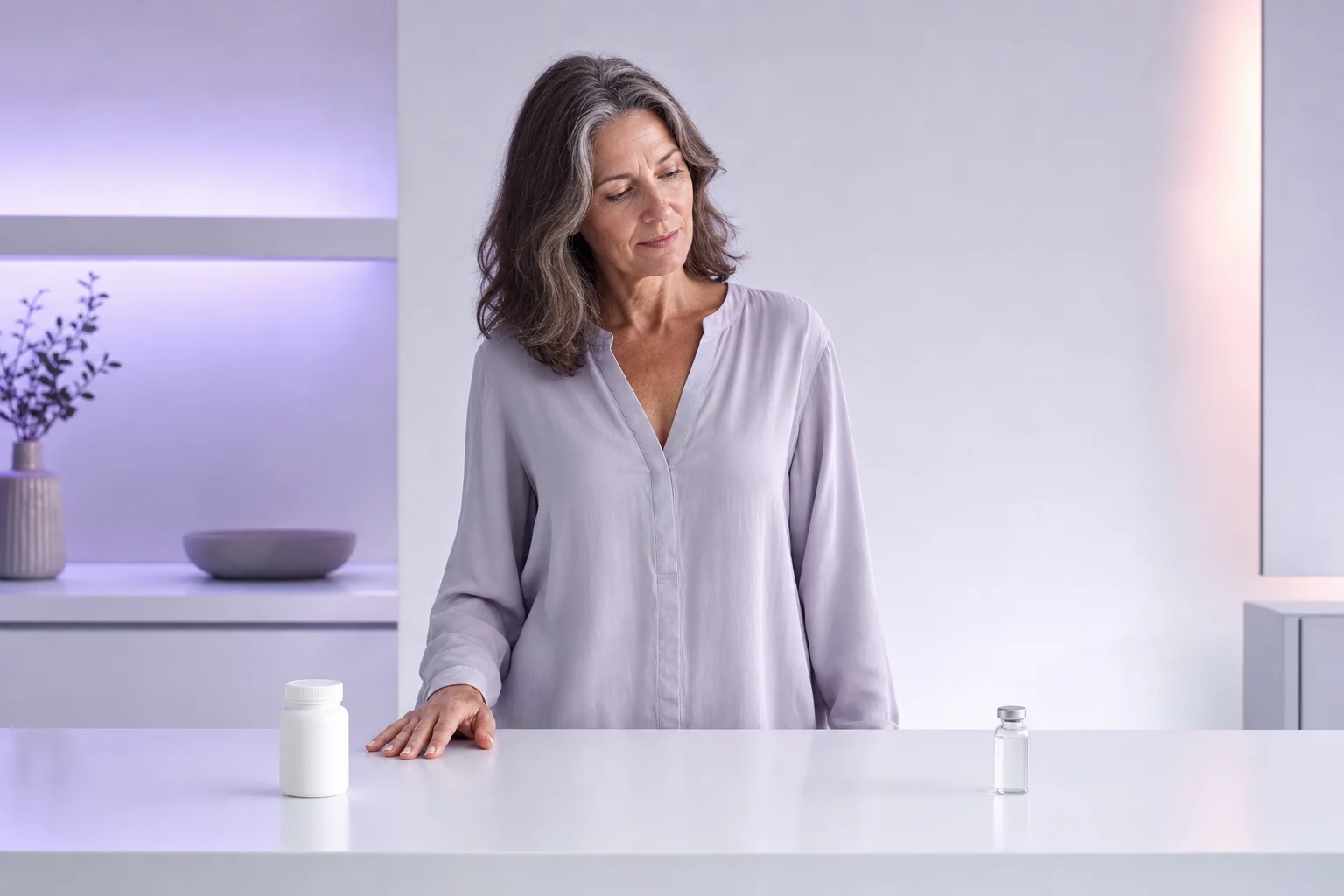
If you've been reading about NAD+ for longevity, you've run into NMN, and the two get presented as rivals. They aren't, quite. NAD+ is the molecule everyone cares about, and NMN is one of the ingredients your body uses to make more of it. So the question isn't which compound is better. It's whether you want the finished molecule directly, usually by injection or an IV drip, or a capsule your own cells assemble it from. That choice changes the evidence you can lean on, the effort involved, and what you pay.
What NAD+ and NMN have in common
Both exist to do the same job, which is to raise the amount of NAD+ (nicotinamide adenine dinucleotide) available inside your cells. NAD+ is a coenzyme found in every living cell, and it's required by two families of enzymes that longevity research cares about, the sirtuins (which regulate gene expression and DNA repair) and the PARPs (which respond to DNA damage). The reason anyone is interested at all traces back to a well-established observation, summarized in Verdin's 2015 review in Science, that NAD+ levels fall with age in tissues including liver, muscle, and brain. Everything downstream, injectable or oral, is an attempt to push that number back up.
How NAD+ works
Injectable NAD+ is the coenzyme itself, delivered straight into circulation by intravenous drip or subcutaneous injection. There's no conversion step, which is the whole point of taking it this way. Oral NAD+ is poorly absorbed intact, because the molecule is large and gets broken down before it reaches your cells, so the injectable and IV routes exist to skip that problem entirely and raise plasma levels quickly. What it buys you in directness, it gives back in practicality. It's sold as a research compound, typically in 500 mg lyophilized vials, it needs reconstituting, it's unstable in solution and generally used within a day or two of mixing, and IV sessions in a clinic setting are expensive. The controlled human trial evidence for injectable NAD+ specifically is also thinner than most people assume, and thinner than the evidence for the oral precursors.
How NMN works
NMN (nicotinamide mononucleotide) is one step upstream. You swallow it, it's absorbed, and your cells convert it into NAD+ through a single enzymatic step. That extra step is what makes it convenient, because a capsule needs no needles, no refrigeration after mixing, and no clinic appointment. It's also where the human data lives. Igarashi and colleagues ran a randomized, double-blind, placebo-controlled trial published in 2022, giving 250 mg of oral NMN daily for 12 weeks to healthy older men, and found whole-blood NAD+ rose significantly, with nominal improvements in gait speed and grip strength that the researchers themselves said needed larger studies to confirm. Katayoshi's 2023 randomized controlled trial looked at 12 weeks of NMN in healthy middle-aged participants and found serum NAD+ significantly elevated, with a trend toward reduced arterial stiffness that didn't reach statistical significance. Martens and colleagues found much the same tolerability and blood-level story in 2018 for nicotinamide riboside, NMN's close cousin.
Key differences
The first difference is where the good evidence sits, and it doesn't sit where the price does. The oral precursors are the better-studied side of this comparison in humans. Multiple controlled trials show that oral NMN raises blood NAD+ reliably and is well tolerated over 12 weeks. Injectable NAD+ produces faster and higher plasma elevation, which is not in dispute, but it has been examined far less rigorously in controlled human trials. If your standard is published human data, the capsule wins that particular argument, which surprises people who assume the harder-to-get form must be the better one.
The second difference is what any of it actually does for you. Both sides share the same limitation. The trials consistently show the biochemical change, meaning blood NAD+ goes up. What they haven't shown is a large, durable functional benefit in people. Effect sizes have been modest, and the claim that raising NAD+ slows human aging rests on preclinical work in model organisms and mechanistic reasoning about sirtuin biology, not on human outcomes. Anyone selling you certainty on this point is ahead of the research.
The third is the channel you buy through. Oral NMN and NR are sold openly as retail supplements, in capsules, priced by the bottle. Injectable NAD+ moves through research-compound vendors, priced by the vial, alongside peptides. That split governs how each one is framed and regulated, and it's worth knowing before you assume a price comparison across the two is apples to apples.
Which brings up cost, where the per-milligram habit earns its keep. Our own vendor tracking puts research-grade NAD+ at a median of about $0.29 per mg, ranging from $0.11 to $0.48 across six vendors, and a typical vial is 500 mg. Retail NMN is sold as a bottle of capsules at a fixed daily dose, and the sticker price hides the only number that matters, which is what a milligram costs you. We don't publish a per-mg median for NMN, so don't take one from us or from anyone quoting a round figure without showing the arithmetic. Run both through the price comparison tool instead. A clinic IV session is a third pricing model again, and it carries by far the biggest markup, because you're paying for the room and the nurse as much as the molecule.
Whichever side you land on, the buy-smart checks are the same. Compare real price per milligram rather than price per bottle or per vial. Ask for third-party purity and identity testing and actually read the certificate. And check the dose the trials used against the dose you're being sold, because 250 mg a day of NMN is what Igarashi's group studied, and a bottle priced for a much larger daily serving isn't automatically better value.
| NAD+ (injectable) | NMN (oral) | |
|---|---|---|
| What it is | The coenzyme itself | Precursor your body converts |
| Route | IV drip or subcutaneous injection | Capsule or powder, swallowed |
| Human trial evidence | Limited controlled data | Several randomized controlled trials |
| Speed of blood increase | Fast, no conversion step | Slower, one conversion step |
| Sold through | Research-compound vendors | Ordinary retail supplement channels |
| Handling | Reconstitute, refrigerate, use quickly | Shelf stable, sealed, room temperature |
| Cost signal | Median around $0.29/mg, 6 vendors | Priced per bottle, do the per-mg math |
| Best for | Wanting the molecule directly, accepting thin data | Wanting the studied route with the least friction |
Bottom line
For most women researching NAD+ for energy, cognition, or general longevity, oral NMN is the more sensible starting point, and that's a real recommendation rather than a hedge. It's the form with actual randomized controlled human trials behind it, it's sold openly so you can inspect what you're buying, it needs no needles or cold chain, and at a studied dose of around 250 mg a day the cost is knowable in advance. If the goal is to try raising your NAD+ and see whether you notice anything, this is the lower-friction, better-documented way to find out.
Injectable NAD+ makes more sense if you specifically want the coenzyme itself without a conversion step, if you've already tried an oral precursor and want to change the variable, or if you're working with a clinician who's using it in a monitored way. Go in knowing the trade. You're getting faster and higher blood levels with less published human evidence behind that specific route, more handling requirements, and a pricing structure where clinic delivery carries by far the biggest markup. If you go this way, buying by per-milligram price with third-party testing in hand is where the savings actually are.
Injectable NAD+ is sold as a research compound, and neither it nor NMN has the kind of large, long-term human trial data that would let anyone promise you an outcome. You already know that. You're an adult making an informed call about your own body, and that call is yours.
Where to go from here
The NAD+ research notes cover the sirtuin and PARP mechanisms in more detail, with the trial citations and the current per-mg range across vendors. If you're weighing NAD+ as part of a wider longevity protocol rather than on its own, the guide to peptide protocols for longevity and anti-aging covers what people commonly combine it with and how thin or solid the reasoning is for each. And when you're ready to price it properly, the comparison tool and the vendor directory are where the per-milligram math gets done for you.