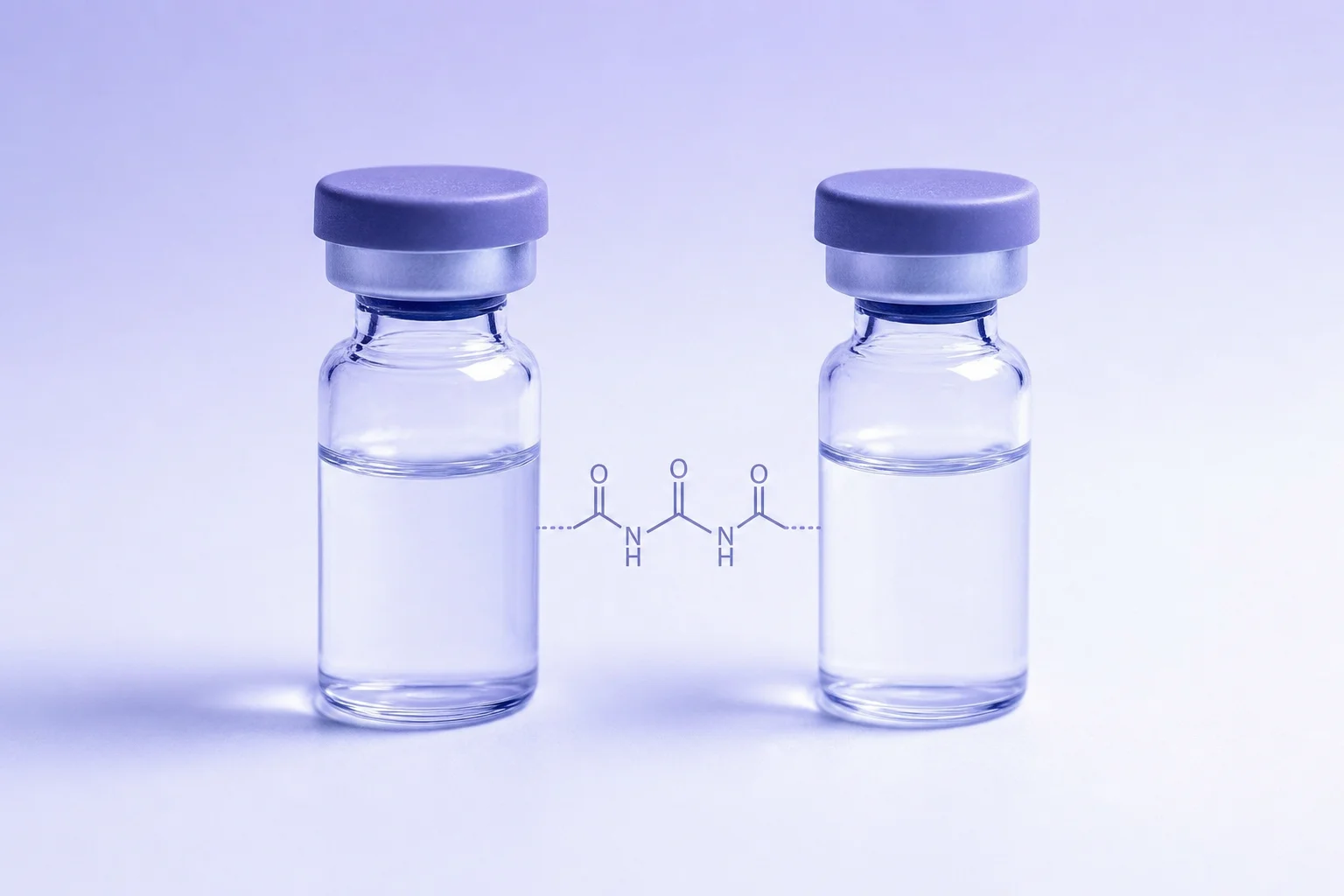
If you've shopped for CJC-1295, you've run into a fork in the road that almost nobody explains: one listing says "DAC" and another says "no DAC," they cost about the same, and the descriptions sound nearly identical. They aren't identical. That four-letter difference changes how long the compound stays active in your body from a few hours to roughly a week, and that's the whole story behind the two versions.
What CJC-1295 actually is
Your body has a built-in chain of command for growth hormone. Your hypothalamus releases a signal molecule called growth hormone-releasing hormone (GHRH), which travels a short distance to your pituitary and tells it to release growth hormone in natural pulses. CJC-1295 is a lab-made compound that mimics that signal. Instead of handing your body growth hormone directly, it taps your pituitary on the shoulder and asks it to make its own.
Here's the catch with the natural signal: your own GHRH lasts only a few minutes before an enzyme in your blood chops it up. So scientists who wanted a longer-lasting version had to solve a durability problem. That's where DAC comes in.
DAC is the part that makes it last
DAC stands for "drug affinity complex," which is a technical name for a simple idea. The researchers attached a small chemical handle to the peptide that lets it grab onto albumin, the most abundant protein floating around in your blood. Think of albumin as a slow-moving bus. On its own, the peptide gets cleared out in minutes. Clipped onto the albumin bus, it rides around for days, slowly releasing its signal the whole time. That single modification stretches the effective half-life out to roughly six to eight days in people.
So the two versions you see for sale are really two different tools:
| Version | What it is | How long it lasts |
|---|---|---|
| CJC-1295 with DAC | The peptide plus the albumin-grabbing handle | Roughly 6 to 8 days |
| CJC-1295 no DAC | Just the bare peptide, no handle (often labeled modified GRF 1-29) | A few hours at most |
This is the single most important thing to understand: when a listing says "no DAC," it usually isn't even the same molecule as "with DAC." The no-DAC product is almost always a closely related compound called modified GRF 1-29, which shares most of the same amino acid sequence but skips the albumin handle entirely. The names get used loosely and the two get mixed up constantly in non-scientific sources, so it's genuinely easy to buy the opposite of what you meant to.
Why women are paying attention
Growth hormone and a related molecule called IGF-1 both drift downward as we age, a slow decline that often shows up in midlife as flatter sleep, body composition that shifts even when nothing about your routine has, and skin that takes longer to bounce back. You'll hear about CJC-1295 mostly in the bodybuilding world, where it gets talked about for muscle. The research that's actually interesting for women in perimenopause and beyond is different: it's the question of whether gently nudging your own GH system, rather than flooding the body with outside growth hormone, is a more measured way to study age-related decline.
The DAC-versus-no-DAC choice matters here too. The longer-lasting DAC version produces a steady, elevated background level of growth hormone signaling. The shorter no-DAC version produces a quick spike that fades fast, which some researchers prefer precisely because it more closely imitates the body's natural rhythm. Neither has been studied specifically in menopausal women, so this is a difference in theory and in timing, not a settled answer about which is better for anyone.
What the research actually shows
The human evidence here's narrow but real, and almost all of it's about the DAC version. The landmark trial enrolled 65 healthy adults aged 21 to 61 and found that a single injection of CJC-1295 raised growth hormone levels for about six days and IGF-1 for nine to eleven days, with effects building up over repeated doses. A second human study answered an important worry: continuously stimulating the pituitary might flatten the natural pulses of GH that happen during deep sleep. It didn't. The pituitary kept its normal rhythm even while the overall level rose.
Beyond that, the picture thins out quickly. In mice bred to lack GHRH, once-daily CJC-1295 normalized their stunted growth, which tells us the mechanism works in a deficient system. But that's mice, in an extreme deficiency, not healthy or normally aging humans. There are no published trials looking at body composition over time, at bone density, at postmenopausal women, or at anything longer than a few weeks. The summary is that we have solid early evidence for one thing (it raises GH and IGF-1, and it lasts) and very little for everything people actually hope it does.
What's genuinely unknown
CJC-1295 isn't approved by the FDA for any use, and it's sold outside regulated pharmaceutical channels as a research compound. Long-term effects in healthy adults are genuinely unknown, and that matters more with the DAC version specifically: because it lingers for days, you can't simply stop and have it clear quickly if something feels off. Elevated growth hormone and IGF-1 aren't automatically harmless, and a steady multi-day elevation is a different exposure than a brief natural pulse.
There's also the mix-up risk itself. Because "DAC" and "no DAC" get swapped so casually by sellers, purity and accurate labeling are real concerns, and there's no standardized third-party testing requirement across vendors. If you're evaluating this compound, knowing exactly which of the two you're looking at is step one, and confirming a vendor actually tests what they sell is step two. Consult a healthcare provider who understands the endocrinology if you're considering it, not just someone repeating the marketing.