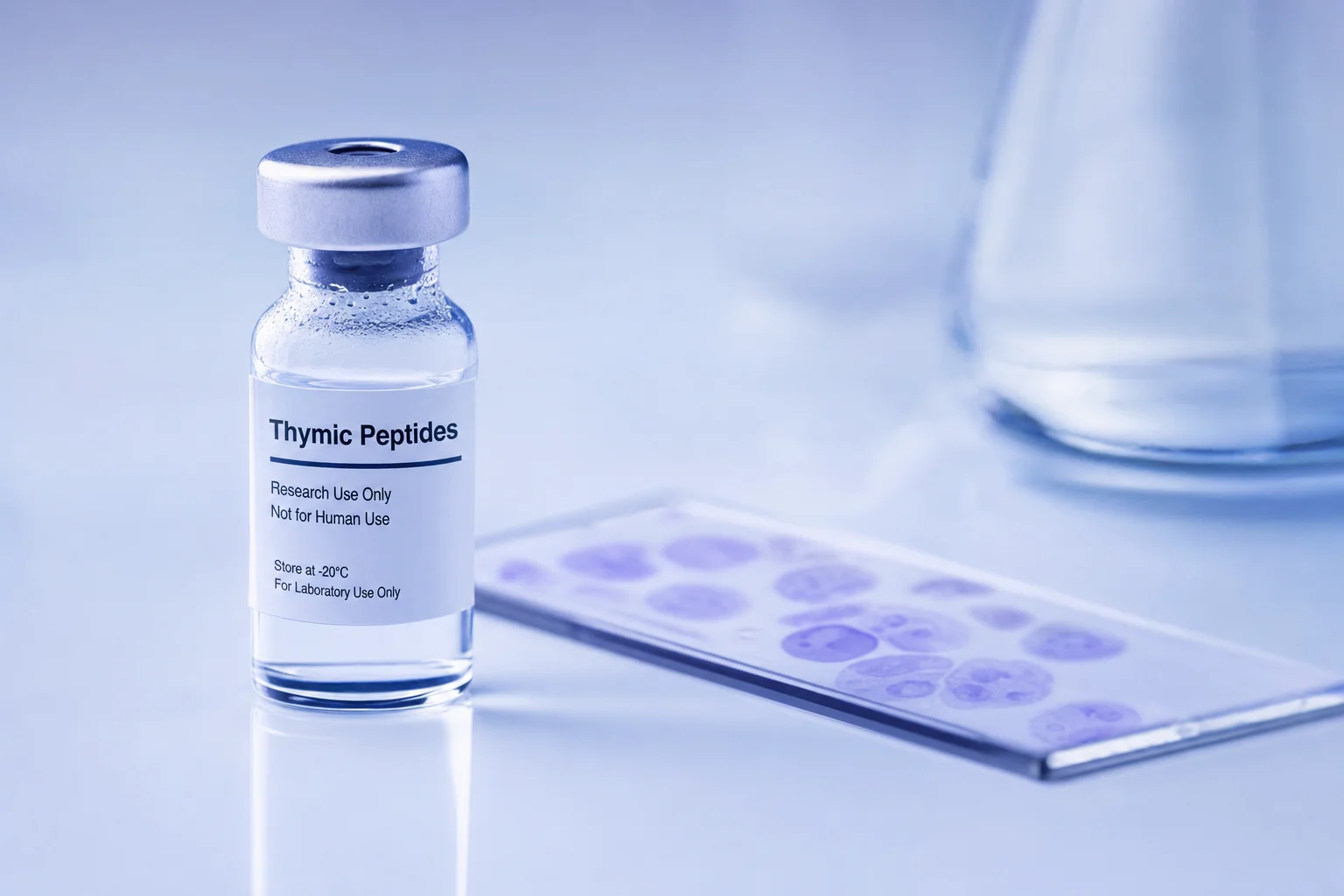
What it is
Thymosin Alpha-1 (Tα1) is a 28-amino-acid peptide originally isolated from thymic tissue and identified as the compound responsible for restoring immune function in thymectomized mice.[1] The thymus is a gland involved in T-cell development; Tα1 is one of several peptides it produces that influence immune cell maturation and activity. The synthetic form is chemically identical to the naturally occurring peptide and is manufactured as an acetate salt for research and clinical use.
Thymosin Alpha-1 is approved and commercially marketed in numerous countries under the brand name Zadaxin (SciClone Pharmaceuticals) for viral infections, immunodeficiency states, and as a vaccine adjuvant. It is not FDA-approved in the United States, where it remains under investigation and is used in research contexts.
What researchers study it for
- T-cell activation and immune system modulation Tα1 acts through Toll-like receptors on both myeloid and plasmacytoid dendritic cells, activating downstream signaling pathways and triggering cytokine production; this pleiotropic mechanism allows it to affect multiple immune cell subsets involved in both innate and adaptive immunity.[1]
- Chronic hepatitis B and C Ancell et al. reviewed clinical trial data in which Tα1 was studied for chronic viral hepatitis: in hepatitis B trials, HBV DNA clearance rates at six months ranged from 40–53% with Tα1 monotherapy compared with lower rates in untreated controls; combination regimens with interferon showed additional benefit in hepatitis C trials.[3]
- Cancer immunotherapy support Wei et al. reviewed Tα1's regulatory effects across immune cell types in tumor microenvironments, noting that combination of Tα1 with chemotherapy showed synergistic anti-tumor activity in preclinical models by enhancing immune cell recruitment and reducing tumor-mediated immunosuppression.[4]
- Immune recovery in SARS-CoV-2 and long COVID Minutolo et al. examined Tα1 in an ex vivo study of individuals with post-acute sequelae of SARS-CoV-2 infection (PASC), finding that Tα1 treatment improved the restoration of depleted naive B and T cell subpopulations, with effects most evident in individuals who had experienced more severe acute illness.[5]
- Age-related immune decline (immunosenescence) Simonova et al. reviewed evidence that age-related thymic involution reduces T-cell output and promotes chronic inflammation; preclinical and clinical studies showed Tα1 can stimulate T-cell differentiation, enhance thymic output, and improve vaccine responses in older individuals.[6]
- Vaccine response enhancement Dominari et al. reviewed a body of literature in which Tα1 was studied as a vaccine adjuvant, with evidence suggesting it amplifies humoral and cellular immune responses when co-administered with standard vaccines, including in immunocompromised populations.[2]
Research context
Thymosin Alpha-1 has one of the more substantial human evidence bases among research peptides, largely because it has been under active clinical investigation since the 1980s and is approved for clinical use in more than 35 countries. The evidence in chronic hepatitis B is the most established: multiple randomized trials have examined viral clearance outcomes, and several systematic reviews have been published.[3] Results have been mixed but generally favorable compared with untreated controls, and combination regimens with interferon have shown stronger effects than monotherapy in hepatitis C. These remain among the best-characterized clinical outcomes for any immunomodulatory peptide.
Interest in Tα1 expanded substantially during and after the COVID-19 pandemic. Clinical observations from China documented decreased hospitalization rates and reduced mortality in severe COVID-19 patients receiving Tα1, and subsequent laboratory work identified plausible mechanisms involving T-cell restoration and reduction of hyperactivated immune responses.[5] The aging research angle is more recent; the connection between thymic involution, declining Tα1 levels, and immunosenescence provides a theoretical basis for its use in longevity contexts, though this application is supported more by preclinical evidence and mechanistic reasoning than by controlled aging trials.[6]
Typical research parameters
| Parameter | Detail |
|---|---|
| Common vial sizes | 1.6 mg (clinical-standard vial), 5 mg (research vials) |
| Supplied as | Lyophilized powder (acetate salt); reconstituted with bacteriostatic water or sterile water |
| Storage | Refrigerate; lyophilized powder stable at room temperature short-term; protect from light |
| Stability | Lyophilized: 24+ months refrigerated; reconstituted: use within 24–48 hours or per manufacturer guidance |
| Administration studied | Subcutaneous injection (all major clinical trials); the 1.6 mg twice-weekly subcutaneous protocol is the most referenced schedule in hepatitis and infection research |
References
- [1] King R, Tuthill C. Immune Modulation with Thymosin Alpha 1 Treatment. Vitam Horm. 2016;102:151-78. PubMed ↗
- [2] Dominari A, Hathaway D III, et al. Thymosin alpha 1: A comprehensive review of the literature. World J Virol. 2020;9(5):67-78. PubMed ↗
- [3] Ancell CD, Phipps J, Young L. Thymosin alpha-1. Am J Health Syst Pharm. 2001;58(10):879-85. PubMed ↗
- [4] Wei Y, Zhang Y, et al. Thymosin α-1 in cancer therapy: Immunoregulation and potential applications. Int Immunopharmacol. 2023;117:109744. PubMed ↗
- [5] Minutolo A, Petrone V, et al. Thymosin alpha 1 restores the immune homeostasis in lymphocytes during Post-Acute sequelae of SARS-CoV-2 infection. Int Immunopharmacol. 2023;118:110055. PubMed ↗
- [6] Simonova MA, Ivanov I, et al. Aging and Thymosin Alpha-1. Int J Mol Sci. 2025;26(23):11470. PubMed ↗