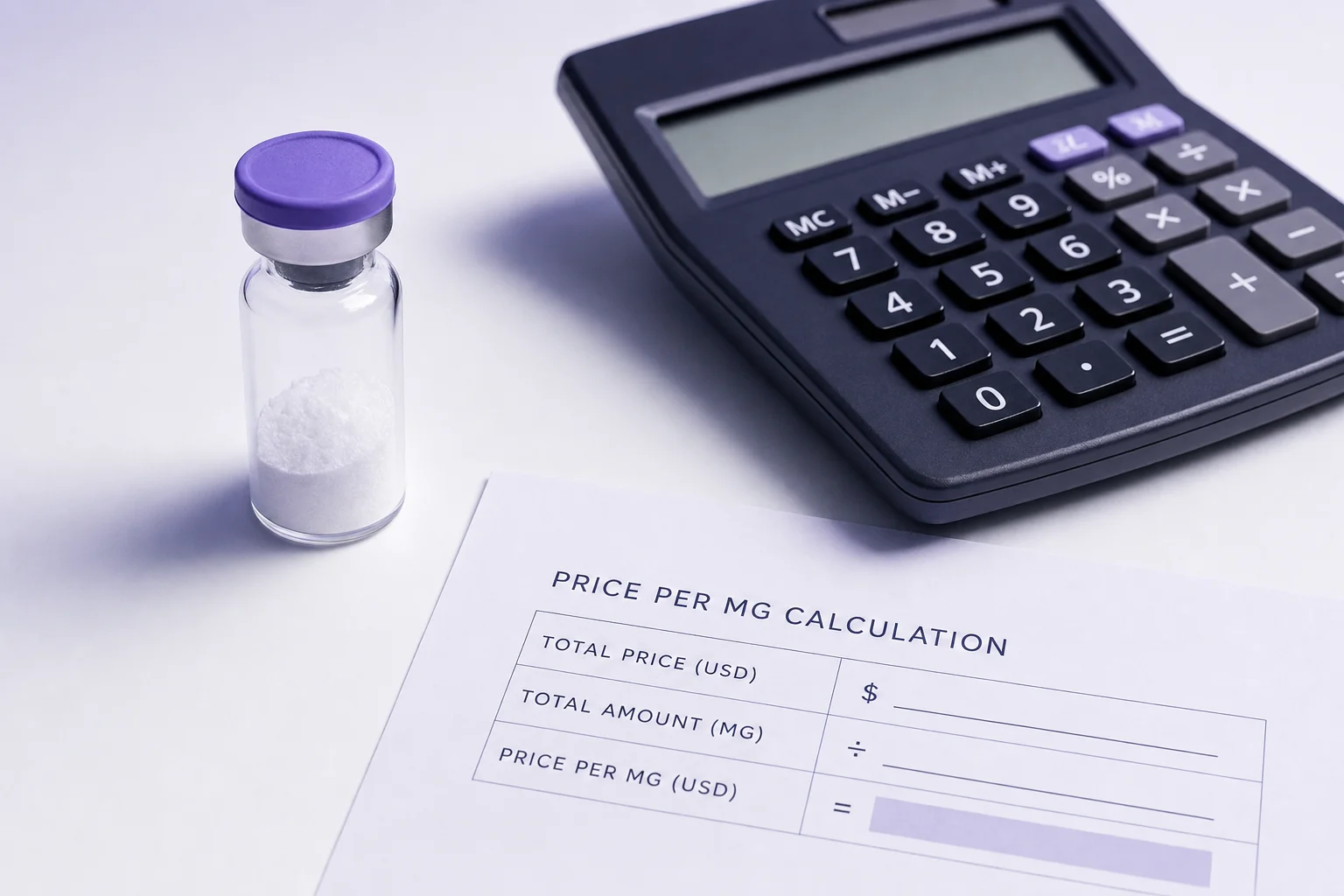
Good morning. We have owed you this since the first issue, and twice since. Today we pay the debt. It is the single most useful piece of arithmetic in this whole market, and almost nobody runs it before they buy.
The label lies a little
A vendor lists a 5mg vial and a 10mg vial of the same peptide. The 10mg almost never costs twice the 5mg. We see the larger vial land somewhere between 1.3 and 1.6 times the smaller one, again and again, across compounds and across vendors.
The reason is structural. A vial has fixed costs that do not scale with what is inside it: the glass, the stopper, the filling run, the quality testing, the box, the shipping. Double the peptide and those costs barely move. So the per-mg price falls as the vial grows. The label shows you the per-vial number because that is the number that looks small. The per-mg number is the one that tells the truth.
Run an illustration. A 5mg vial at $40 is $8 per mg. The 10mg of the same peptide at $60 looks more expensive on the shelf, but it is $6 per mg. That is a 25% discount hiding behind a bigger sticker price. The numbers vary by vendor; the direction does not.
The per-vial price is what you pay. The per-mg price is what you actually buy. Compare the wrong one and you will overpay on the cheaper-looking vial almost every time.
When bigger stops winning
Larger is not free of tradeoffs, and the plain version of this issue has to say so. Once a peptide is reconstituted, its stable window is finite. Buying more mg than a project will use before that window closes does not save money. It wastes peptide that the per-mg math told you was a bargain. The per-mg discount is real only up to the point where you can actually use what you bought. Past that line, the cheapest vial is the one sitting unopened in the freezer.
This is exactly what our app is built to surface: it ranks by per-mg, not per-vial, so the structural discount shows up where you can see it.
Worth your weekend
A 2025 review in the growth hormone secretagogue literature pulled together the small human trials on this class and was refreshingly plain about their limits: short durations, modest sample sizes, populations that skew young and male. It is a good weekend read precisely because it does not oversell. A careful summary of thin evidence is more useful than a confident summary of none.
Next week: the certificate of analysis that looks perfect and proves almost nothing. The second half of reading a COA.