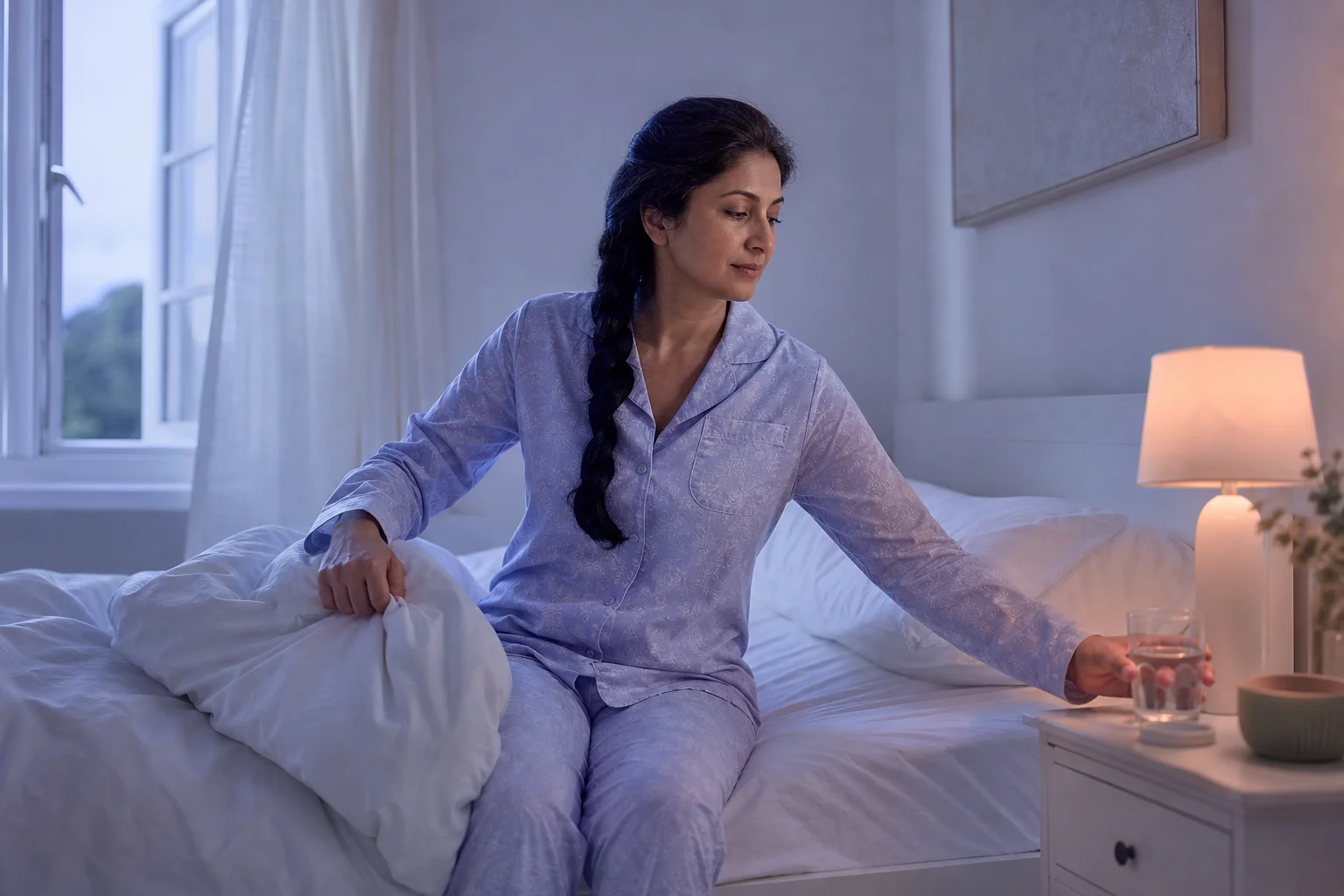
What changes in your sleep after 40
Deep sleep, the stage that leaves you feeling restored, shrinks steadily with age, according to a pooled analysis of sleep studies across the lifespan, so sleep gets lighter and easier to break, and the body clock tends to drift earlier. Perimenopause then adds its own layer, which our perimenopause guide covers more broadly. Night sweats wake you up, and falling progesterone, a hormone with a mildly calming effect, takes away some of the help you used to get falling and staying asleep.
Sleep apnea, where breathing stops and starts through the night, becomes more common after menopause, as a long-running study that followed women through the change found, and in women it often shows up as insomnia, morning headaches or tiredness after a full night rather than the loud snoring people expect. Thyroid changes, low iron, a bladder that wakes you, an evening glass of wine and plain stress all join in. So the 3am wake-up usually has a cause, and often more than one.
How to tell which one is yours
| What you notice | Likely cause | What helps first |
|---|---|---|
| Waking hot or damp | Night sweats from perimenopause | Hormone therapy, a cooler room |
| Awake at 3am, mind racing | Insomnia, stress | A structured insomnia program |
| Snoring, gasping, tired anyway | Possible sleep apnea | A sleep study |
| Up to pee more than once | Bladder changes, evening fluids | Raising it with your clinician |
| Waking a few hours after a drink | Alcohol wearing off | An earlier or skipped drink |
| Wide awake at 5, sleepy by 9 | An earlier body clock | Evening light, a steady wake time |
The structured insomnia program is cognitive behavioral therapy for insomnia, a short course of sleep-retraining that the American College of Physicians recommends as the first treatment for chronic insomnia, ahead of sleeping pills. It's available through clinicians, apps and telehealth. When night sweats are the cause, treating the sweats is how you treat the sleep they break, and the Menopause Society's 2022 hormone therapy position statement calls hormone therapy the most effective treatment for them, which our answer on whether peptides can replace HRT explains.
Where peptides come in
Two kinds of peptide come up for sleep. DSIP (delta sleep-inducing peptide) is named for deep sleep, and the growth hormone peptides, ipamorelin and CJC-1295, are discussed because growth hormone and deep sleep fall together with age. The human research on both is small, and none of it was done in women whose sleep changed in midlife. Our guide to peptides for sleep covers the growth hormone route, and the sleep and stress combinations covers DSIP and the rest.
A peptide on top of untreated apnea or night sweats is an expensive way to keep the cause hidden. Check the table first, then read about the compounds, or browse everything we have on sleep and stress.
When to see a clinician about it
Snoring with gasping, or real daytime sleepiness after what should have been enough sleep, is worth a sleep study, because apnea is common, treatable and easy to miss in women. Trouble sleeping three or more nights a week for three months is chronic insomnia by the usual definition, and it has a treatment that works.
DSIP and the growth hormone peptides are sold for research, and the big human trials haven't been run yet. You knew that, it's why you're reading this and not the label.
Questions people ask
Does perimenopause cause insomnia?
It can. Night sweats wake you, and the hormone swings themselves are linked to lighter, more broken sleep, so trouble sleeping is one of the most common perimenopause complaints.
Why do I wake up at 3am every night?
Common reasons after 40 are night sweats, a drink in the evening wearing off, a full bladder, stress and an earlier body clock. If it happens three or more nights a week for three months, that meets the usual definition of chronic insomnia and is worth raising with a clinician.
Why is my sleep worse on HRT?
Some women sleep worse in the first weeks of hormone replacement therapy (HRT) or after a dose change, and the type and timing of the progesterone part of HRT can matter, since oral progesterone taken at night makes many people drowsy. It's a question for your prescriber rather than a reason to stop on your own.
Can peptides help with sleep?
DSIP and the growth hormone peptides are the ones discussed for sleep, and the human evidence for both is small. They make the most sense once the common causes have been checked.
Do you need less sleep as you get older?
Not really. The American Academy of Sleep Medicine advises seven or more hours for adults of every age, and what changes after 40 is how deep and unbroken that sleep is.