SLU-PP-332 dosage for capsules and vials
Vendor pages give 250 to 500 mcg of SLU-PP-332 a day in capsules. No human study sets a dose, and the mouse studies used injected amounts on a very different scale. Here's what each figure is and where it comes from.
How much SLU-PP-332 do people take?
Amount
250–500 mcga day, vendor pagesTiming
Once a dayvendor pagesCourse
Not setno source gives oneRoute
Capsuleby mouthAmount, timing and route are the convention on vendor capsule pages. No study or label sets a human amount, a schedule or a course length. The only published doses are from mouse studies, shown in the chart.
SLU-PP-332 dosage chart
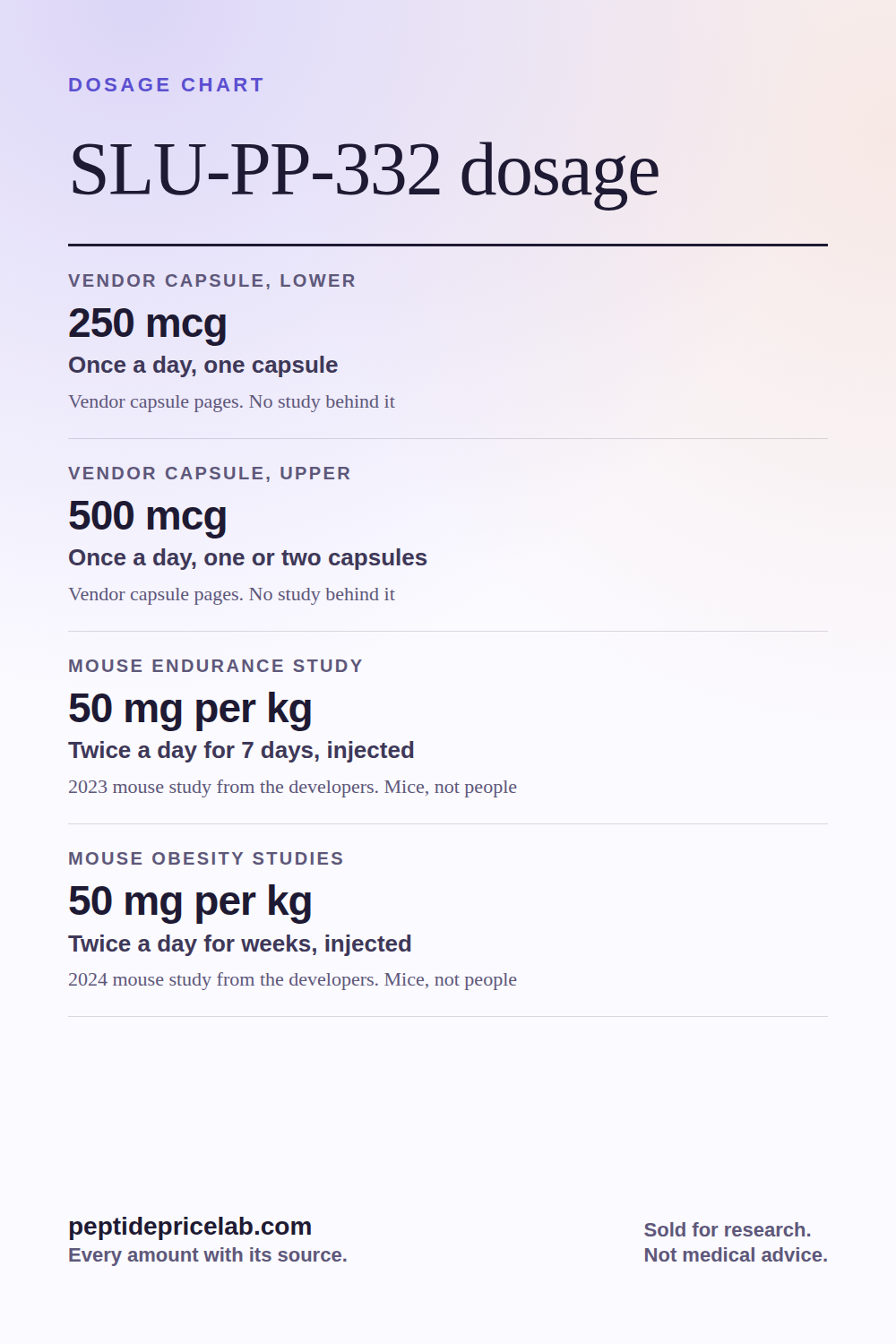
How to read the SLU-PP-332 chart
The chart has two kinds of rows, and they aren't the same kind of number. The capsule rows are what vendors print on the bottle page, and the mouse rows are what the published research used. Neither is a human dose from a study, because no human study exists. Background on what SLU-PP-332 is and what the mouse work found is on the SLU-PP-332 page.
SLU-PP-332 is a small lab-made molecule, not a peptide, which is why it comes in capsules at all. Most peptides would be broken down in the gut, and this one isn't a peptide to begin with.
Every published result comes from mice injected into the abdomen at 50 mg per kg of body weight, twice a day. Per kg means the amount scales with body weight. In the endurance study the mice were treated for 7 days before their treadmill test, and in the obesity studies for several weeks. Those amounts and schedules come from the developers' 2023 and 2024 mouse papers.
Mouse doses don't translate to people pound for pound, because small animals burn through drugs faster. The FDA's standard conversion from mouse to human divides the mouse dose by about 12. That conversion isn't a dose and nobody suggests using it. It's here to show the scale: the capsule amount of 250 to 500 mcg sits more than a thousand times below what the mice got, given by a route the mice never used.
That gap doesn't mean the capsule amount does nothing or that a higher amount would be better. It means the vendor figure and the research figure aren't describing the same thing, and anyone comparing them should know that.
SLU-PP-332 dosage per day, oral capsules
Capsules are the form most vendors sell. They come at 250 mcg or 500 mcg each, in bottles of 30, 60 or 100. Vendor capsule pages give 250 to 500 mcg a day, taken once a day, and some vendor pages suggest starting with a single capsule. That's the whole of the human-facing guidance, and none of it traces back to a study.
| Capsule | 250 mcg a day | 500 mcg a day | Source |
|---|---|---|---|
| 250 mcg | 1 capsule | 2 capsules | Vendor capsule pages |
| 500 mcg | Can't split evenly | 1 capsule | Vendor capsule pages |
Capsule counts are simple division of the vendor amount by the capsule strength. A capsule holds powder, so it can't be split accurately.
The open question with capsules is absorption. The researchers who made SLU-PP-332 describe it as lacking oral bioavailability, meaning little of it reaches the blood when swallowed, and they built a newer compound, SLU-PP-915, partly to fix that. No one has published how much of a 250 or 500 mcg capsule gets into a person. So the capsule amount isn't just untested, it's untested on a route the developers themselves flagged.
SLU-PP-332 injection dosage and vials
Some vendors sell SLU-PP-332 as a powder in 5 mg and 10 mg vials. With a peptide you'd mix the powder with bacteriostatic water, sterile water with a preservative so one vial can be drawn from more than once, and the math would give units on the syringe. SLU-PP-332 doesn't work that way. Chemical suppliers list it as insoluble in water and soluble in DMSO, a lab solvent, and the mouse studies dissolved it in a solvent mix before injecting.
That's why there's no units table on this page. A powder that won't dissolve in bacteriostatic water can't be measured out by the units on a U-100 syringe, and no source we trust gives either a mixing method or an injected amount for people. Some vendor pages describe mixing it with bacteriostatic water anyway, and that runs against the supplier data. If you're comparing vials, the reconstitution calculator handles the math for anything that does dissolve.
If a vial is mixed, it goes on the same 28-day clock in the fridge as any other mixed vial, starting the day liquid goes in.
When and how often
Once a day on vendor pages. The capsule pages describe one daily amount, with no time of day attached.
Twice a day in the mice. The research schedule was two injections a day, which reflects how quickly mice clear the compound rather than anything about people.
No course length or break. No source sets how many weeks to take it or when to stop. The mouse studies ran from one week to a few months, and those were study lengths, not courses.
Time of day. No study or label sets one, and vendor pages don't name one either.
How long a bottle lasts
With capsules the math is just the count divided by how many you take a day. A 30-count bottle of 250 mcg capsules lasts 30 days at 250 mcg a day and 15 days at 500 mcg. A 60-count bottle of the same capsules lasts 60 days or 30 days. A 100-count bottle of 500 mcg capsules lasts 100 days at 500 mcg a day.
Because capsule strength and count vary so much, the price of a bottle tells you little. Compare on price per milligram: a 30-count bottle of 250 mcg capsules holds 7.5 mg in all, a 60-count holds 15 mg, and a 100-count of 500 mcg capsules holds 50 mg. A 5 mg vial holds 5 mg and a 10 mg vial holds 10 mg, so on paper one 10 mg vial carries as much as 40 of the smaller capsules.
Small amounts make testing matter more. A 250 mcg capsule is a quarter of a milligram of powder, usually mixed with filler, so you can't judge it by eye or by weight in your hand. Before buying, look for a vendor that posts a third-party test for that batch showing the compound's identity, meaning the powder really is SLU-PP-332, and its purity. A test on the raw powder is good, and a test on the finished capsules is better, since it also shows each capsule holds what the label says.
Price per milligram also makes the capsule-versus-vial question easier to see. A vial packs far more milligrams into one container, but it comes with the mixing problem above, while capsules come ready to take. Neither form has been tested in people, so the comparison is about what you're buying, not about which one works better.
For storage, chemical suppliers keep the dry powder in the freezer at about -4°F (-20°C), where they list it as stable for years. Vendor capsule pages vary, so follow the label on the bottle you buy.
SLU-PP-332 vs SLU-PP-915, and taking it with other compounds
SLU-PP-915 is a different molecule from the same lab, made to work when swallowed. In a 2026 mouse study it matched SLU-PP-332's endurance effect given by mouth. Amounts don't carry over between the two, and neither has a human dose behind it.
People who take SLU-PP-332 often look at MOTS-c for similar reasons, and its amounts are on the MOTS-c dosage page. No source sets a combined schedule for the two.
Signs the amount or timing is off
There aren't enough consistent reports yet to describe a pattern. Forum posts are scattered and mostly say people noticed little either way, which fits a compound the developers say absorbs poorly by mouth. These are the things people say they watch for.
A racing heart or feeling overheated. In the developers' mouse studies it raised whole-body energy use, working through receptors that are busiest in heart and muscle. Some people report stopping when it happens, which is reported use rather than studied.
Stomach upset after a capsule. Some people report taking it with food when this happens. It's reported, not studied.
Redness, a lump or pain where you injected, for anyone using a vial. With a powder that doesn't dissolve in water, people who get a lump that lingers stop and get it looked at.
No human safety data exists for SLU-PP-332, and the open questions are set out on the SLU-PP-332 page. If you're comparing it with another compound bought for metabolism, the 5-Amino-1MQ dosage page covers the one people most often weigh it against.
It's sold for research, and the big human trials haven't been run yet. You knew that, it's why you're reading this and not the label.
Questions people ask about SLU-PP-332 dosage
How much SLU-PP-332 per day?
Vendor capsule pages give 250 to 500 mcg a day. No human study or label sets an amount, so that range is a sales convention rather than a tested dose.
Is SLU-PP-332 better oral or injected?
Its developers describe it as lacking oral bioavailability, and every mouse study injected it. No one has published how much of a capsule reaches the blood in people, so there's no tested answer for either route.
How much bacteriostatic water for a 10 mg vial of SLU-PP-332?
There's no good answer, because chemical suppliers list SLU-PP-332 as insoluble in water. The research dissolved it in a lab solvent, and no source we trust gives a mixing method or an injected amount for people.
How long should you take SLU-PP-332?
No study or label sets a course length or a break. The mouse studies ran from one week to a few months, and that says nothing about how long a person should take it.
Can you take SLU-PP-332 every day?
Vendor pages describe a daily capsule, and no study has tested daily use in people. The mice were treated every day for the length of each study.
Can you take SLU-PP-332 with MOTS-c?
No study or label sets a combined schedule. People describe taking the two for similar reasons, and that's reported use rather than tested use.
Where to buy SLU-PP-332
The five lowest per-mg prices in this morning's check, one listing per vendor.
- Alpha Labs 100 mg · $111.99 $1.12/mg
- Profound Aminos 50 mg · $65.00 $1.30/mg
- Next Gen Peptides 100 mg · $150.00 $1.50/mg
- Verified Peptides 30 mg · $124.99 $4.17/mg
- SP Bio Labs 15 mg · $63.00 $4.20/mg
Tell me when SLU-PP-332 gets cheaper
Free. We'll email you when the lowest price we track drops 10% below today's, with the vendor and the link.
One click to confirm. Your alert lives in a free account under this email, so you can change or stop it in the app. We'll also send a few short emails on buying smart, and you can unsubscribe from those anytime without losing your alert.
More on SLU-PP-332
Your next step
Also on Android