Cardiogen dosage for a 20 mg vial
Cardiogen amounts in circulation run from 200 mcg to 1 mg a day for a 10 to 20 day course. Here's where each comes from, and the math for a 20 mg vial.
How much Cardiogen do people take?
Amount
200 mcg–1 mgonce a dayTiming
Once a dayevery day of the courseCourse
10–20 days2–3 courses a yearRoute
Under the skininjectionThe 200 mcg amount, the 10-day course and 2 to 3 courses a year are from peptide protocol pages. The 1 mg amount and the 10 to 20 day course are the community-reported figures on peptide reference sites. No approved label or dose-finding study sets any of them.
Cardiogen dosage chart
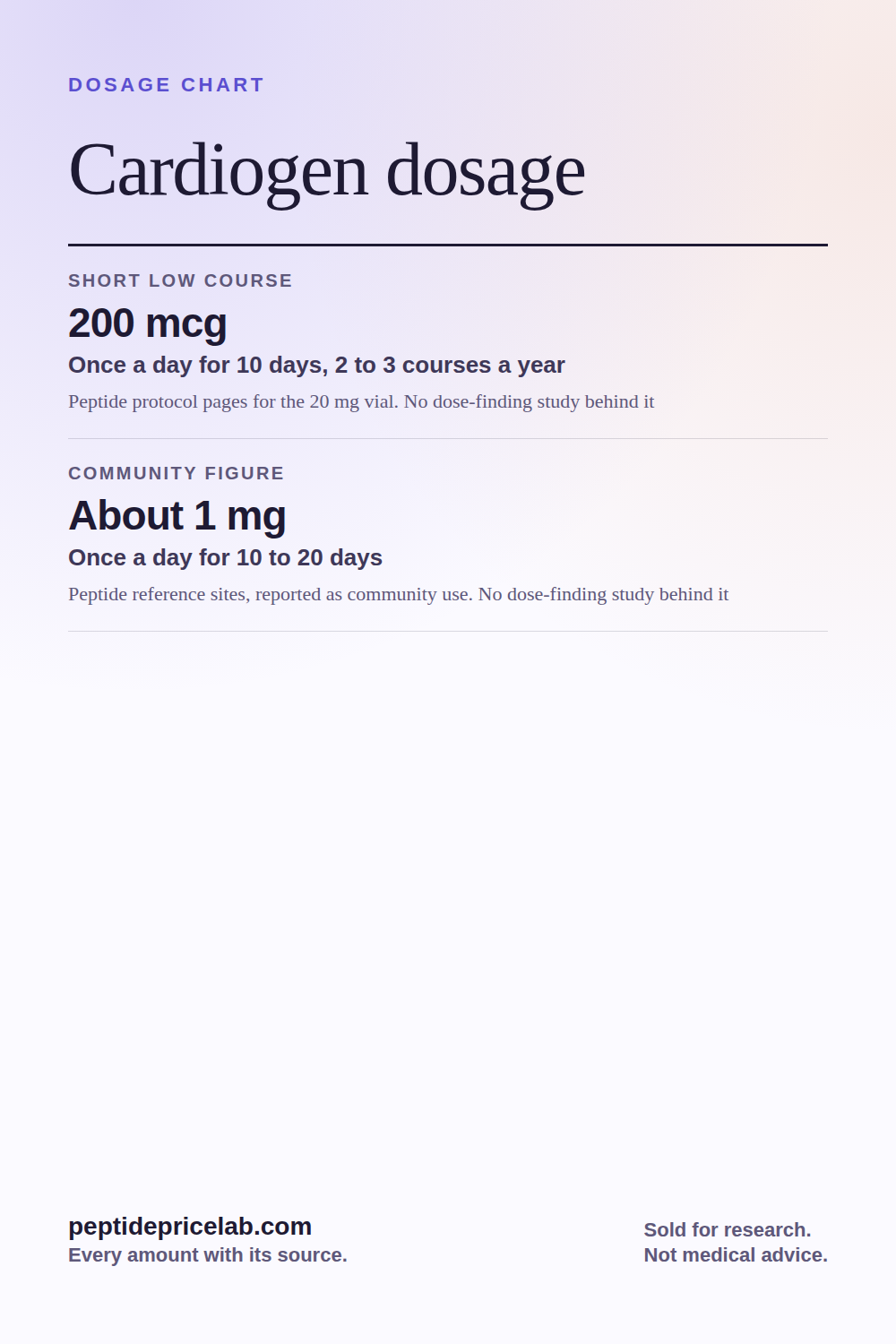
Where each amount comes from
Two patterns are in circulation, and the daily amounts in them differ fivefold, 200 mcg at the low end and about 1 mg at the high end. They share the same shape, a short daily course followed by months off. Read the source column with each row, because none of these figures comes from a trial in people. Background on what Cardiogen is and what the research covers is on the Cardiogen page.
The spread is wide because each source is borrowing from somewhere different. The 200 mcg figure is the low amount protocol sites use across the injectable Khavinson peptides. The 1 mg figure is what reference sites report people taking from the 20 mg vial, by analogy with older bioregulators rather than from any Cardiogen study. Nobody has compared these amounts against each other, so there's no "right" row, only rows with their sources. Starting at the low end and staying within one row for a whole course is what most people describe. If you take heart medication, the amount matters less than the fact that nobody has tested Cardiogen alongside it, which is covered on the hub page.
Cardiogen 20 mg vial dosage and mixing
Cardiogen is usually sold as a 20 mg vial of freeze-dried powder. You mix it with bacteriostatic water, which is sterile water with a preservative so the vial can be drawn from more than once, and inject it under the skin. That's the route the protocol and reference pages describe. Oral capsules sold as a "heart bioregulator" are a different product with their own amounts, so nothing below applies to them.
The table shows the units to draw on a U-100 syringe, which holds 100 units in 1 mL, for 1, 2 and 3 mL of water. The amounts are the ones in the chart.
| Water | Strength | 200 mcg | 1 mg |
|---|---|---|---|
| 1 mL | 20 mg per mL | 1 unit, hard to measure | 5 units |
| 2 mL | 10 mg per mL | 2 units | 10 units |
| 3 mL | 6.7 mg per mL | 3 units | 15 units |
Units are math from the chart amounts, with the strength rounded to one decimal.
The low amount is the awkward one. At 200 mcg, 1 to 3 mL of water leaves a draw of 1 to 3 units, which is hard to measure on a syringe. A standard vial only holds a few mL, so more water isn't the fix. A 0.3 mL (30 unit) syringe, whose tick marks are easier to read at that size, is what helps. At 1 mg, 2 mL of water gives a round number, 10 units. For any other vial, water or amount, the reconstitution calculator does the same math.
Mixing itself is simple. Let the vial come to room temperature, wipe the rubber top with an alcohol swab, and run the water slowly down the inside of the glass rather than straight onto the powder. Then swirl gently, the way you'd swirl a glass of wine, until it's clear, and don't shake it. Each dose is drawn with a fresh syringe, so one vial and a 10-day course means one vial and ten syringes.
Storage comes from the reference and protocol pages. Before mixing, vendors list the powder for the fridge or freezer, away from light. After mixing, the vial goes in the fridge at 36 to 46°F (2 to 8°C), away from light, and it's used within 28 days.
When and how often
Once a day. Every pattern in the chart uses one injection a day for the length of the course, as described on the protocol and reference pages.
Ten to twenty days per course. The protocol pages give 10 days at 200 mcg. The reference sites give 10 to 20 days at about 1 mg, which they describe as the Russian bioregulator convention.
Months off between courses. The protocol pages describe 2 to 3 courses a year, with 4 to 6 months between them. None of it comes from a study that compared schedules.
Time of day. The 200 mcg protocol pages say evening, and the reference sites say morning. No study or label sets a time, so most people pick one they can repeat every day of the course.
For planning, a 10-day course at 200 mcg a day is 2 mg in all, a 10-day course at 1 mg a day is 10 mg, and a 20-day course at 1 mg a day is 20 mg. That's why a single 20 mg vial is the size most vendors sell. Compare vendors on price per milligram against your course total, not on the price of one vial.
Say you plan the community figure of 1 mg a day for 20 days, twice a year. Each course is 20 mg, one vial, mixed with 2 mL of water and drawn at 10 units a day. Two courses a year is two vials, bought close to when each course starts, so neither one sits in the fridge after mixing for longer than the 28 days it keeps.
How long a vial lasts
A mixed vial goes on a 28-day clock in the fridge the day water goes in, however much of it gets used. Here's how a 20 mg vial plays out at each amount in the chart.
At 1 mg a day, one vial is one 20-day course with nothing left over, or a 10-day course with half the vial unused when the clock runs out. At 200 mcg a day, the vial holds 100 doses, but a 10-day course uses 2 mg of it, and the rest won't keep until the next course months away. Some people mix only part of the powder at a time, and the reconstitution calculator handles that math.
Taking Cardiogen with other bioregulators
Cardiogen is often bought with other Khavinson peptides, and no source sets a combined schedule. People describe running each one as its own short course, often in the same few weeks, with its own vial and its own syringe so the amounts never get mixed in one draw. That keeps the math for each vial simple, and it means one fridge clock per vial rather than one blended product to track. The epithalon dosage page covers the best-studied member of the family, and the pinealon page covers the brain-focused one.
Signs the amount or timing is off
These are reported experiences from people who've run Cardiogen, not findings from a study.
Redness or itching where you injected. It's the most common report, usually mild and brief. People move to a fresh spot each day.
A racing or skipping heartbeat, chest discomfort or unusual breathlessness. These aren't side effects to wait out. People who notice this stop the course and get checked the same day.
A headache. It's reported less often. People usually stop the course if it carries on past a day or two.
Nothing noticeable at all. It's a common report, and it isn't a reason to raise the amount past the chart. People who want to know whether anything changed track the numbers their doctor already watches, like blood pressure and cholesterol, before and after a course rather than going by feel.
No human safety study exists for Cardiogen, and the open questions, including heart medications and pregnancy, are on the Cardiogen page.
What to check before you buy Cardiogen
Cardiogen is a small, specialty listing, usually carried by vendors that stock the whole Khavinson range. Look for a recent third-party certificate of analysis for the batch you're buying, and compare the price per milligram rather than per vial.
Check three things on the listing before you buy. The vial size should say 20 mg, because a 10 mg listing at a lower sticker price can cost more per milligram. The certificate of analysis should name the same batch as the vial, and it should come from an independent lab rather than the vendor itself. And the sequence should read alanine, glutamic acid, aspartic acid, arginine, sometimes written AEDR or Ala-Glu-Asp-Arg, since several Khavinson peptides have similar names and short, similar sequences.
It's sold for research, and the big human trials haven't been run yet. You knew that, it's why you're reading this and not the label.
Questions people ask about Cardiogen dosage
How much Cardiogen should I take per day?
The amounts in circulation are 200 mcg or about 1 mg once a day, injected under the skin. Protocol pages give 200 mcg, and reference sites give 1 mg as the community-reported figure. No label or dose-finding study sets either one.
How much bacteriostatic water for a 20 mg vial of Cardiogen?
It depends on your amount. With 2 mL, the vial is 10 mg per mL, so 1 mg is 10 units on a U-100 syringe. At 200 mcg a day, that same mix puts the dose at 2 units, which is hard to read on a syringe, so the low amount is the one to measure most carefully.
Can you take Cardiogen every day without a break?
No study or label sets daily use with no stop date. Both patterns people describe are short courses of 10 to 20 days followed by months off.
What time of day should you take Cardiogen?
No study or label sets a time. Protocol pages say evening and reference sites say morning, so most people pick one they can repeat every day of the course.
Can Cardiogen be taken with other bioregulators?
No study or label sets a combined schedule. People describe running Khavinson peptides like epithalon or pinealon as separate courses in the same part of the year, and that's reported use rather than tested use.
Where to buy Cardiogen
The five lowest per-mg prices in this morning's check, one listing per vendor.
- Flawless Compounds 20 mg · $32.45 $1.62/mg
- Glow Aminos 20 mg · $32.45 $1.62/mg
- Mile High Compounds 25 mg · $44.99 $1.80/mg
- Peptide Crafters 25 mg · $49.50 $1.98/mg
- Evolve BioPep 20 mg · $39.99 $2.00/mg
Tell me when Cardiogen gets cheaper
Free. We'll email you when the lowest price we track drops 10% below today's, with the vendor and the link.
One click to confirm. Your alert lives in a free account under this email, so you can change or stop it in the app. We'll also send a few short emails on buying smart, and you can unsubscribe from those anytime without losing your alert.
More on Cardiogen
Your next step
Also on Android